Plomin Robert
MRC Social, Genetic and Developmental Psychiatry Centre, Institute of Psychiatry, King's College London, PO80, De Crespigny Park, London, SE5 8AF, UK,
Behav Genet. 2014 Nov;44(6):629-38. doi: 10.1007/s10519-014-9673-7. Epub 2014 Sep 7.
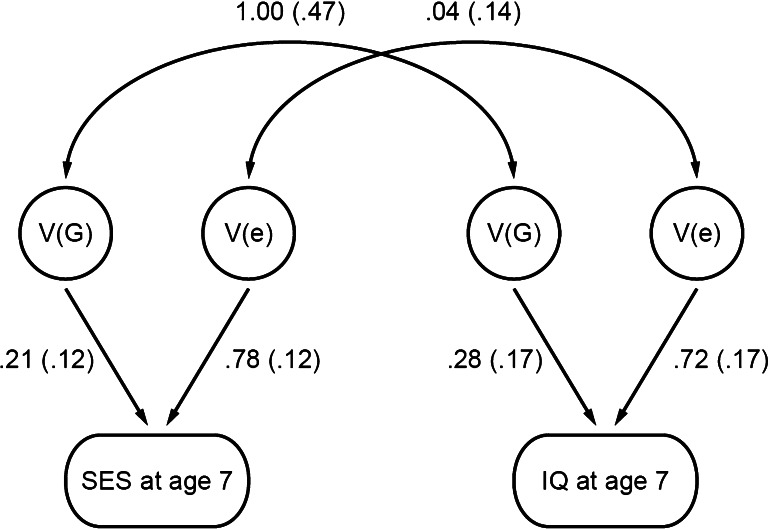
One of John Loehlin's many contributions to the field of behavioral genetics involves gene-environment (GE) correlation. The empirical base for GE correlation was research showing that environmental measures are nearly as heritable as behavioral measures and that genetic factors mediate correlations between environment and behavior. Attempts to identify genes responsible for these phenomena will come up against the 'missing heritability' problem that plagues DNA research on complex traits throughout the life sciences. However, DNA can also be used for quantitative genetic analyses of unrelated individuals (Genome-wide Complex Trait Analysis, GCTA) to investigate genetic influence on environmental measures and their behavioral correlates. A novel feature of GCTA is that it enables genetic analysis of family-level environments (e.g., parental socioeconomic status) and school-level environments (e.g., teaching quality) that cannot be investigated using within-family designs such as the twin method. An important implication of GE correlation is its shift from a passive model of the environment imposed on individuals to an active model in which individuals actively create their own experiences in part on the basis of their genetic propensities.
约翰·洛林对行为遗传学领域的诸多贡献之一涉及基因-环境(GE)相关性。GE相关性的实证基础是研究表明环境测量指标的遗传度与行为测量指标几乎相同,并且遗传因素介导了环境与行为之间的相关性。试图识别导致这些现象的基因将会遇到“缺失遗传度”问题,这一问题困扰着整个生命科学领域对复杂性状的DNA研究。然而,DNA也可用于对无亲属关系个体的数量遗传学分析(全基因组复杂性状分析,GCTA),以研究遗传因素对环境测量指标及其行为相关性的影响。GCTA的一个新颖之处在于,它能够对家庭层面的环境(例如父母的社会经济地位)和学校层面的环境(例如教学质量)进行遗传分析,而这些环境无法使用诸如双胞胎法等家庭内部设计进行研究。GE相关性的一个重要意义在于,它从一种强加于个体的被动环境模型转变为一种主动模型,即个体部分地基于自身的遗传倾向积极创造自己的经历。