Zaph C, Cooper P J, Harris N L
The Biomedical Research Centre, University of British Columbia, Vancouver, BC, Canada; Department of Pathology and Laboratory Medicine, University of British Columbia, Vancouver, BC, Canada.
Parasite Immunol. 2014 Sep;36(9):439-52. doi: 10.1111/pim.12090.
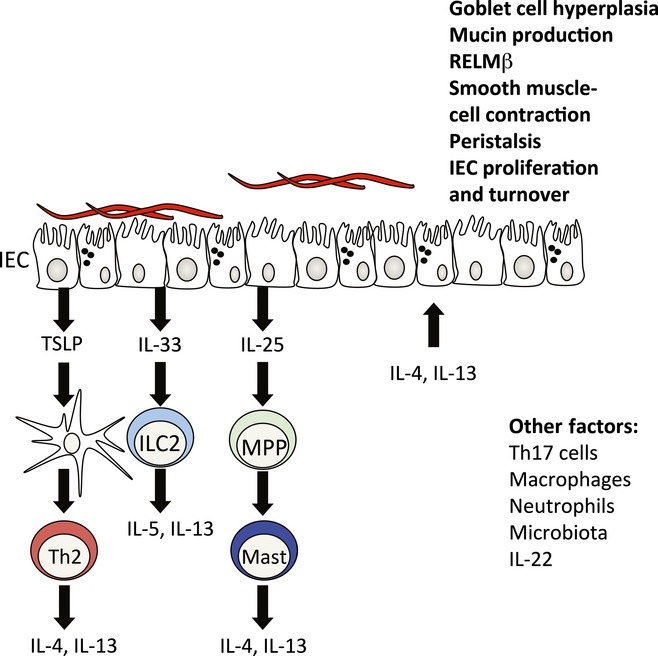
In most natural environments, the large majority of mammals harbour parasitic helminths that often live as adults within the intestine for prolonged periods (1-2 years). Although these organisms have been eradicated to a large extent within westernized human populations, those living within rural areas of developing countries continue to suffer from high infection rates. Indeed, recent estimates indicate that approximately 2.5 billion people worldwide, mainly children, currently suffer from infection with intestinal helminths (also known as geohelminths and soil-transmitted helminths) . Paradoxically, the eradication of helminths is thought to contribute to the increased incidence of autoimmune diseases and allergy observed in developed countries. In this review, we will summarize our current understanding of host-helminth interactions at the mucosal surface that result in parasite expulsion or permit the establishment of chronic infections with luminal dwelling adult worms. We will also provide insight into the adaptive immune mechanisms that provide immune protection against re-infection with helminth larvae, a process that is likely to be key to the future development of successful vaccination strategies. Lastly, the contribution of helminths to immune modulation and particularly to the treatment of allergy and inflammatory bowel disease will be discussed.
在大多数自然环境中,绝大多数哺乳动物体内都寄生着蠕虫,这些蠕虫通常会在肠道内以成虫的形式长期存活(1至2年)。尽管在西方化的人群中,这些寄生虫已在很大程度上被根除,但生活在发展中国家农村地区的人们仍遭受着高感染率的困扰。事实上,最近的估计表明,目前全球约有25亿人,主要是儿童,感染了肠道蠕虫(也称为土源性蠕虫和土壤传播的蠕虫)。矛盾的是,蠕虫的根除被认为是导致发达国家自身免疫性疾病和过敏发病率上升的原因之一。在这篇综述中,我们将总结目前对黏膜表面宿主与蠕虫相互作用的理解,这种相互作用会导致寄生虫被排出,或者使管腔内成年蠕虫建立慢性感染。我们还将深入探讨适应性免疫机制,该机制可提供针对蠕虫幼虫再次感染的免疫保护,这一过程可能是未来成功制定疫苗接种策略的关键。最后,我们将讨论蠕虫对免疫调节的作用,特别是对过敏和炎症性肠病治疗的作用。