Harrison Lee, Wilson Sue, Munafò Marcus R
Pain Res Manag. 2014 Sep-Oct;19(5):e139-45. doi: 10.1155/2014/615203.
The prevalence of musculoskeletal chronic pain in adolescents is estimated to be approximately 4% to 40%. The development of musculoskeletal pain during teenage years could have a marked impact on physical, psychological and social well-being.
To examine whether sleep problems during adolescence are associated with musculoskeletal pain, particularly chronic regional pain and chronic widespread pain.
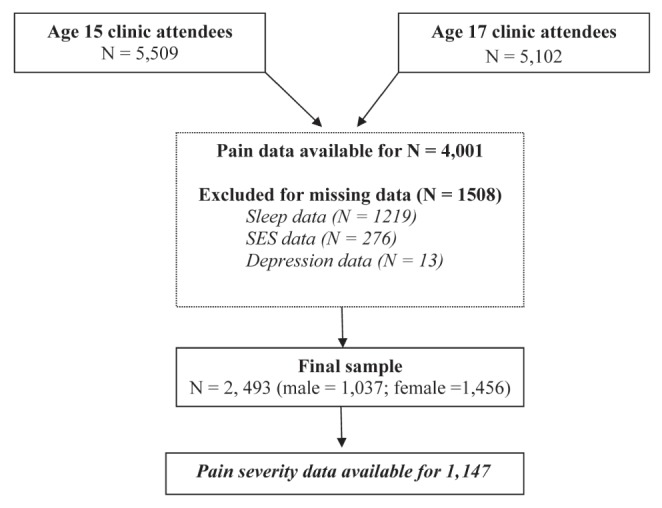
Using data from the Avon Longitudinal Study of Children, the relationship between sleep problems at 15 years of age and the presence of chronic regional and widespread pain at 17 years of age was explored. Pain data were not available at 15 years of age. A total of 2493 participants with complete data were identified. Relationships among sleep problems and musculoskeletal pain were examined using logistic regression. ORs were calculated after adjusting for sex, ethnicity, socioeconomic position and depression (15 years of age).
Sleep disturbance (usually wakes up more than two or three times), difficulties with hypersomnolence and poor subjective sleep perception were associated with the presence of both musculoskeletal regional and widespread pain. Finally, using ordered logistic regression, poor subjective sleep perception was also found to be associated with greater pain severity in participants with chronic musculoskeletal regional and widespread pain.
The results of the present study suggest an association between sleep problems during adolescence and the presence of musculoskeletal pain at a later stage. These findings are consistent with adult literature suggesting a link between sleep problems and musculoskeletal pain. Given these associations, sleep problems in adolescence may be an important risk factor for musculoskeletal pain.
据估计,青少年肌肉骨骼慢性疼痛的患病率约为4%至40%。青少年时期肌肉骨骼疼痛的发展可能对身体、心理和社会幸福感产生显著影响。
研究青少年时期的睡眠问题是否与肌肉骨骼疼痛相关,尤其是慢性局部疼痛和慢性广泛性疼痛。
利用雅芳儿童纵向研究的数据,探讨15岁时的睡眠问题与17岁时慢性局部和广泛性疼痛的存在之间的关系。15岁时没有疼痛数据。共确定了2493名有完整数据的参与者。使用逻辑回归分析睡眠问题与肌肉骨骼疼痛之间的关系。在校正性别、种族、社会经济地位和抑郁(15岁时)后计算比值比(OR)。
睡眠障碍(通常醒来超过两三次)、嗜睡困难和主观睡眠感知差与肌肉骨骼局部和广泛性疼痛的存在均相关。最后,使用有序逻辑回归分析,还发现主观睡眠感知差与慢性肌肉骨骼局部和广泛性疼痛参与者的疼痛严重程度更高相关。
本研究结果表明青少年时期的睡眠问题与后期肌肉骨骼疼痛的存在之间存在关联。这些发现与成人文献中表明睡眠问题与肌肉骨骼疼痛之间存在联系的观点一致。鉴于这些关联,青少年时期的睡眠问题可能是肌肉骨骼疼痛的一个重要危险因素。