El Lithy Ahmed, Abdella Rana M, El-Faissal Yahia M, Sayed Ahmed M, Samie Rasha M Abdel
Obstetrics and Gynecology Department, Cairo University, Cairo, Egypt.
BMC Pregnancy Childbirth. 2014 Oct 13;14:362. doi: 10.1186/1471-2393-14-362.
A great association between vitamin D deficiency and type 2 diabetes mellitus has been suggested in literature. During pregnancy, this deficiency is even more critical. It appears that vitamin D insufficiency during pregnancy may be associated with maternal hazards. The aim of this study was to assess the relation between the levels of 25-hydroxy-cholecalciferol (vitamin D), and the glycemic control in pregnant women.
An observational cross-section study including 160 pregnant women between 20-40 years in age, in their third trimester, divided into two equal groups. First group consisted of 80 women with established diagnosis of gestational diabetes and the second group with proved normal blood glucose levels. We assessed vitamin D in serum, fasting blood glucose, serum insulin and glycosylated hemoglobin (HbA1c) levels and we depicted the insulin sensitivity using the Quantitative insulin sensitivity check index (Quicki). The results were collected and statistically correlated.
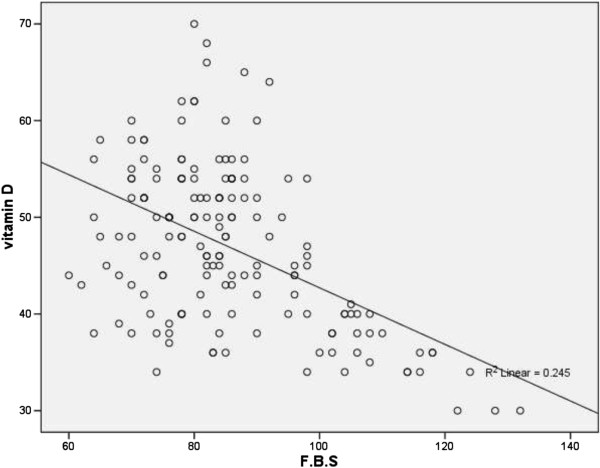
The mean vitamin D levels were 46.61 ± 6.087 and 47.25 ± 10.181in controls and women with gestational diabetes mellitus (GDM) respectively. The fasting insulin levels were significantly higher in the group with GDM with a mean of 18.51 ± 6.44 compared to 8.95 ± 2.52 in the control group.The correlation coefficient (r) between HbA1c levels and Vitamin D level was -0.492 with a P value <0.05. Similar associations were also found with the fasting blood sugar levels (r = -0.386) and with Quicki values (r = -0.250). Vitamin D levels correlated significantly with the fasting blood glucose, the fasting serum insulin and the HbA1c levels, the P value in all these correlations were <0.05. The P value with Quicki results was 0.064.
There is a statistically significant negative correlation between the glycemic control and vitamin D levels in serum in the whole study population. The effect of adequate vitamin D replacement on glycemic control was not studied in our work correlation. We suggest larger scale studies addressing this issue.
文献表明维生素D缺乏与2型糖尿病之间存在密切关联。在孕期,这种缺乏更为关键。孕期维生素D不足似乎与母体风险有关。本研究旨在评估25-羟胆钙化醇(维生素D)水平与孕妇血糖控制之间的关系。
一项观察性横断面研究,纳入160名年龄在20至40岁之间、处于孕晚期的孕妇,分为两组,每组80人。第一组由80名已确诊为妊娠期糖尿病的女性组成,第二组血糖水平经证实正常。我们评估了血清中的维生素D、空腹血糖、血清胰岛素和糖化血红蛋白(HbA1c)水平,并使用定量胰岛素敏感性检查指数(Quicki)描述胰岛素敏感性。收集结果并进行统计学关联分析。
对照组和妊娠期糖尿病(GDM)女性的平均维生素D水平分别为46.61±6.087和47.25±10.181。GDM组的空腹胰岛素水平显著更高,平均值为18.51±6.44,而对照组为8.95±2.52。HbA1c水平与维生素D水平之间的相关系数(r)为-0.492,P值<0.05。空腹血糖水平(r = -0.386)和Quicki值(r = -0.250)也发现了类似的关联。维生素D水平与空腹血糖、空腹血清胰岛素和HbA1c水平显著相关,所有这些相关性的P值均<0.05。Quicki结果的P值为0.064。
在整个研究人群中,血糖控制与血清维生素D水平之间存在统计学上显著的负相关。本研究未探讨充足补充维生素D对血糖控制的影响。我们建议开展更大规模的研究来解决这个问题。