Branquinho Raquel, Sousa Clara, Lopes João, Pintado Manuela E, Peixe Luísa V, Osório Hugo
REQUIMTE, Laboratório de Microbiologia, Departamento de Ciências Biológicas, Faculdade de Farmácia, Universidade do Porto, Porto, Portugal.
REQUIMTE, Laboratório de Microbiologia, Departamento de Ciências Biológicas, Faculdade de Farmácia, Universidade do Porto, Porto, Portugal; CEB, Centro de Engenharia Biológica, Universidade do Minho, Braga, Portugal.
PLoS One. 2014 Oct 14;9(10):e110127. doi: 10.1371/journal.pone.0110127. eCollection 2014.
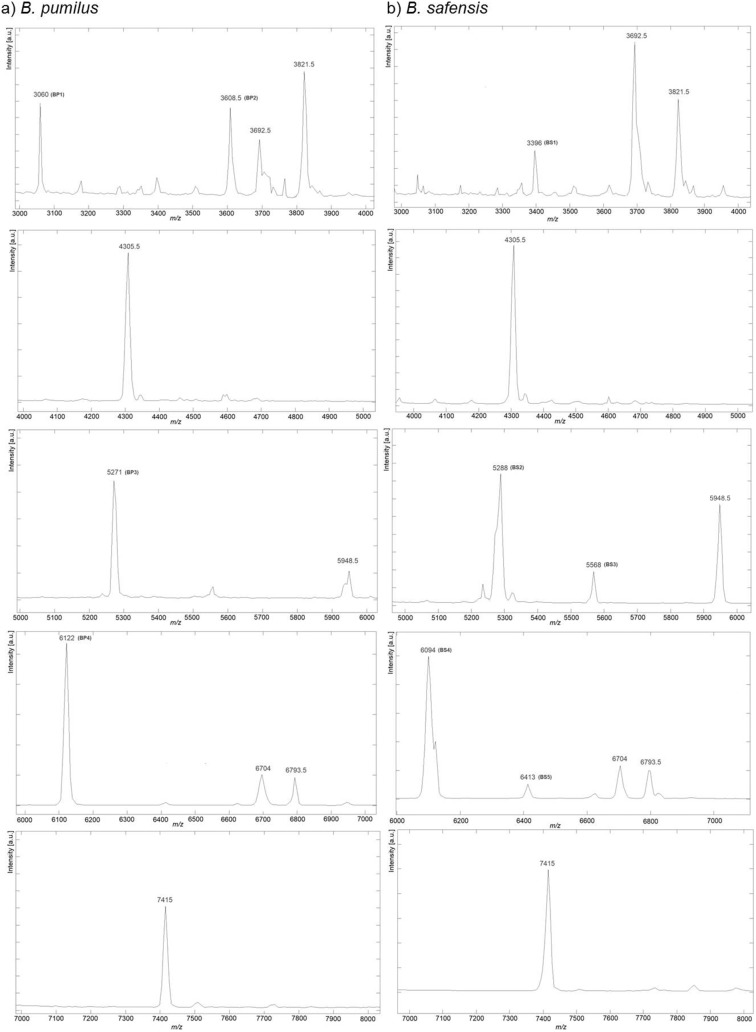
Matrix-assisted laser desorption/ionization time-of-flight mass spectrometry (MALDI-TOF-MS) despite being increasingly used as a method for microbial identification, still present limitations in which concerns the differentiation of closely related species. Bacillus pumillus and Bacillus safensis, are species of biotechnological and pharmaceutical significance, difficult to differentiate by conventional methodologies. In this study, using a well-characterized collection of B. pumillus and B. safensis isolates, we demonstrated the suitability of MALDI-TOF-MS combined with chemometrics to accurately and rapidly identify them. Moreover, characteristic species-specific ion masses were tentatively assigned, using UniProtKB/Swiss-Prot and UniProtKB/TrEMBL databases and primary literature. Delineation of B. pumilus (ions at m/z 5271 and 6122) and B. safensis (ions at m/z 5288, 5568 and 6413) species were supported by a congruent characteristic protein pattern. Moreover, using a chemometric approach, the score plot created by partial least square discriminant analysis (PLSDA) of mass spectra demonstrated the presence of two individualized clusters, each one enclosing isolates belonging to a species-specific spectral group. The generated pool of species-specific proteins comprised mostly ribosomal and SASPs proteins. Therefore, in B. pumilus the specific ion at m/z 5271 was associated with a small acid-soluble spore protein (SASP O) or with 50S protein L35, whereas in B. safensis specific ions at m/z 5288 and 5568 were associated with SASP J and P, respectively, and an ion at m/z 6413 with 50S protein L32. Thus, the resulting unique protein profile combined with chemometric analysis, proved to be valuable tools for B. pumilus and B. safensis discrimination, allowing their reliable, reproducible and rapid identification.
基质辅助激光解吸/电离飞行时间质谱(MALDI-TOF-MS)尽管越来越多地被用作微生物鉴定方法,但在区分密切相关物种方面仍存在局限性。短小芽孢杆菌和沙福芽孢杆菌是具有生物技术和药学意义的物种,难以通过传统方法进行区分。在本研究中,我们使用了一组特征明确的短小芽孢杆菌和沙福芽孢杆菌分离株,证明了MALDI-TOF-MS结合化学计量学能够准确、快速地鉴定它们。此外,利用UniProtKB/Swiss-Prot和UniProtKB/TrEMBL数据库以及原始文献,初步确定了特征性的物种特异性离子质量。短小芽孢杆菌(m/z 5271和6122处的离子)和沙福芽孢杆菌(m/z 5288、5568和6413处的离子)物种的划分得到了一致的特征蛋白图谱的支持。此外,使用化学计量学方法,通过质谱的偏最小二乘判别分析(PLSDA)创建的得分图显示存在两个独立的聚类,每个聚类包含属于特定物种光谱组的分离株。生成 的物种特异性蛋白质库主要由核糖体蛋白和小酸溶性芽孢蛋白(SASP)组成。因此,在短小芽孢杆菌中,m/z 5271处的特定离子与一种小酸溶性芽孢蛋白(SASP O)或50S蛋白L35相关,而在沙福芽孢杆菌中,m/z 5288和5568处的特定离子分别与SASP J和P相关,m/z 6413处的离子与50S蛋白L32相关。因此,由此产生的独特蛋白质谱与化学计量学分析相结合,被证明是区分短小芽孢杆菌和沙福芽孢杆菌的有价值工具,能够对它们进行可靠、可重复和快速的鉴定。