Seol Kyeong In, Song Seung Ha, Kim Ka Lim, Oh Seung Taek, Kim Young Tae, Im Woo Young, Song Dong Ho, Cheon Keun-Ah
Division of Child and Adolescent Psychiatry, Department of Psychiatry and Institute of Behavioral Science in Medicine, Yonsei University College of Medicine, Seoul, Korea.
Department of Communication Disorder, Ewha Woman's University, Seoul, Korea.
Yonsei Med J. 2014 Nov;55(6):1721-8. doi: 10.3349/ymj.2014.55.6.1721.
It is well known that expressive language impairment is commonly less severe than receptive language impairment in children with autism spectrum disorder (ASD). However, this result is based on experiments in Western countries with Western language scales. This study tries to find whether the result above is applicable for toddlers in a non-Western country; more specifically, in Korea with non-Western language scales.
The participants were 166 toddlers aged between 20 months and 50 months who visited the clinic from December 2010 to January 2013. The number of toddlers diagnosed as ASD and developmental language delay (DLD) was 103 and 63, respectively. Language development level was assessed using Sequenced Language Scale for Infants (SELSI), a Korean language scale. Using SELSI, each group was divided into 3 sub-groups. Moreover, the group difference by age was observed by dividing them into three age groups. Chi-square test and linear-by-linear association was used for analysis.
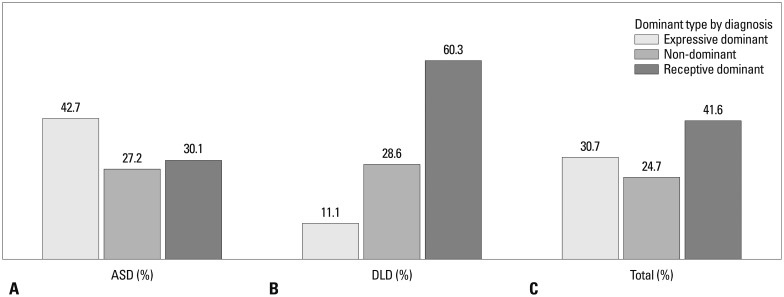
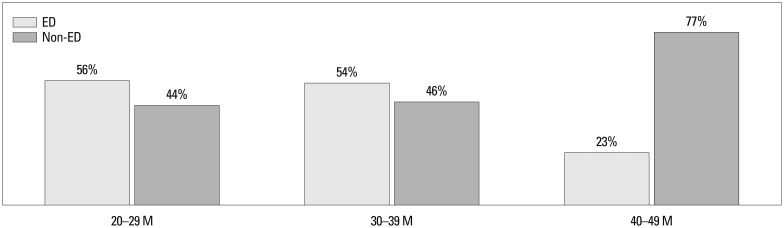
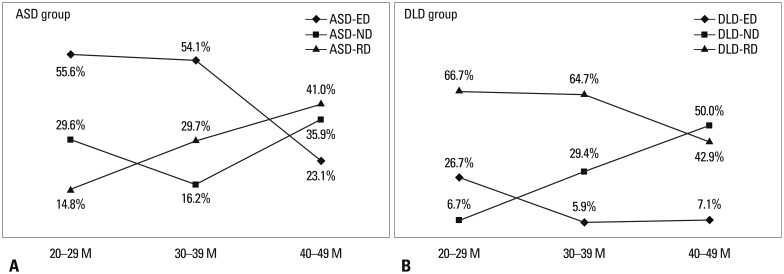
Receptive language ability of the DLD group was superior to that of the ASD group in all age groups. However, expressive language ability in both groups showed no difference in all age groups. A greater proportion of expressive dominant type was found in ASD. The 20-29 months group in ASD showed the largest proportion of expressive language dominant type in the three age groups, suggesting that the younger the ASD toddler is, the more severe the receptive language impairment is.
These findings suggest that receptive-expressive language characteristics in ASD at earlier age could be useful in the early detection of ASD.
众所周知,在自闭症谱系障碍(ASD)儿童中,表达性语言障碍通常不如接受性语言障碍严重。然而,这一结果是基于西方国家使用西方语言量表进行的实验得出的。本研究试图探究上述结果是否适用于非西方国家的幼儿;更具体地说,适用于使用非西方语言量表的韩国幼儿。
研究对象为2010年12月至2013年1月期间到诊所就诊的166名年龄在20个月至50个月之间的幼儿。被诊断为ASD和发育性语言迟缓(DLD)的幼儿数量分别为103名和63名。使用韩国语言量表《婴儿语言发展顺序量表》(SELSI)评估语言发展水平。根据SELSI,将每组分为3个亚组。此外,通过将他们分为三个年龄组来观察年龄组间的差异。采用卡方检验和线性 - 线性关联分析。
在所有年龄组中,DLD组的接受性语言能力均优于ASD组。然而,两组的表达性语言能力在所有年龄组中均无差异。在ASD组中发现表达主导型的比例更高。ASD组中20 - 29个月龄组在三个年龄组中表达性语言主导型的比例最大,这表明ASD幼儿年龄越小,接受性语言障碍越严重。
这些发现表明,ASD早期的接受 - 表达性语言特征可能有助于ASD的早期检测。