Nonlinear Dynamics Department, Max Planck Institute for Dynamics and Self-Organization Goettingen, Germany ; Bernstein Center for Computational Neuroscience, Max Planck Institute for Dynamics and Self-Organization Goettingen, Germany ; Applied Mathematics Department, University of Washington Seattle, WA, USA.
School of Psychology and Center for Neural Dynamics, University of Ottawa Ottawa, ON, Canada.
Front Comput Neurosci. 2014 Oct 2;8:123. doi: 10.3389/fncom.2014.00123. eCollection 2014.
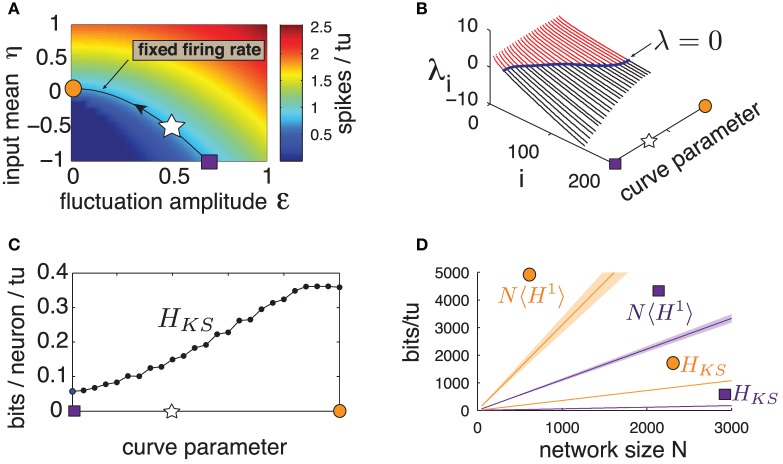
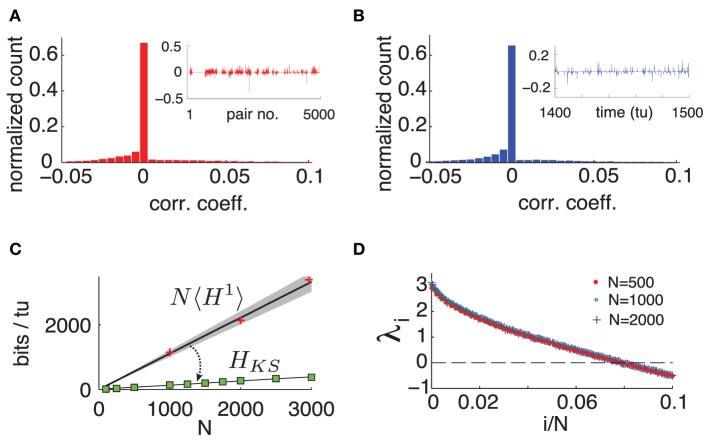
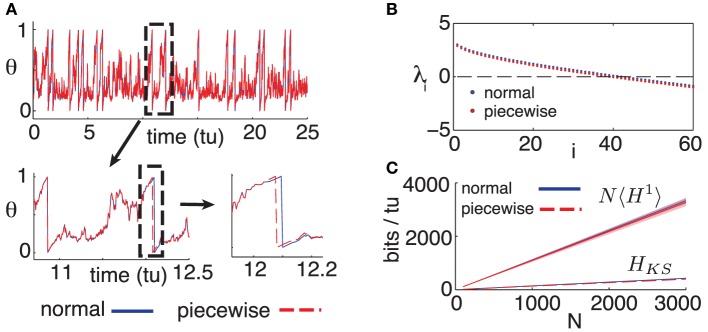
Large networks of sparsely coupled, excitatory and inhibitory cells occur throughout the brain. For many models of these networks, a striking feature is that their dynamics are chaotic and thus, are sensitive to small perturbations. How does this chaos manifest in the neural code? Specifically, how variable are the spike patterns that such a network produces in response to an input signal? To answer this, we derive a bound for a general measure of variability-spike-train entropy. This leads to important insights on the variability of multi-cell spike pattern distributions in large recurrent networks of spiking neurons responding to fluctuating inputs. The analysis is based on results from random dynamical systems theory and is complemented by detailed numerical simulations. We find that the spike pattern entropy is an order of magnitude lower than what would be extrapolated from single cells. This holds despite the fact that network coupling becomes vanishingly sparse as network size grows-a phenomenon that depends on "extensive chaos," as previously discovered for balanced networks without stimulus drive. Moreover, we show how spike pattern entropy is controlled by temporal features of the inputs. Our findings provide insight into how neural networks may encode stimuli in the presence of inherently chaotic dynamics.
整个大脑中都存在着稀疏耦合的兴奋性和抑制性细胞的大型网络。对于这些网络的许多模型来说,一个显著的特点是它们的动力学是混沌的,因此对小的扰动很敏感。这种混沌在神经编码中是如何表现出来的呢?具体来说,这样的网络对输入信号会产生出多少种可变的脉冲模式?为了回答这个问题,我们推导出了一个一般的可变性度量——脉冲序列熵的界。这为在响应波动输入的大型脉冲神经元递归网络中,多细胞脉冲模式分布的可变性提供了重要的见解。该分析基于随机动力系统理论的结果,并辅以详细的数值模拟。我们发现,尽管随着网络规模的增长,网络耦合变得几乎为零,这一现象依赖于“广泛的混沌”,就像以前在没有刺激驱动的平衡网络中发现的那样,但是脉冲模式熵要比从单个细胞推断出来的低一个数量级。此外,我们展示了如何通过输入的时间特征来控制脉冲模式熵。我们的研究结果为神经网络在存在固有混沌动力学的情况下如何编码刺激提供了深入的了解。