Department of Mathematics, University of Pittsburgh Pittsburgh, PA, USA ; Center for the Neural Basis of Cognition, University of Pittsburgh and Carnegie Mellon University Pittsburgh, PA, USA.
Center for the Neural Basis of Cognition, University of Pittsburgh and Carnegie Mellon University Pittsburgh, PA, USA ; Program for Neural Computation, University of Pittsburgh and Carnegie Mellon University Pittsburgh, PA, USA.
Front Comput Neurosci. 2014 May 27;8:56. doi: 10.3389/fncom.2014.00056. eCollection 2014.
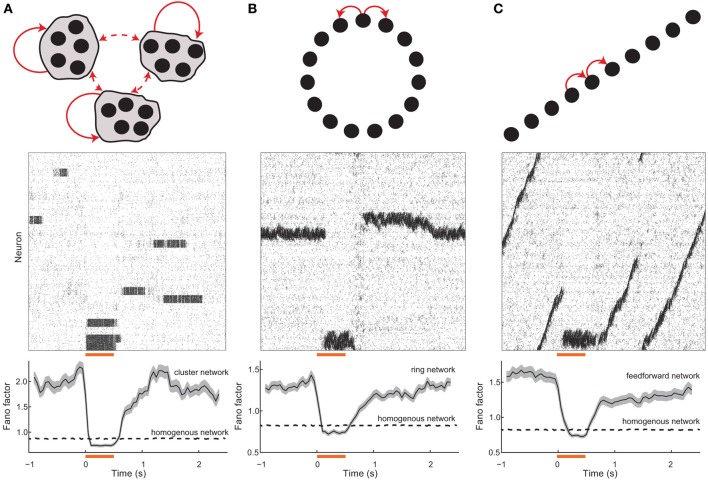
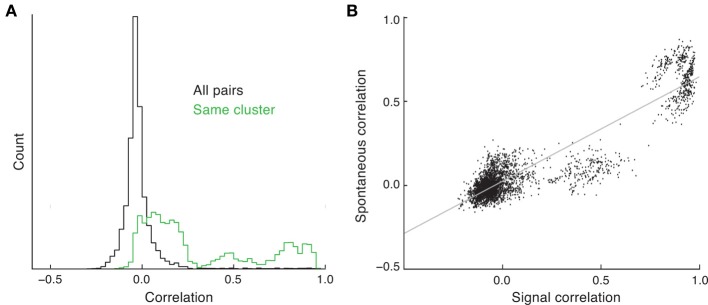
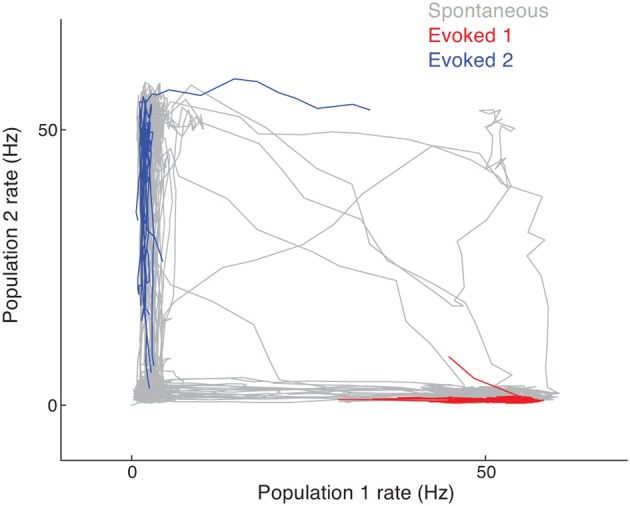
A signature feature of cortical spike trains is their trial-to-trial variability. This variability is large in the spontaneous state and is reduced when cortex is driven by a stimulus or task. Models of recurrent cortical networks with unstructured, yet balanced, excitation and inhibition generate variability consistent with evoked conditions. However, these models produce spike trains which lack the long timescale fluctuations and large variability exhibited during spontaneous cortical dynamics. We propose that global network architectures which support a large number of stable states (attractor networks) allow balanced networks to capture key features of neural variability in both spontaneous and evoked conditions. We illustrate this using balanced spiking networks with clustered assembly, feedforward chain, and ring structures. By assuming that global network structure is related to stimulus preference, we show that signal correlations are related to the magnitude of correlations in the spontaneous state. Finally, we contrast the impact of stimulation on the trial-to-trial variability in attractor networks with that of strongly coupled spiking networks with chaotic firing rate instabilities, recently investigated by Ostojic (2014). We find that only attractor networks replicate an experimentally observed stimulus-induced quenching of trial-to-trial variability. In total, the comparison of the trial-variable dynamics of single neurons or neuron pairs during spontaneous and evoked activity can be a window into the global structure of balanced cortical networks.
皮质尖峰序列的一个显著特征是其试验间的可变性。这种可变性在自发状态下很大,当皮质受到刺激或任务驱动时会降低。具有非结构化但平衡的兴奋和抑制的递归皮质网络模型会产生与诱发条件一致的可变性。然而,这些模型产生的尖峰序列缺乏在自发皮质动力学中表现出的长时间尺度波动和大的可变性。我们提出,支持大量稳定状态(吸引子网络)的全局网络架构允许平衡网络捕获自发和诱发条件下神经可变性的关键特征。我们使用具有聚类组件、前馈链和环形结构的平衡尖峰网络来说明这一点。通过假设全局网络结构与刺激偏好相关,我们表明信号相关性与自发状态下相关性的大小相关。最后,我们对比了吸引子网络中刺激对试验间可变性的影响,以及 Ostojic(2014)最近研究的具有混沌发放率不稳定性的强耦合尖峰网络的影响。我们发现只有吸引子网络复制了实验观察到的刺激诱导的试验间可变性的抑制。总的来说,在自发和诱发活动期间单个神经元或神经元对的试验变量动力学的比较可以是平衡皮质网络全局结构的一个窗口。