Simmons Lyle A, Foti James J, Cohen Susan E, Walker Graham C
Department of Biology, Massachusetts Institute of Technology, Cambridge, MA 02139.
EcoSal Plus. 2008 Jul 25;2008. doi: 10.1128/ecosalplus.5.4.3.
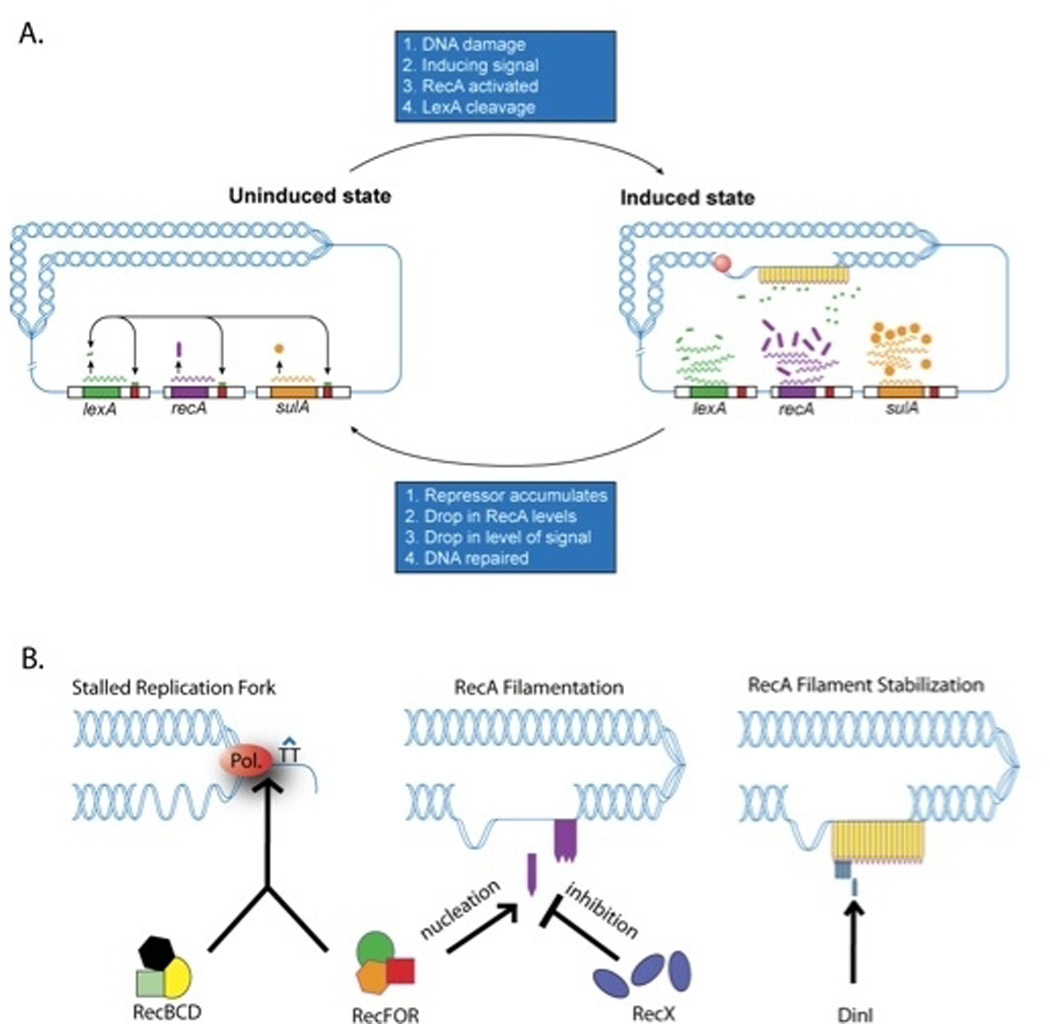
All organisms possess a diverse set of genetic programs that are used to alter cellular physiology in response to environmental cues. The gram-negative bacterium, , mounts what is known as the "" following DNA damage, replication fork arrest, and a myriad of other environmental stresses. For over 50 years, has served as the paradigm for our understanding of the transcriptional, and physiological changes that occur following DNA damage (400). In this chapter, we summarize the current view of the SOS response and discuss how this genetic circuit is regulated. In addition to examining the SOS response, we also include a discussion of the SOS regulatory networks in other bacteria to provide a broader perspective on how prokaryotes respond to DNA damage.
所有生物体都拥有一系列多样的遗传程序,这些程序用于根据环境线索改变细胞生理状态。革兰氏阴性细菌 在DNA损伤、复制叉停滞以及众多其他环境压力下会启动所谓的“ ”。五十多年来, 一直是我们理解DNA损伤后发生的转录和生理变化的范例(400)。在本章中,我们总结了对SOS反应的当前观点,并讨论了这个遗传回路是如何被调控的。除了研究 的SOS反应外,我们还讨论了其他细菌中的SOS调控网络,以便更全面地了解原核生物如何应对DNA损伤。