Serra e Silva Filho Wagner, Casarin Renato C V, Nicolela Eduardo L, Passos Humberto M, Sallum Antônio W, Gonçalves Reginaldo B
Federal University of Piauí, Piauí, Brazil.
Paulista University, São Paulo, Brazil.
PLoS One. 2014 Oct 16;9(10):e109761. doi: 10.1371/journal.pone.0109761. eCollection 2014.
The immune and infectious alterations occurring in periodontitis have been shown to alter the development and severity of cardiovascular disease. One of these relationships is the translocation of oral bacteria to atheroma plaques, thereby promoting plaque development. Thus, the aim of this study was to assess, by 16s cloning and sequencing, the microbial diversity of the subgingival environment and atheroma plaques of patients concomitantly suffering from periodontitis and obstructive coronary artery atherosclerosis (OCAA).
Subgingival biofilm and coronary balloons used in percutaneous transluminal coronary angioplasty were collected from 18 subjects presenting with generalized moderate to severe periodontitis and OCAA. DNA was extracted and the gene 16S was amplified, cloned and sequenced.
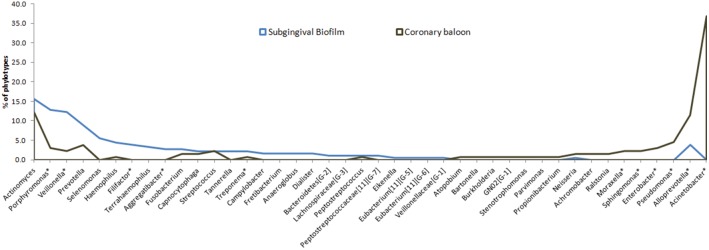
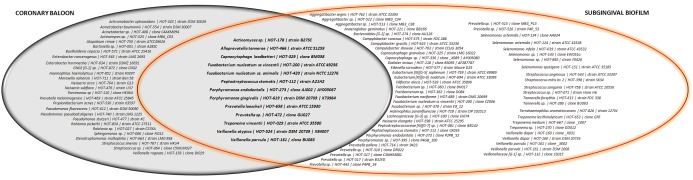
Significant differences in microbial diversity were observed between both environments. While subgingival samples mostly contained the phylum Firmicutes, in coronary balloons, Proteobacteria (p<0.05) was predominant. In addition, the most commonly detected genera in coronary balloons were Acinetobacter, Alloprevotella, Pseudomonas, Enterobacter, Sphingomonas and Moraxella, while in subgingival samples Porphyromonas, Filifactor, Veillonella, Aggregatibacter and Treponema (p<0.05) were found. Interestingly, 17 identical phylotypes were found in atheroma and subgingival samples, indicating possible bacterial translocation between periodontal pockets and coronary arteries.
Periodontal pockets and atheromatous plaques of cardiovascular disease patients can present similarities in the microbial diversity.
牙周炎中发生的免疫和感染改变已被证明会改变心血管疾病的发展和严重程度。其中一种关系是口腔细菌易位至动脉粥样硬化斑块,从而促进斑块发展。因此,本研究的目的是通过16s克隆和测序,评估同时患有牙周炎和阻塞性冠状动脉粥样硬化(OCAA)的患者龈下环境和动脉粥样硬化斑块的微生物多样性。
从18例患有广泛性中度至重度牙周炎和OCAA的受试者中收集龈下生物膜和经皮腔内冠状动脉成形术中使用的冠状动脉球囊。提取DNA并扩增、克隆和测序16S基因。
在两种环境之间观察到微生物多样性的显著差异。虽然龈下样本主要包含厚壁菌门,但在冠状动脉球囊中,变形菌门(p<0.05)占主导地位。此外,在冠状动脉球囊中最常检测到的属是不动杆菌属、嗜胆菌属、假单胞菌属、肠杆菌属、鞘氨醇单胞菌属和莫拉菌属,而在龈下样本中发现了卟啉单胞菌属、丝状杆菌属、韦荣球菌属、聚集杆菌属和密螺旋体属(p<0.05)。有趣的是,在动脉粥样硬化和龈下样本中发现了17种相同的系统发育型,表明牙周袋和冠状动脉之间可能存在细菌易位。
心血管疾病患者的牙周袋和动脉粥样硬化斑块在微生物多样性方面可能存在相似之处。