Department of Gynecology and Gynecologic Oncology, Kliniken Essen-Mitte, Essen, Germany ; Department of Gynecology and Obstetrics, Rotkreuzklinikum Munich, Munich, Germany.
Department of Gynecology and Obstetrics, Rotkreuzklinikum Munich, Munich, Germany.
Onco Targets Ther. 2014 Oct 6;7:1723-31. doi: 10.2147/OTT.S62676. eCollection 2014.
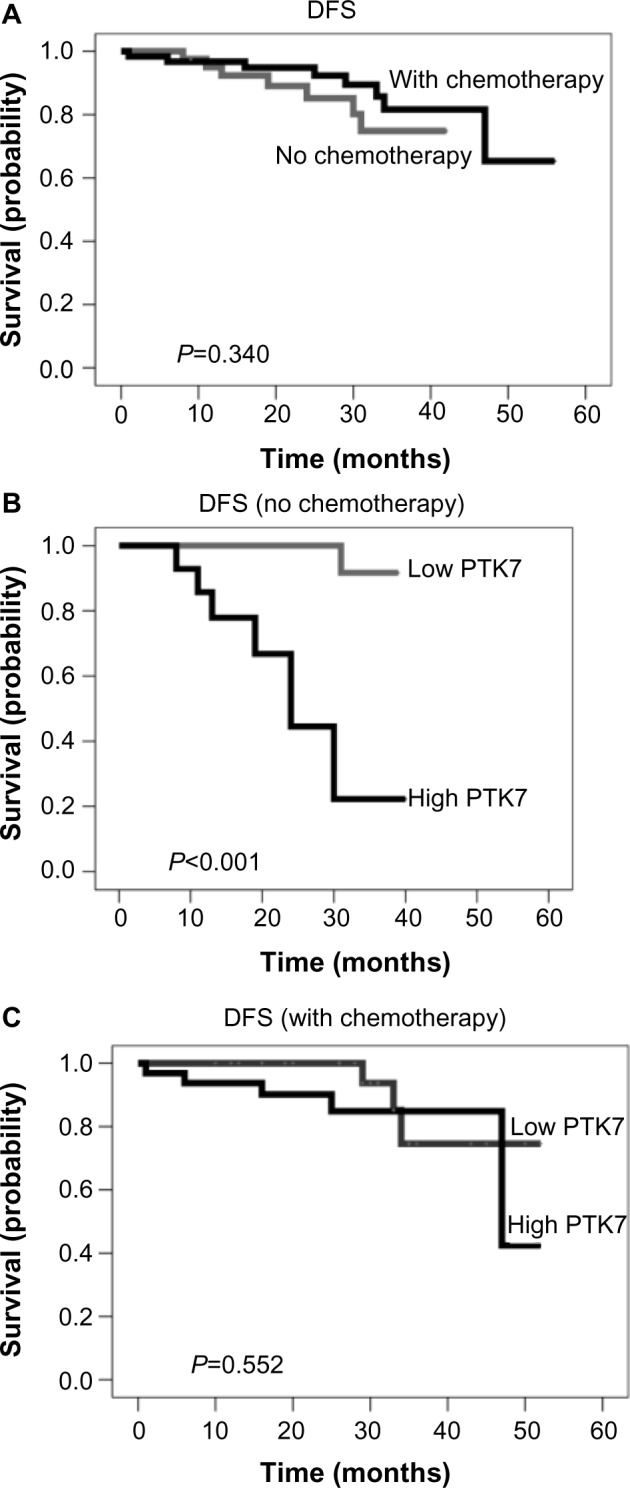
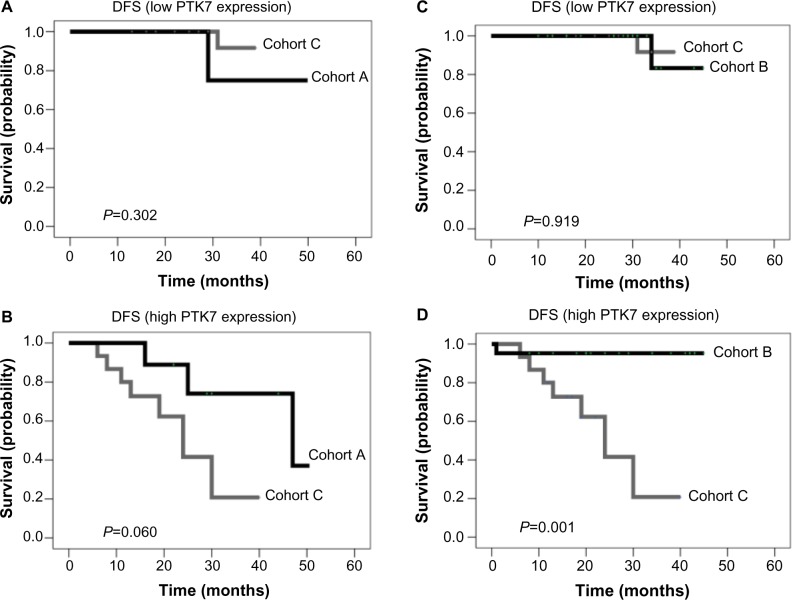
Biomarkers predicting resistance to particular chemotherapy regimens could play a key role in optimally individualized treatment concepts. PTK7 (protein tyrosine kinase 7) belongs to the receptor tyrosine kinase family involved in several physiological, but also malignant, cell behaviors. Recent studies in acute myeloid leukemia have associated PTK7 expression with resistance to anthracycline therapy. PTK7 mRNA expression in primary tumor tissue (PTT) and corresponding lymph node tissue (LNT) were retrospectively measured in 117 patients with early breast cancer; PTK7 expression was available in 103 PTT and 108 LNT samples. Median age was 60 years (range, 27-87 years). At a median follow-up of 28.5 months, 6 deaths and 16 recurrences had occurred. PTK7 expression correlations with clinicopathological features were computed and PTK7 expression effects on patient outcome were analyzed in three cohorts defined by adjuvant treatment: anthracycline-based treatment, other chemotherapy regimens (including taxane or other substances), or no chemotherapy. Association of PTK7 expression with clinicopathological features was seen only for age in PTT and nodal stage in LNT. High LN PTK7 was associated with poorer disease-free survival (DFS) in the total population (3-year DFS: low [81.7%] versus high [70.4%]; P=0.016) and in patients without adjuvant chemotherapy (3-year DFS: low [91.7%] versus high [22.3%]; P<0.001), but not in patients receiving adjuvant chemotherapy (P=0.552). DFS stratified by PTK7 expression was compared in treatment cohorts: In patients with low LN PTK7 expression, neither chemotherapy cohort showed significantly better survival than the no-chemotherapy cohort. In patients with high LN PTK7 expression, those receiving chemotherapy, including substances other than anthracyclines, but not those receiving only anthracycline-based chemotherapy, showed significantly better DFS than those receiving no chemotherapy (P=0.001). Our results support earlier findings that PTK7 may be a prognostic and predictive marker associated with resistance to anthracycline-based chemotherapy. Further investigations are needed to validate these findings in breast cancer.
预测特定化疗方案耐药的生物标志物可能在最佳个体化治疗概念中发挥关键作用。PTK7(蛋白酪氨酸激酶 7)属于受体酪氨酸激酶家族,参与多种生理过程,也与恶性细胞行为有关。最近在急性髓性白血病中的研究表明,PTK7 表达与蒽环类药物治疗耐药有关。回顾性测量了 117 例早期乳腺癌患者的原发肿瘤组织(PTT)和相应的淋巴结组织(LNT)中的 PTK7mRNA 表达;PTT 中有 103 例和 LNT 中有 108 例可获得 PTK7 表达。中位年龄为 60 岁(范围,27-87 岁)。中位随访 28.5 个月时,发生了 6 例死亡和 16 例复发。计算了 PTK7 表达与临床病理特征的相关性,并根据辅助治疗将患者分为三组进行分析:基于蒽环类药物的治疗、其他化疗方案(包括紫杉烷或其他物质)或无化疗。仅在 PTT 中观察到 PTK7 表达与年龄和 LNT 中淋巴结分期相关,而在 LNT 中观察到与年龄和淋巴结分期相关。高 LN PTK7 与总人群的无病生存(DFS)较差相关(3 年 DFS:低[81.7%]与高[70.4%];P=0.016)和无辅助化疗的患者(3 年 DFS:低[91.7%]与高[22.3%];P<0.001),但在接受辅助化疗的患者中则不然(P=0.552)。按 PTK7 表达分层比较了治疗队列的 DFS:在 LN PTK7 表达低的患者中,无化疗组与其他化疗组的生存均无显著差异。在 LN PTK7 表达高的患者中,接受包括蒽环类药物以外的其他药物化疗但未接受单纯蒽环类药物化疗的患者,DFS 显著优于未接受化疗的患者(P=0.001)。我们的结果支持早期发现,即 PTK7 可能是与蒽环类药物化疗耐药相关的预后和预测标志物。需要进一步的研究来验证这些在乳腺癌中的发现。