Wall Benjamin T, Cermak Naomi M, van Loon Luc J C
NUTRIM School for Nutrition, Toxicology and Metabolism, Maastricht University, Maastricht, 6200 MD, The Netherlands.
Sports Med. 2014 Nov;44 Suppl 2(Suppl 2):S185-94. doi: 10.1007/s40279-014-0258-7.
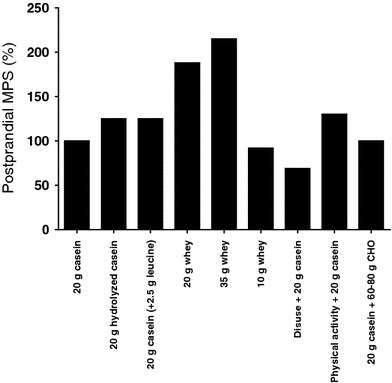
Given our rapidly aging world-wide population, the loss of skeletal muscle mass with healthy aging (sarcopenia) represents an important societal and public health concern. Maintaining or adopting an active lifestyle alleviates age-related muscle loss to a certain extent. Over time, even small losses of muscle tissue can hinder the ability to maintain an active lifestyle and, as such, contribute to the development of frailty and metabolic disease. Considerable research focus has addressed the application of dietary protein supplementation to support exercise-induced gains in muscle mass in younger individuals. In contrast, the role of dietary protein in supporting the maintenance (or gain) of skeletal muscle mass in active older persons has received less attention. Older individuals display a blunted muscle protein synthetic response to dietary protein ingestion. However, this reduced anabolic response can largely be overcome when physical activity is performed in close temporal proximity to protein consumption. Moreover, recent evidence has helped elucidate the optimal type and amount of dietary protein that should be ingested by the older adult throughout the day in order to maximize the skeletal muscle adaptive response to physical activity. Evidence demonstrates that when these principles are adhered to, muscle maintenance or hypertrophy over prolonged periods can be further augmented in active older persons. The present review outlines the current understanding of the role that dietary protein occupies in the lifestyle of active older adults as a means to increase skeletal muscle mass, strength and function, and thus support healthier aging.
鉴于全球人口迅速老龄化,健康衰老过程中骨骼肌质量的流失(肌肉减少症)成为一项重要的社会和公共卫生问题。保持或采取积极的生活方式在一定程度上可缓解与年龄相关的肌肉流失。随着时间推移,即使是少量的肌肉组织流失也会妨碍维持积极生活方式的能力,进而导致身体虚弱和代谢疾病的发展。大量研究聚焦于补充膳食蛋白质以促进年轻个体运动诱导的肌肉量增加。相比之下,膳食蛋白质在支持活跃老年人维持(或增加)骨骼肌质量方面的作用受到的关注较少。老年人对膳食蛋白质摄入的肌肉蛋白合成反应较为迟钝。然而,当在摄入蛋白质后不久进行体育活动时,这种减弱的合成代谢反应在很大程度上可以被克服。此外,最近的证据有助于阐明老年人全天应摄入的最佳膳食蛋白质类型和量,以便最大限度地增强骨骼肌对体育活动的适应性反应。有证据表明,当遵循这些原则时,活跃老年人长期的肌肉维持或肥大可以进一步增强。本综述概述了目前对膳食蛋白质在活跃老年人生活方式中的作用的理解,将其作为增加骨骼肌质量、力量和功能的一种手段,从而支持更健康的衰老。