Khan Wasim, Westman Eric, Jones Nigel, Wahlund Lars-Olof, Mecocci Patrizia, Vellas Bruno, Tsolaki Magda, Kłoszewska Iwona, Soininen Hilkka, Spenger Christian, Lovestone Simon, Muehlboeck J-Sebastian, Simmons Andrew
Department of Neuroimaging, Institute of Psychiatry, King's College London, De Crespigny Park, London, SE5 8AF, UK.
Department of Neurobiology, Care Sciences and Society, Karolinska Institutet, Stockholm, Sweden.
Brain Topogr. 2015 Sep;28(5):746-759. doi: 10.1007/s10548-014-0415-1. Epub 2014 Nov 5.
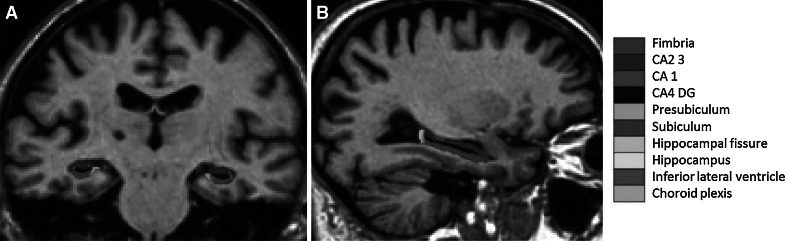
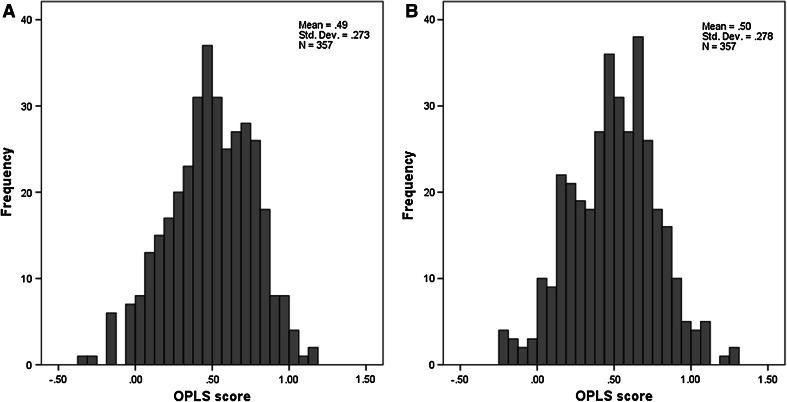
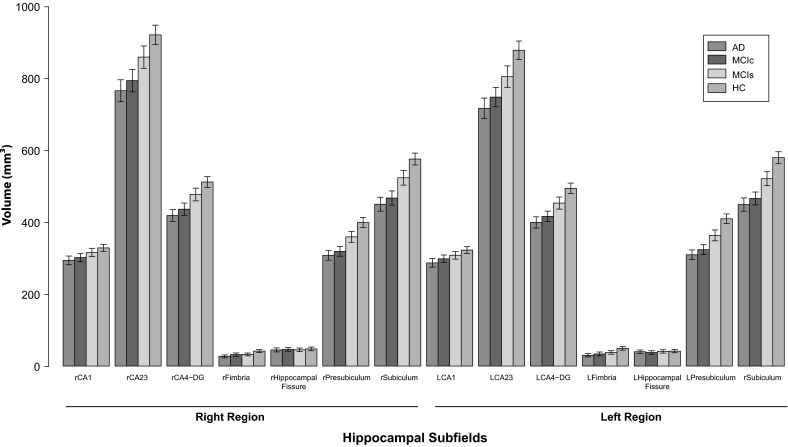
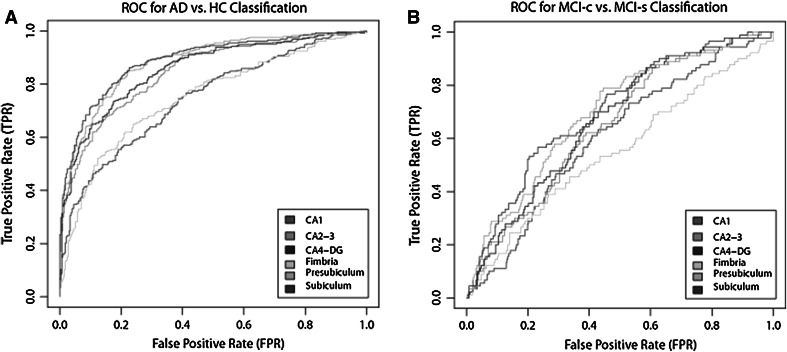
Previous studies have shown that hippocampal subfields may be differentially affected by Alzheimer's disease (AD). This study used an automated analysis technique and two large cohorts to (1) investigate patterns of subfield volume loss in mild cognitive impairment (MCI) and AD, (2) determine the pattern of subfield volume loss due to age, gender, education, APOE ε4 genotype, and neuropsychological test scores, (3) compare combined subfield volumes to hippocampal volume alone at discriminating between AD and healthy controls (HC), and predicting future MCI conversion to AD at 12 months. 1,069 subjects were selected from the AddNeuroMed and Alzheimer's disease neuroimaging initiative (ADNI) cohorts. Freesurfer was used for automated segmentation of the hippocampus and hippocampal subfields. Orthogonal partial least squares to latent structures (OPLS) was used to train models on AD and HC subjects using one cohort for training and the other for testing and the combined cohort was used to predict MCI conversion. MANCOVA and linear regression analyses showed multiple subfield volumes including Cornu Ammonis 1 (CA1), subiculum and presubiculum were atrophied in AD and MCI and were related to age, gender, education, APOE ε4 genotype, and neuropsychological test scores. For classifying AD from HC, combined subfield volumes achieved comparable classification accuracy (81.7%) to total hippocampal (80.7%), subiculum (81.2%) and presubiculum (80.6%) volume. For predicting MCI conversion to AD combined subfield volumes and presubiculum volume were more accurate (81.1%) than total hippocampal volume. (76.7%).
先前的研究表明,海马亚区可能受到阿尔茨海默病(AD)的不同影响。本研究使用了一种自动分析技术和两个大型队列,以(1)研究轻度认知障碍(MCI)和AD患者海马亚区体积减少的模式,(2)确定年龄、性别、教育程度、APOE ε4基因型和神经心理学测试分数导致的海马亚区体积减少模式,(3)比较联合亚区体积与单独的海马体积在区分AD和健康对照(HC)以及预测未来12个月MCI向AD转化方面的效果。从AddNeuroMed和阿尔茨海默病神经影像倡议(ADNI)队列中选取了1069名受试者。使用FreeSurfer对海马和海马亚区进行自动分割。采用正交偏最小二乘判别分析(OPLS),利用一个队列进行训练,另一个队列进行测试,对AD和HC受试者建立模型,并使用联合队列预测MCI的转化。多因素协方差分析和线性回归分析表明,包括海马1区(CA1)、下托和前下托在内的多个亚区体积在AD和MCI患者中萎缩,且与年龄、性别、教育程度、APOE ε4基因型和神经心理学测试分数相关。对于从HC中分类AD,联合亚区体积的分类准确率(81.7%)与整个海马体积(80.7%)、下托(81.2%)和前下托(80.6%)相当。对于预测MCI向AD的转化,联合亚区体积和前下托体积比整个海马体积(76.7%)更准确(81.1%)。