Department of Neuroimaging, Institute of Psychiatry, King's College London, De Crespigny Park, London, UK.
Brain Topogr. 2013 Jan;26(1):9-23. doi: 10.1007/s10548-012-0246-x. Epub 2012 Aug 14.
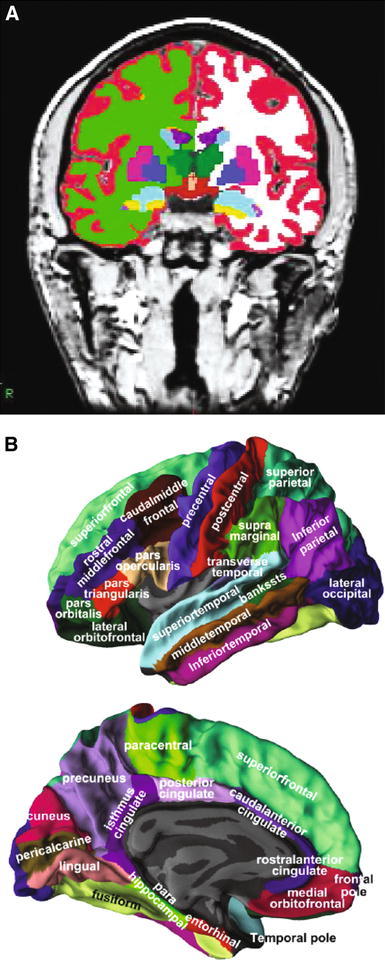
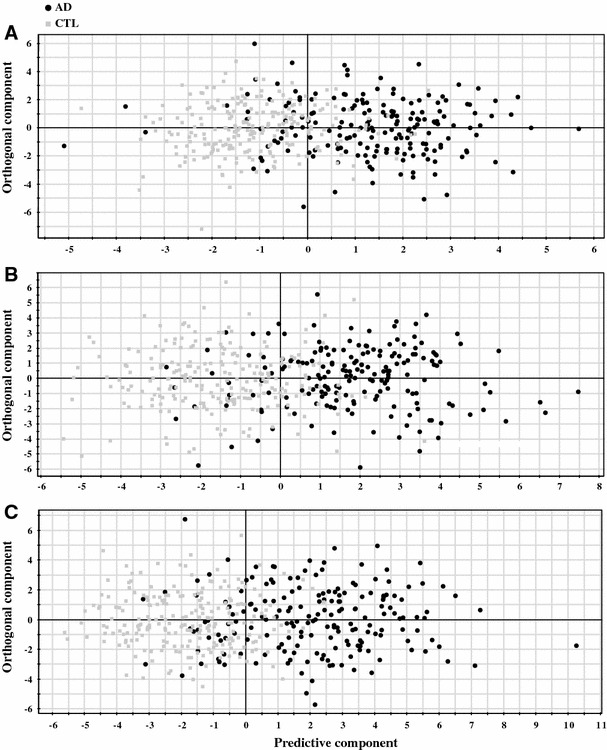
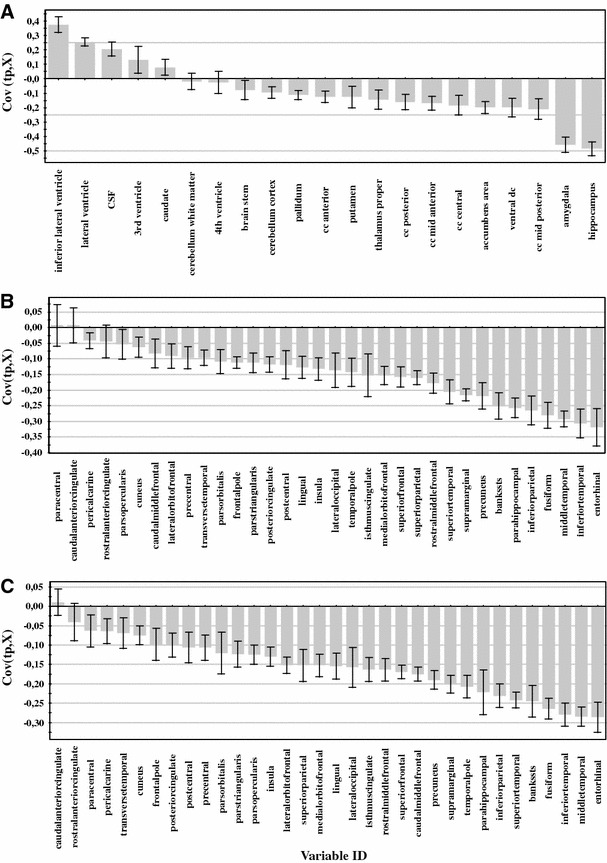
Automated structural magnetic resonance imaging (MRI) processing pipelines are gaining popularity for Alzheimer's disease (AD) research. They generate regional volumes, cortical thickness measures and other measures, which can be used as input for multivariate analysis. It is not clear which combination of measures and normalization approach are most useful for AD classification and to predict mild cognitive impairment (MCI) conversion. The current study includes MRI scans from 699 subjects [AD, MCI and controls (CTL)] from the Alzheimer's disease Neuroimaging Initiative (ADNI). The Freesurfer pipeline was used to generate regional volume, cortical thickness, gray matter volume, surface area, mean curvature, gaussian curvature, folding index and curvature index measures. 259 variables were used for orthogonal partial least square to latent structures (OPLS) multivariate analysis. Normalisation approaches were explored and the optimal combination of measures determined. Results indicate that cortical thickness measures should not be normalized, while volumes should probably be normalized by intracranial volume (ICV). Combining regional cortical thickness measures (not normalized) with cortical and subcortical volumes (normalized with ICV) using OPLS gave a prediction accuracy of 91.5 % when distinguishing AD versus CTL. This model prospectively predicted future decline from MCI to AD with 75.9 % of converters correctly classified. Normalization strategy did not have a significant effect on the accuracies of multivariate models containing multiple MRI measures for this large dataset. The appropriate choice of input for multivariate analysis in AD and MCI is of great importance. The results support the use of un-normalised cortical thickness measures and volumes normalised by ICV.
自动化结构磁共振成像(MRI)处理管道在阿尔茨海默病(AD)研究中越来越受欢迎。它们生成区域体积、皮质厚度测量值和其他测量值,可作为多元分析的输入。目前尚不清楚哪些测量值组合和归一化方法对 AD 分类和预测轻度认知障碍(MCI)转化最有用。本研究包括来自阿尔茨海默病神经影像学倡议(ADNI)的 699 名受试者(AD、MCI 和对照组(CTL))的 MRI 扫描。使用 Freesurfer 管道生成区域体积、皮质厚度、灰质体积、表面积、平均曲率、高斯曲率、折叠指数和曲率指数测量值。使用正交偏最小二乘到潜在结构(OPLS)多元分析了 259 个变量。探讨了归一化方法并确定了最佳测量值组合。结果表明,皮质厚度测量值不应进行归一化,而体积可能应该通过颅内体积(ICV)进行归一化。使用 OPLS 将未归一化的区域皮质厚度测量值与皮质和皮质下体积(用 ICV 归一化)相结合,在区分 AD 与 CTL 时可达到 91.5%的预测准确率。该模型前瞻性地预测了从 MCI 到 AD 的未来下降,75.9%的转化者被正确分类。对于这个大型数据集,包含多个 MRI 测量值的多元模型的归一化策略对准确率没有显著影响。在 AD 和 MCI 中,多元分析的适当输入选择非常重要。结果支持使用未归一化的皮质厚度测量值和用 ICV 归一化的体积。