Van Borm Steven, Belák Sándor, Freimanis Graham, Fusaro Alice, Granberg Fredrik, Höper Dirk, King Donald P, Monne Isabella, Orton Richard, Rosseel Toon
Veterinary and Agrochemical Research Center, Brussels, Belgium,
Methods Mol Biol. 2015;1247:415-36. doi: 10.1007/978-1-4939-2004-4_30.
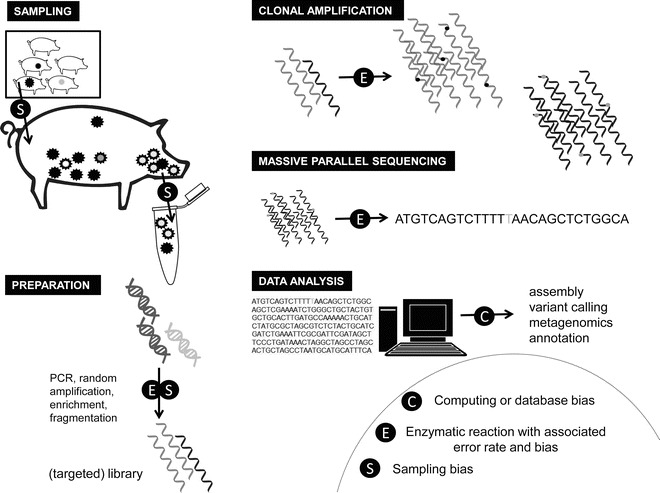
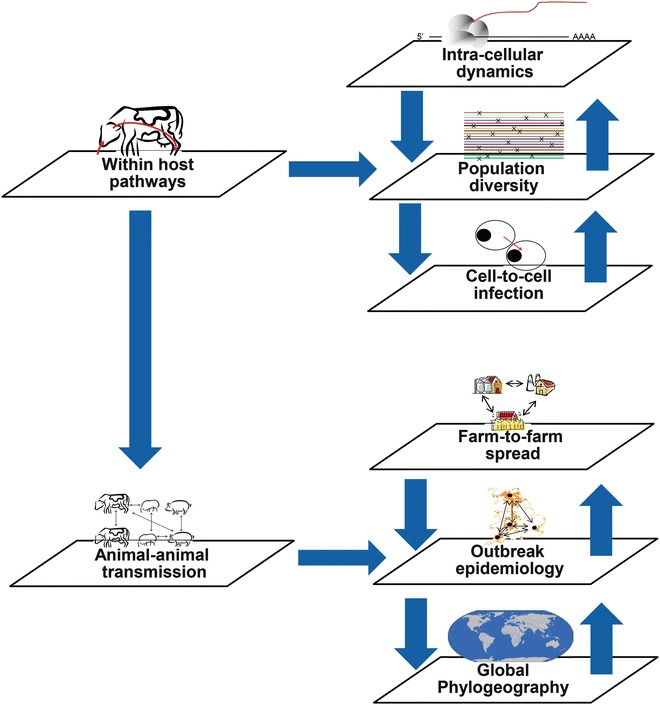
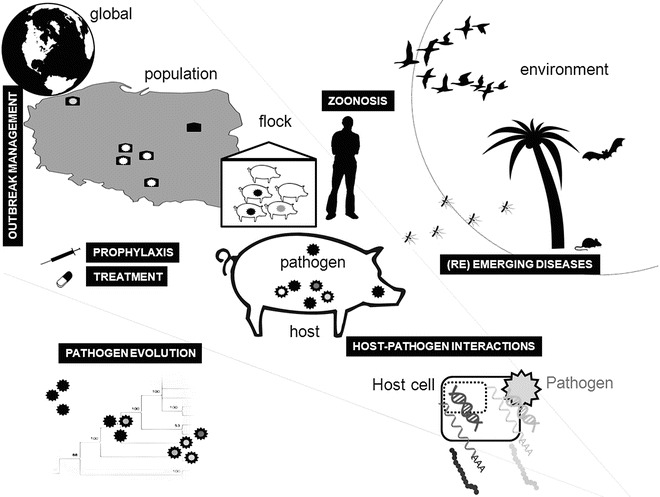
The development of high-throughput molecular technologies and associated bioinformatics has dramatically changed the capacities of scientists to produce, handle, and analyze large amounts of genomic, transcriptomic, and proteomic data. A clear example of this step-change is represented by the amount of DNA sequence data that can be now produced using next-generation sequencing (NGS) platforms. Similarly, recent improvements in protein and peptide separation efficiencies and highly accurate mass spectrometry have promoted the identification and quantification of proteins in a given sample. These advancements in biotechnology have increasingly been applied to the study of animal infectious diseases and are beginning to revolutionize the way that biological and evolutionary processes can be studied at the molecular level. Studies have demonstrated the value of NGS technologies for molecular characterization, ranging from metagenomic characterization of unknown pathogens or microbial communities to molecular epidemiology and evolution of viral quasispecies. Moreover, high-throughput technologies now allow detailed studies of host-pathogen interactions at the level of their genomes (genomics), transcriptomes (transcriptomics), or proteomes (proteomics). Ultimately, the interaction between pathogen and host biological networks can be questioned by analytically integrating these levels (integrative OMICS and systems biology). The application of high-throughput biotechnology platforms in these fields and their typical low-cost per information content has revolutionized the resolution with which these processes can now be studied. The aim of this chapter is to provide a current and prospective view on the opportunities and challenges associated with the application of massive parallel sequencing technologies to veterinary medicine, with particular focus on applications that have a potential impact on disease control and management.
高通量分子技术及相关生物信息学的发展极大地改变了科学家生成、处理和分析大量基因组、转录组和蛋白质组数据的能力。这种跨越式发展的一个明显例子体现在如今使用下一代测序(NGS)平台所能产生的DNA序列数据量上。同样,蛋白质和肽分离效率的近期提高以及高精度质谱技术推动了对给定样本中蛋白质的鉴定和定量。生物技术的这些进步越来越多地应用于动物传染病研究,并开始彻底改变在分子水平研究生物学和进化过程的方式。研究已证明NGS技术在分子特征分析方面的价值,范围从未知病原体或微生物群落的宏基因组特征分析到病毒准种的分子流行病学和进化研究。此外,高通量技术现在允许在基因组(基因组学)、转录组(转录组学)或蛋白质组(蛋白质组学)水平上详细研究宿主 - 病原体相互作用。最终,通过分析整合这些层面(综合组学和系统生物学),可以探究病原体与宿主生物网络之间的相互作用。高通量生物技术平台在这些领域的应用及其每信息内容典型的低成本,彻底改变了现在研究这些过程的分辨率。本章旨在对大规模平行测序技术应用于兽医学所带来的机遇和挑战提供当前及前瞻性的观点,特别关注对疾病控制和管理有潜在影响的应用。