Wille Michelle, Avril Alexis, Tolf Conny, Schager Anna, Larsson Sara, Borg Olivia, Olsen Björn, Waldenström Jonas
Centre for Ecology and Evolution in Microbial Model Systems, Linnaeus University, SE-391 82 Kalmar, Sweden.
Centre for Ecology and Evolution in Microbial Model Systems, Linnaeus University, SE-391 82 Kalmar, Sweden; CIRAD, Campus international de Baillarguet, 34398 Montpellier, France.
Infect Genet Evol. 2015 Jan;29:129-37. doi: 10.1016/j.meegid.2014.11.014. Epub 2014 Nov 21.
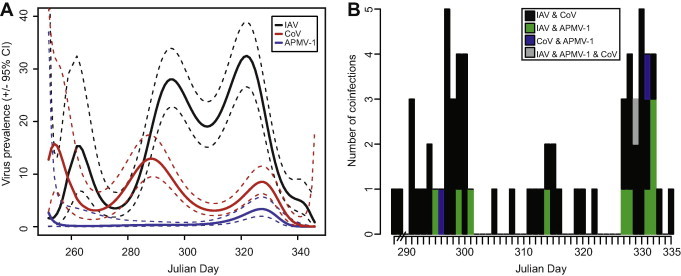
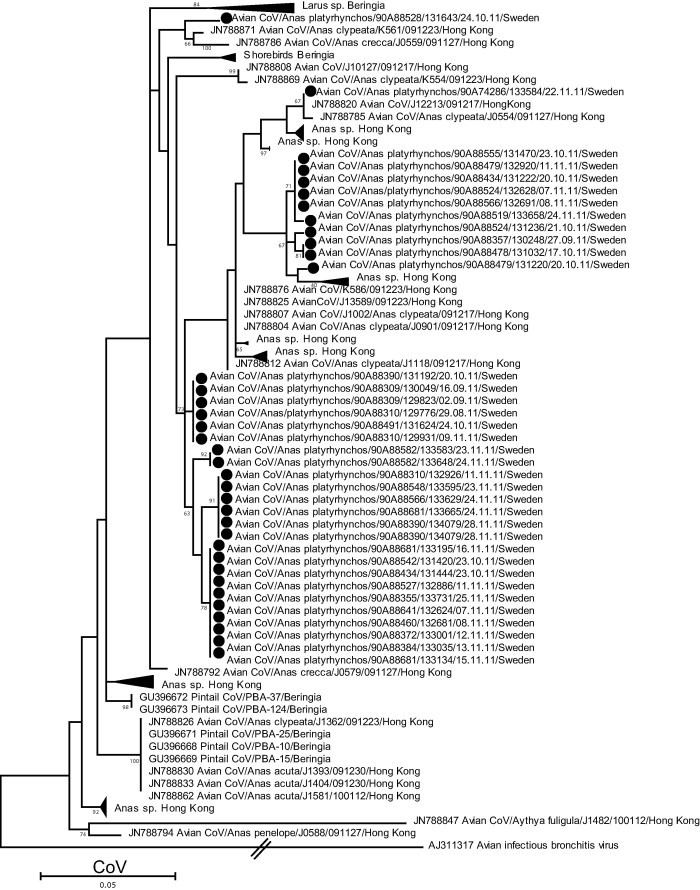
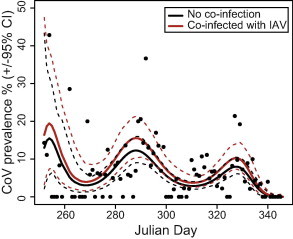
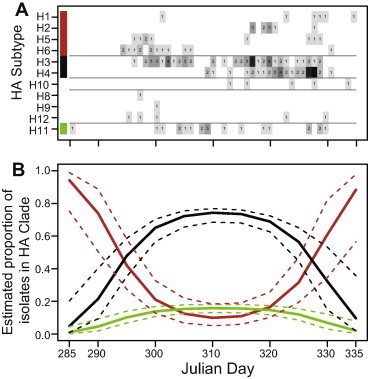
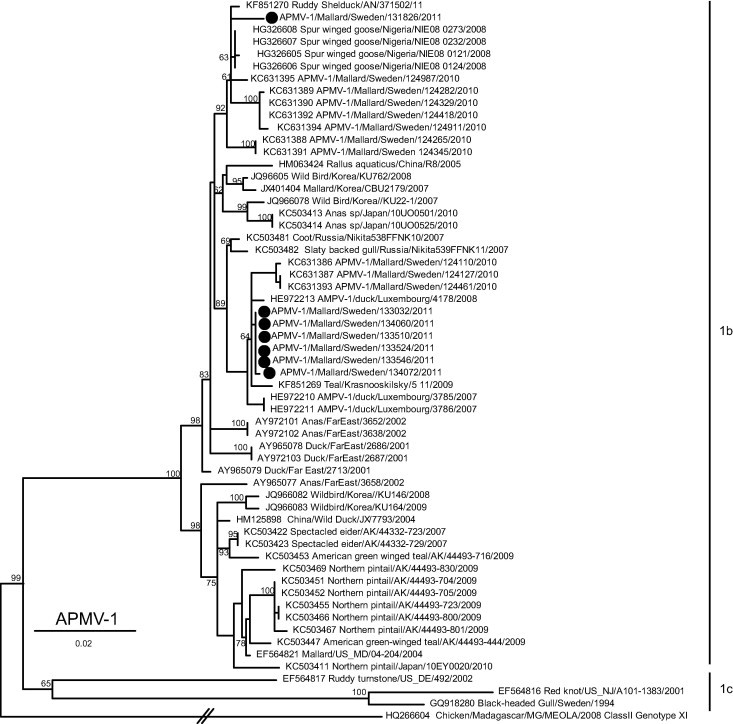
Multiple infections, or simultaneous infection of a host with multiple parasites, are the rule rather than the exception. Interactions between co-occurring pathogens in a population may be mutualistic, competitive or facilitative. For some pathogen combinations, these interrelated effects will have epidemiological consequences; however this is as yet poorly incorporated into practical disease ecology. For example, screening of Mallards for influenza A viruses (IAV) have repeatedly revealed high prevalence and large subtype diversity in the Northern Hemisphere. Other studies have identified avian paramyxovirus type 1 (APMV-1) and coronaviruses (CoVs) in Mallards, but without making inferences on the larger viral assemblage. In this study we followed 144 wild Mallards across an autumn season in a natural stopover site and constructed infection histories of IAV, APMV-1 and CoV. There was a high prevalence of IAV, comprising of 27 subtype combinations, while APMV-1 had a comparatively low prevalence (with a peak of 2%) and limited strain variation, similar to previous findings. Avian CoVs were common, with prevalence up to 12%, and sequence analysis identified different putative genetic lineages. An investigation of the dynamics of co-infections revealed a synergistic effect between CoV and IAV, whereby CoV prevalence was higher given that the birds were co-infected with IAV. There were no interactive effects between IAV and APMV-1. Disease dynamics are the result of an interplay between parasites, host immune responses, and resources; and is imperative that we begin to include all factors to better understand infectious disease risk.
多重感染,即宿主同时感染多种寄生虫,是常态而非例外。种群中同时存在的病原体之间的相互作用可能是互利共生、竞争或促进的。对于某些病原体组合而言,这些相互关联的效应会产生流行病学后果;然而,这一点在实际疾病生态学中尚未得到充分体现。例如,对绿头鸭进行甲型流感病毒(IAV)筛查,多次发现北半球的感染率很高且亚型多样性大。其他研究已在绿头鸭中鉴定出1型禽副黏病毒(APMV - 1)和冠状病毒(CoV),但未对更大的病毒组合进行推断。在本研究中,我们在一个自然中途停留地追踪了144只野生绿头鸭度过一个秋季,并构建了IAV、APMV - 1和CoV的感染史。IAV的感染率很高,包括27种亚型组合,而APMV - 1的感染率相对较低(峰值为2%)且毒株变异有限,这与之前的研究结果相似。禽CoV很常见,感染率高达12%,序列分析确定了不同的假定遗传谱系。对共感染动态的调查显示CoV和IAV之间存在协同效应,即当鸟类同时感染IAV时,CoV的感染率更高。IAV和APMV - 1之间没有交互作用。疾病动态是寄生虫、宿主免疫反应和资源之间相互作用的结果;我们必须开始纳入所有因素,以更好地了解传染病风险。