Hankivsky Olena, Grace Daniel, Hunting Gemma, Giesbrecht Melissa, Fridkin Alycia, Rudrum Sarah, Ferlatte Olivier, Clark Natalie
School of Public Policy, Simon Fraser University, Vancouver, British Columbia (BC), Canada.
London School of Hygiene & Tropical Medicine, London, UK.
Int J Equity Health. 2014 Dec 10;13:119. doi: 10.1186/s12939-014-0119-x.
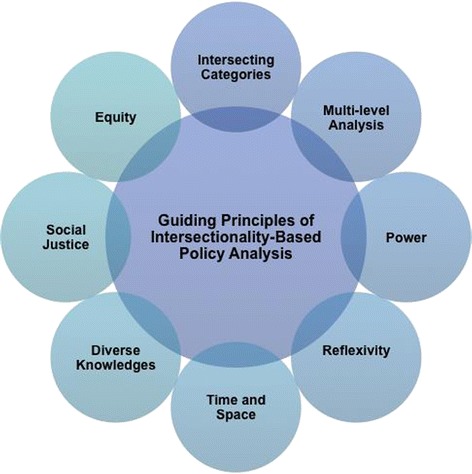
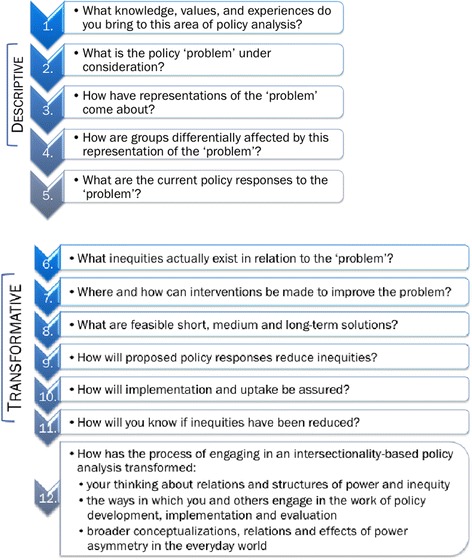
In the field of health, numerous frameworks have emerged that advance understandings of the differential impacts of health policies to produce inclusive and socially just health outcomes. In this paper, we present the development of an important contribution to these efforts - an Intersectionality-Based Policy Analysis (IBPA) Framework.
Developed over the course of two years in consultation with key stakeholders and drawing on best and promising practices of other equity-informed approaches, this participatory and iterative IBPA Framework provides guidance and direction for researchers, civil society, public health professionals and policy actors seeking to address the challenges of health inequities across diverse populations. Importantly, we present the application of the IBPA Framework in seven priority health-related policy case studies.
The analysis of each case study is focused on explaining how IBPA: 1) provides an innovative structure for critical policy analysis; 2) captures the different dimensions of policy contexts including history, politics, everyday lived experiences, diverse knowledges and intersecting social locations; and 3) generates transformative insights, knowledge, policy solutions and actions that cannot be gleaned from other equity-focused policy frameworks.
The aim of this paper is to inspire a range of policy actors to recognize the potential of IBPA to foreground the complex contexts of health and social problems, and ultimately to transform how policy analysis is undertaken.
在卫生领域,已出现众多框架,这些框架推动了对卫生政策不同影响的理解,以实现包容性和社会公正的卫生成果。在本文中,我们介绍了对这些努力的一项重要贡献的发展——基于交叉性的政策分析(IBPA)框架。
该参与式和迭代式的IBPA框架在与关键利益相关者协商的过程中,历时两年制定而成,并借鉴了其他公平性导向方法的最佳和有前景的实践经验,为寻求应对不同人群中卫生不公平挑战的研究人员、民间社会、公共卫生专业人员和政策行为者提供指导和方向。重要的是,我们展示了IBPA框架在七个与卫生相关的优先政策案例研究中的应用。
对每个案例研究的分析重点在于解释IBPA如何:1)为批判性政策分析提供创新结构;2)捕捉政策背景的不同维度,包括历史、政治、日常生活经历、多样的知识和交叉的社会位置;3)产生从其他以公平为重点的政策框架中无法获得的变革性见解、知识、政策解决方案和行动。
本文的目的是激励一系列政策行为者认识到IBPA在突出卫生和社会问题复杂背景方面的潜力,并最终改变政策分析的方式。