Hu Jian, Jiang Zhi-Lin, Nardi Francesco, Liu Yuan-Yuan, Luo Xiao-Rong, Li Hong-Xiang, Zhang Zhong-Kai
Ministry of Agriculture Key Lab of Southwestern Crop Gene Resources and Germplasm Innovation, Yunnan Provincial Key Lab of Agricultural Biotechnology, Biotechnology and Germplasm Resources Institute, Yunnan Academy of Agricultural Sciences, 650223, Kunming, China.
Pu'er University, 665000, Pu'er, China.
J Insect Sci. 2014 Jan 1;14. doi: 10.1093/jisesa/ieu143. Print 2014.
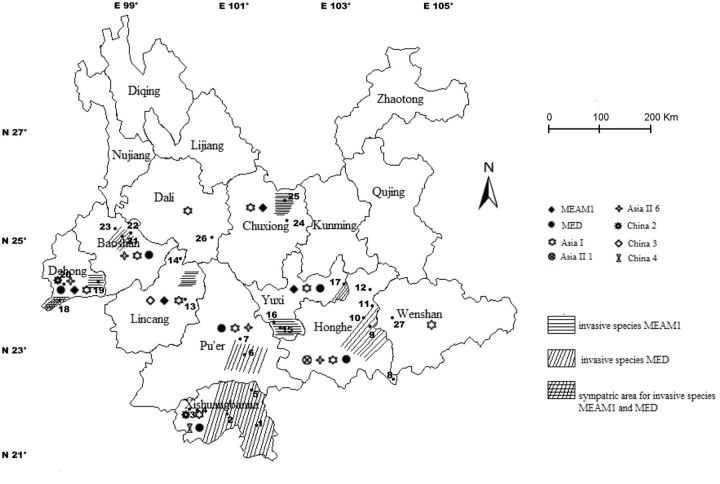
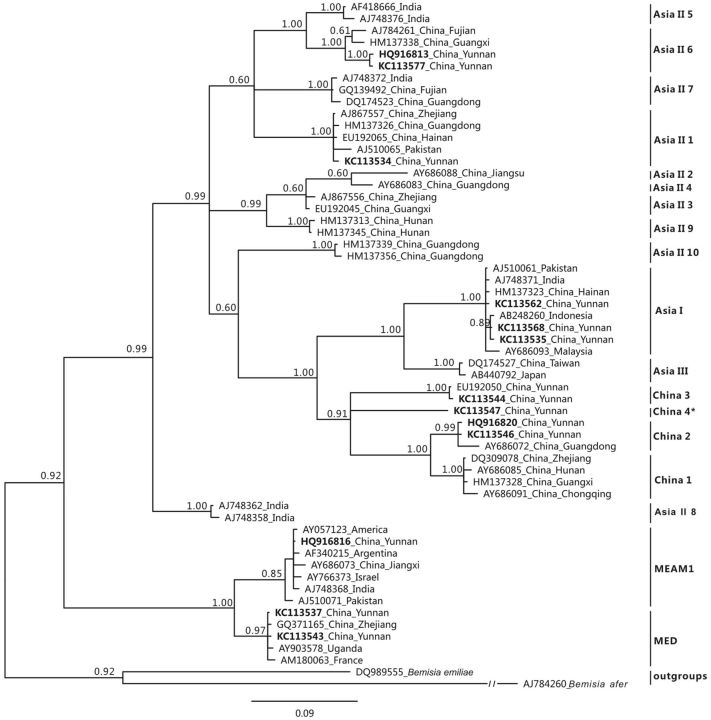
Bemisia tabaci (Gennadius) (Hemiptera: Aleyrodidae) is a cryptic species complex that includes some of the most significant pests of agriculture and horticulture worldwide. To understand the diversity and distribution of B. tabaci cryptic species in Yunnan, a famous biodiversity hotspot in China, a large-scale sampling was conducted from year 2010 to 2013 in 10 prefectures. Mitochondrial cytochrome oxidase I gene sequences were used to identify different cryptic species. Phylogenetic analyses were performed using Bayesian methods to assess the position of a new B. tabaci cryptic species in the context of the B. tabaci diversity in Asia. The survey indicates at least eight B. tabaci cryptic species are present in Yunnan, two invasive (MEAM1 and MED) and six indigenous (China 2, China3, China 4, Asia I, Asia II 1, and Asia II 6), MEAM1, MED, and Asia I being the three predominant cryptic species in Yunnan. Compared with MEAM1, MED has a wider distribution. Based on molecular data, a new cryptic species, here named China 4, was identified that appears to be related to China 1, China 2, and China 3. Future efforts should focus on the interactions between predominant B. tabaci cryptic species and begomoviruses and on the development of effective control strategies.
烟粉虱(Gennadius)(半翅目:粉虱科)是一个包含一些全球农业和园艺领域最重要害虫的复合隐性物种。为了解中国著名生物多样性热点地区云南烟粉虱复合隐性物种的多样性和分布情况,于2010年至2013年在10个州进行了大规模采样。利用线粒体细胞色素氧化酶I基因序列来鉴定不同的隐性物种。使用贝叶斯方法进行系统发育分析,以评估一种新的烟粉虱复合隐性物种在亚洲烟粉虱多样性背景下的位置。调查表明云南至少存在8种烟粉虱复合隐性物种,其中2种为入侵物种(MEAM1和MED),6种为本地物种(中国2、中国3、中国4、亚洲I、亚洲II 1和亚洲II 6),MEAM1、MED和亚洲I是云南的三种主要复合隐性物种。与MEAM1相比,MED分布更广。基于分子数据,鉴定出一个新的隐性物种,此处命名为中国4,它似乎与中国1、中国2和中国3相关。未来的工作应集中在主要烟粉虱复合隐性物种与双生病毒之间的相互作用以及有效防治策略的开发上。