Mekary Rania A, Grøntved Anders, Despres Jean-Pierre, De Moura Leandro Pereira, Asgarzadeh Morteza, Willett Walter C, Rimm Eric B, Giovannucci Edward, Hu Frank B
Department of Nutrition, Harvard School of Public Health, Boston, Massachusetts, USA; Massachusetts College of Pharmacy and Health Sciences University, Boston, Massachusetts, USA.
Obesity (Silver Spring). 2015 Feb;23(2):461-7. doi: 10.1002/oby.20949. Epub 2014 Dec 19.
Findings on weight training and waist circumference (WC) change are controversial. This study examined prospectively whether weight training, moderate to vigorous aerobic activity (MVAA), and replacement of one activity for another were associated with favorable changes in WC and body weight (BW).
Physical activity, WC, and BW were reported in 1996 and 2008 in a cohort of 10,500 healthy U.S. men in the Health Professionals Follow-up Study. Multiple linear regression models (partition/substitution) to assess these associations were used.
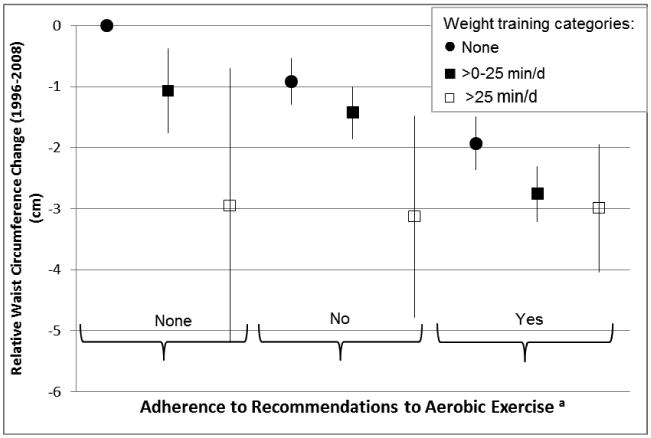
After adjusting for potential confounders, a significant inverse dose-response relationship between weight training and WC change (P-trend <0.001) was observed. Less age-associated WC increase was seen with a 20-min/day activity increase; this benefit was significantly stronger for weight training (-0.67 cm, 95% CI -0.93, -0.41) than for MVAA (-0.33 cm, 95% CI -0.40, -0.27), other activities (-0.16 cm, 95% CI -0.28, -0.03), or TV watching (0.08 cm, 95% CI 0.05, 0.12). Substituting 20 min/day of weight training for any other discretionary activity had the strongest inverse association with WC change. MVAA had the strongest inverse association with BW change (-0.23 kg, 95% CI -0.29, -0.17).
Among various activities, weight training had the strongest association with less WC increase. Studies on frequency/volume of weight training and WC change are warranted.
关于力量训练与腰围(WC)变化的研究结果存在争议。本研究前瞻性地考察了力量训练、中度至剧烈有氧运动(MVAA)以及一种活动替代另一种活动是否与WC和体重(BW)的有利变化相关。
在健康专业人员随访研究中,对10500名美国健康男性队列在1996年和2008年报告的身体活动、WC和BW进行了研究。使用多元线性回归模型(分组/替代)来评估这些关联。
在调整潜在混杂因素后,观察到力量训练与WC变化之间存在显著的剂量 - 反应负相关关系(P趋势<0.001)。每天活动增加20分钟,与年龄相关的WC增加减少;力量训练(-0.67厘米,95%可信区间-0.93,-0.41)带来的这种益处明显强于MVAA(-0.33厘米,95%可信区间-0.40,-0.27)、其他活动(-0.16厘米,95%可信区间-0.28,-0.03)或看电视(0.08厘米,95%可信区间0.05,0.12)。用每天20分钟的力量训练替代任何其他自由选择的活动与WC变化的负相关最强。MVAA与BW变化的负相关最强(-0.23千克,95%可信区间-0.29,-0.17)。
在各种活动中,力量训练与较少的WC增加关联最强。有必要对力量训练的频率/量与WC变化进行研究。