Blaauw Duane, Ditlopo Prudence, Rispel Laetitia C
Centre for Health Policy & Medical Research Council Health Policy Research Group, School of Public Health and Faculty of Health Sciences, University of the Witwatersrand, Johannesburg, South Africa;
Centre for Health Policy & Medical Research Council Health Policy Research Group, School of Public Health and Faculty of Health Sciences, University of the Witwatersrand, Johannesburg, South Africa.
Glob Health Action. 2014 Dec 22;7:26401. doi: 10.3402/gha.v7.26401. eCollection 2014.
Nursing education reform is identified as an important strategy for enhancing health workforce performance, and thereby improving the functioning of health systems. Globally, a predominant trend in such reform is towards greater professionalisation and university-based education. Related nursing education reform in South Africa culminated in a new Framework for Nursing Qualifications in 2013.
We undertook a policy analysis study of the development of the new Nursing Qualifications Framework in South Africa.
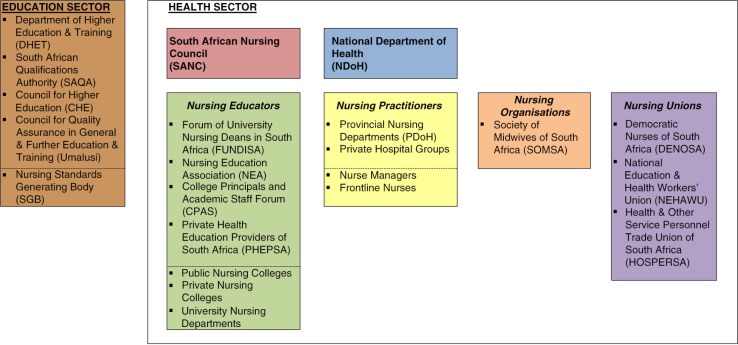
We used a policy analysis framework derived from Walt and Gilson that interrogated the context, content, actors, and processes of policy development and implementation. Following informed consent, in-depth interviews were conducted with 28 key informants from national and provincial government; the South African Nursing Council; the national nursing association; nursing academics, managers, and educators; and other nursing organisations. The interviews were complemented with a review of relevant legislation and policy documents. Documents and interview transcripts were coded thematically using Atlas-ti software.
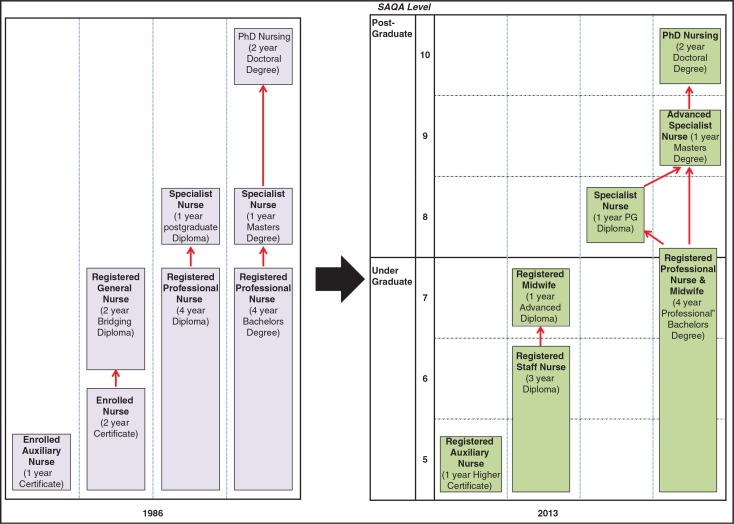
The revision of nursing qualifications was part of the post-apartheid transformation of nursing, but was also influenced by changes in the education sector. The policy process took more than 10 years to complete and the final Regulations were promulgated in 2013. The two most important changes are the requirement for a baccalaureate degree to qualify as a professional nurse and abolishing the enrolled nurse with 2 years training in favour of a staff nurse with a 3-year college diploma. Respondents criticised slow progress, weak governance by the Nursing Council and the Department of Health, limited planning for implementation, and the inappropriateness of the proposals for South Africa.
The study found significant weaknesses in the policy capacity of the main institutions responsible for the leadership and governance of nursing in South Africa, which will need to be addressed if important nursing education reforms are to be realised.
护理教育改革被视为提高卫生人力绩效、进而改善卫生系统运作的一项重要战略。在全球范围内,此类改革的一个主要趋势是走向更高的专业化和基于大学的教育。南非相关的护理教育改革在2013年形成了新的《护理资格框架》。
我们对南非新的护理资格框架的制定进行了一项政策分析研究。
我们使用了一个源自沃尔特和吉尔森的政策分析框架,该框架审视了政策制定与实施的背景、内容、行为主体和过程。在获得知情同意后,对来自国家和省级政府、南非护理理事会、全国护理协会、护理学者、管理人员和教育工作者以及其他护理组织的28名关键 informant 进行了深入访谈。访谈辅以对相关立法和政策文件的审查。使用阿特拉斯-ti软件对文件和访谈记录进行主题编码。
护理资格的修订是种族隔离后护理转型的一部分,但也受到教育部门变化的影响。政策制定过程耗时10多年,最终条例于2013年颁布。两个最重要的变化是要求具备学士学位才能成为专业护士,以及废除了经过2年培训的注册护士,转而支持拥有3年制大专文凭的 staff nurse。受访者批评进展缓慢、护理理事会和卫生部治理不力、实施规划有限以及这些提议对南非不适用。
该研究发现,在南非负责护理领导和治理的主要机构的政策能力存在重大弱点,如果要实现重要的护理教育改革,这些弱点需要得到解决。