Alliance for Research in Exercise, Nutrition and Activity (ARENA), Sansom Institute for Health Research, School of Health Sciences, University of South Australia, City East Campus, Adelaide, SA, Australia ; Respiratory Clinical Research Unit, Repatriation General Hospital, Daw Park, SA, Australia.
Respiratory Clinical Research Unit, Repatriation General Hospital, Daw Park, SA, Australia.
Int J Chron Obstruct Pulmon Dis. 2014 Dec 12;9:1377-88. doi: 10.2147/COPD.S74298. eCollection 2014.
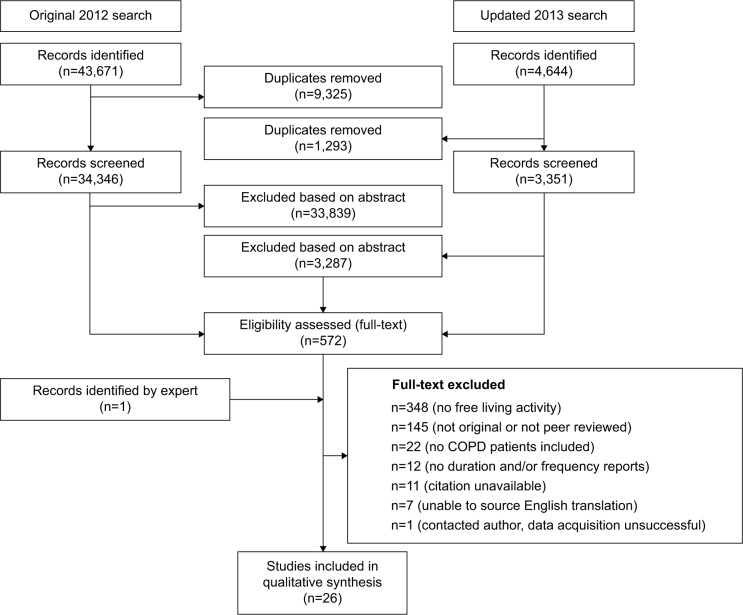
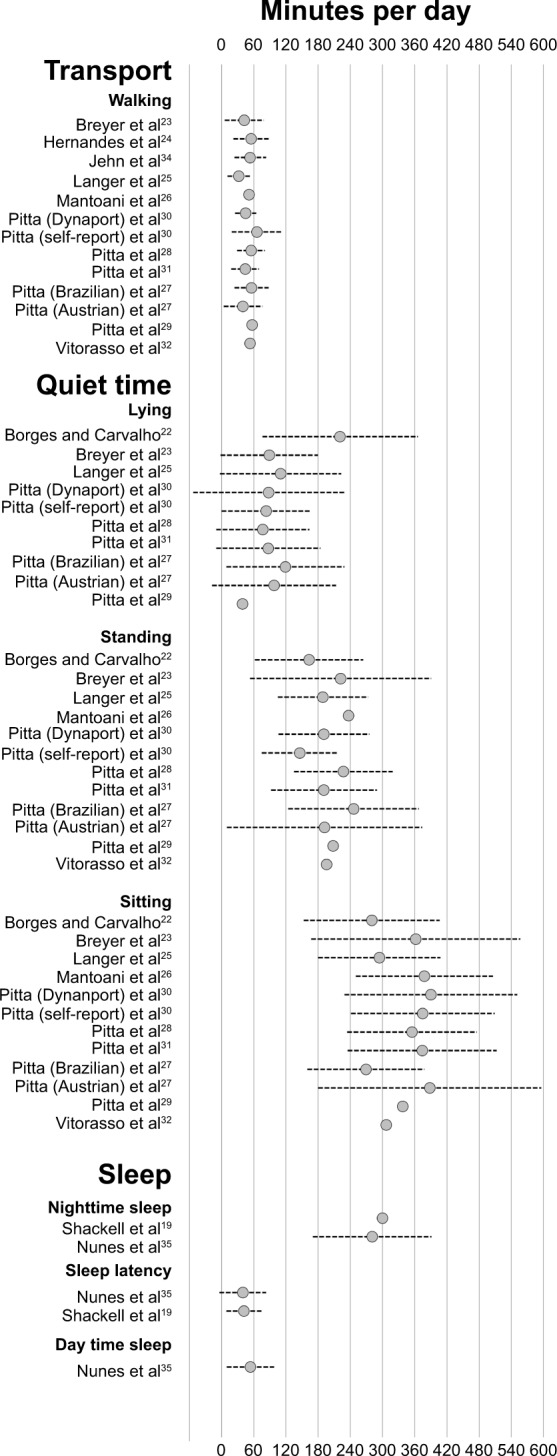
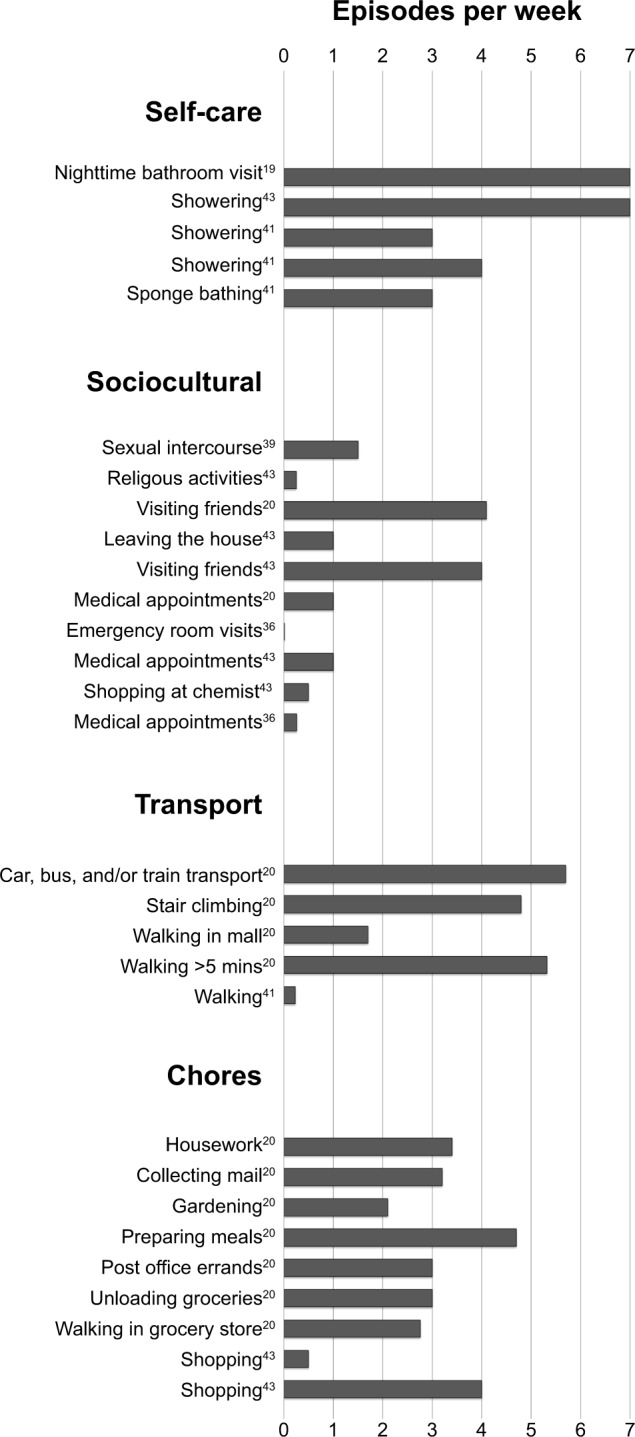
"Physical inactivity" and "sedentary lifestyles" are phrases often used when describing lifestyles of people with chronic obstructive pulmonary disease (COPD). Evidence suggests activity types, independent of energy expenditure, influence health outcomes, so understanding patterns of time use is important, particularly in chronic disease. We aimed to identify reports of time use in people with COPD. Predefined search strategies were used with six electronic databases to identify individual activity reports (including frequencies and/or durations) in which community-dwelling people with COPD engaged. Eligible studies were assessed independently against predefined criteria and data were extracted by two reviewers. Data synthesis was achieved by aggregating activity reports into activity domains (sports/exercise, screen time, transport, quiet time, self-care, sociocultural, work/study, chores, and sleep). Twenty-six publications reported 37 specific daily activities. People with COPD were found to spend extended periods in sedentary behaviors (eg, standing [194 min/day]; sitting [359 min/day]; lying [88 min/day]), have limited engagement in physical activity (eg, walking [51 min/day]; exercising [1.2 episodes per week {ep/w}, 13 min/day]), have high health care needs (medical appointments [1.0 ep/w]), and experience difficulties associated with activities of daily living (eg, showering [2.5 ep/w, 60 minutes per episode]; preparing meals [4.7 ep/w]). Little data could be found describing how people with COPD use their time, and data synthesis was problematic because of variations in methodologies, population differences, and research emphases. Identified data largely referred to posture and were skewed according to country, assessment methods, and disease severity. Comparisons with age-matched population data showed people with COPD spent less time engaged in personal-care activities (self-care and sleeping) and chores than people in similar age groups. The incorporation of time-use outcomes in future research designs should be encouraged. Ideally, these tools should use consistent frameworks and comparable outcome measures in order to provide clearer descriptions of time use in chronic disease.
“身体活动不足”和“久坐的生活方式”是描述慢性阻塞性肺疾病(COPD)患者生活方式时常用的短语。有证据表明,活动类型(独立于能量消耗)会影响健康结果,因此了解时间利用模式很重要,尤其是在慢性病中。我们旨在确定 COPD 患者的时间利用报告。使用六个电子数据库的预定义搜索策略来确定社区居住的 COPD 患者参与的个人活动报告(包括频率和/或持续时间)。符合条件的研究根据预定义标准进行独立评估,并由两名审查员提取数据。通过将活动报告汇总到活动领域(运动/锻炼、屏幕时间、交通、安静时间、自我护理、社会文化、工作/学习、家务和睡眠)来实现数据综合。26 篇出版物报告了 37 项特定的日常活动。发现 COPD 患者长时间处于久坐行为(例如,站立[194 分钟/天];坐着[359 分钟/天];躺着[88 分钟/天]),身体活动参与度有限(例如,散步[51 分钟/天];锻炼[每周 1.2 次,每次 13 分钟]),有较高的医疗保健需求(医疗预约[每周 1.0 次]),并且与日常生活活动相关的困难(例如,洗澡[每周 2.5 次,每次 60 分钟];准备饭菜[每周 4.7 次])。关于 COPD 患者如何利用时间的数据很少,并且由于方法学、人群差异和研究重点的不同,数据综合存在问题。确定的数据主要涉及姿势,并且根据国家、评估方法和疾病严重程度存在偏差。与年龄匹配的人群数据进行比较表明,COPD 患者用于个人护理活动(自我护理和睡眠)和家务的时间少于年龄相近的人群。应鼓励在未来的研究设计中纳入时间利用结果。理想情况下,这些工具应使用一致的框架和可比的结果衡量标准,以便更清楚地描述慢性病中的时间利用。