Guo Weisheng, Sun Xiaolian, Jacobson Orit, Yan Xuefeng, Min Kyunghyun, Srivatsan Avinash, Niu Gang, Kiesewetter Dale O, Chang Jin, Chen Xiaoyuan
School of Materials Science and Engineering, School of Life Sciences, Tianjin University , Tianjin 300072, China.
ACS Nano. 2015 Jan 27;9(1):488-95. doi: 10.1021/nn505660r. Epub 2015 Jan 2.
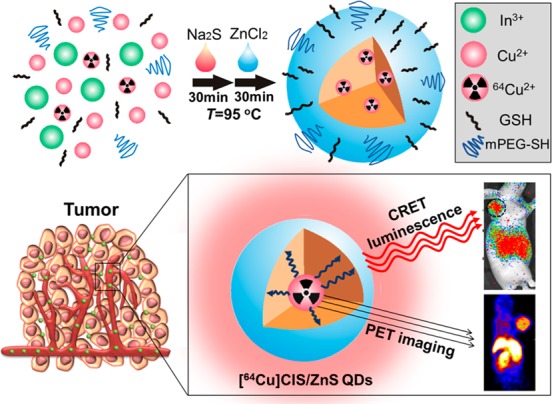
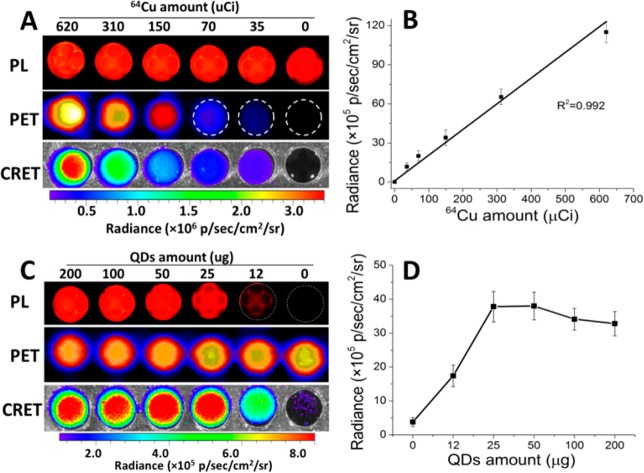
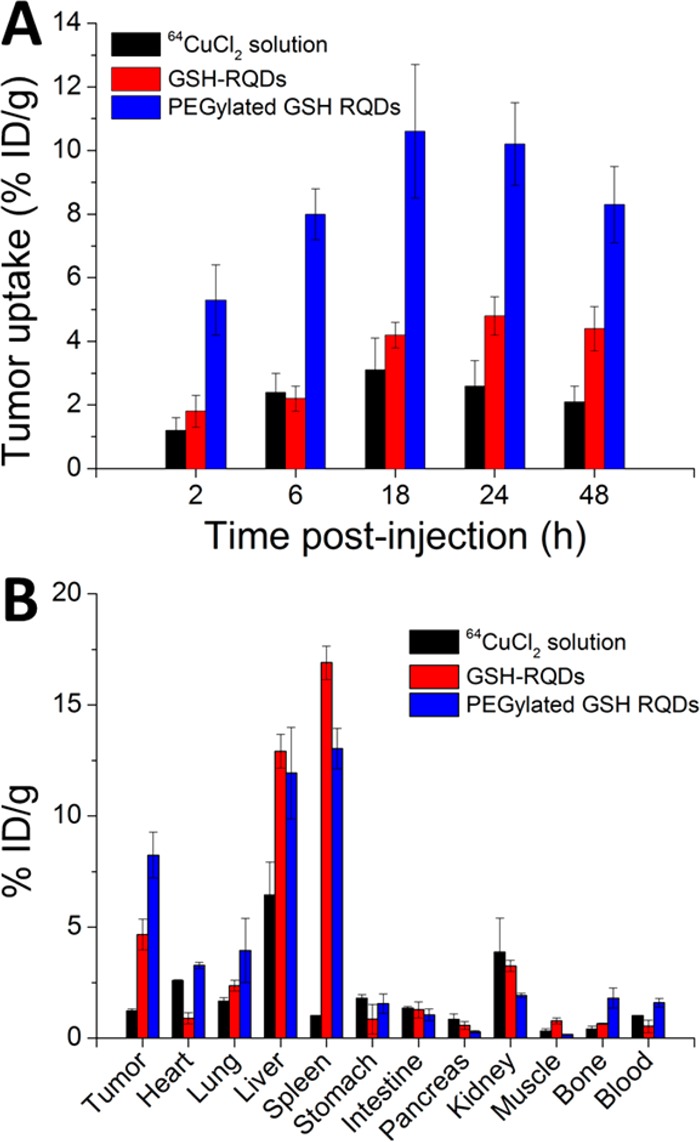
Functionalized quantum dots (QDs) have been widely explored for multimodality bioimaging and proven to be versatile agents. Attaching positron-emitting radioisotopes onto QDs not only endows their positron emission tomography (PET) functionality, but also results in self-illuminating QDs, with no need for an external light source, by Cerenkov resonance energy transfer (CRET). Traditional chelation methods have been used to incorporate the radionuclide, but these methods are compromised by the potential for loss of radionuclide due to cleavage of the linker between particle and chelator, decomplexation of the metal, and possible altered pharmacokinetics of nanomaterials. Herein, we described a straightforward synthesis of intrinsically radioactive [(64)Cu]CuInS/ZnS QDs by directly incorporating (64)Cu into CuInS/ZnS nanostructure with (64)CuCl2 as synthesis precursor. The [(64)Cu]CuInS/ZnS QDs demonstrated excellent radiochemical stability with less than 3% free (64)Cu detected even after exposure to serum containing EDTA (5 mM) for 24 h. PEGylation can be achieved in situ during synthesis, and the PEGylated radioactive QDs showed high tumor uptake (10.8% ID/g) in a U87MG mouse xenograft model. CRET efficiency was studied as a function of concentration and (64)Cu radioactivity concentration. These [(64)Cu]CuInS/ZnS QDs were successfully applied as an efficient PET/self-illuminating luminescence in vivo imaging agents.
功能化量子点(QDs)已被广泛用于多模态生物成像,并被证明是多功能试剂。将发射正电子的放射性同位素附着到量子点上,不仅赋予其正电子发射断层扫描(PET)功能,还通过切伦科夫共振能量转移(CRET)产生无需外部光源的自发光量子点。传统的螯合方法已用于掺入放射性核素,但这些方法存在缺陷,因为粒子与螯合剂之间的连接子断裂、金属解络以及纳米材料可能改变的药代动力学,导致放射性核素流失。在此,我们描述了一种直接合成本征放射性[(64)Cu]CuInS/ZnS量子点的方法,即将(64)CuCl2作为合成前体直接掺入CuInS/ZnS纳米结构中。[(64)Cu]CuInS/ZnS量子点表现出优异的放射化学稳定性,即使在暴露于含有EDTA(5 mM)的血清中24小时后,检测到的游离(64)Cu也不到3%。聚乙二醇化可以在合成过程中原位实现,并且聚乙二醇化的放射性量子点在U87MG小鼠异种移植模型中显示出高肿瘤摄取率(10.8% ID/g)。研究了CRET效率与浓度和(64)Cu放射性浓度的函数关系。这些[(64)Cu]CuInS/ZnS量子点已成功用作高效的PET/自发光体内成像剂。