Pigot Alex L, Etienne Rampal S
Centre for Ecological and Evolutionary Studies, University of Groningen, Box 11103, 9700 CC, Groningen, The Netherlands; Department of Zoology, Edward Grey Institute, University of Oxford, Oxford, OX1 3PS, UK.
Ecol Lett. 2015 Feb;18(2):153-63. doi: 10.1111/ele.12395. Epub 2015 Jan 6.
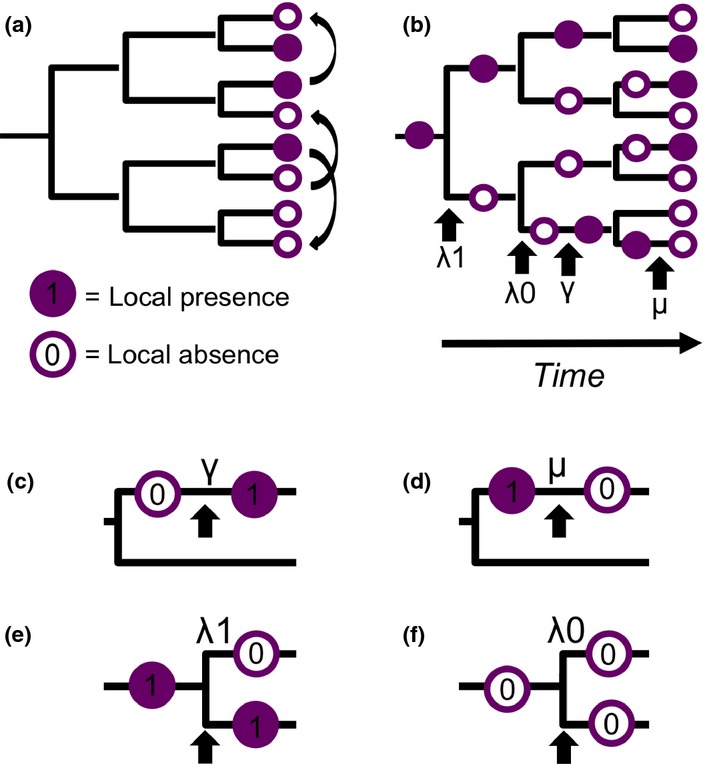
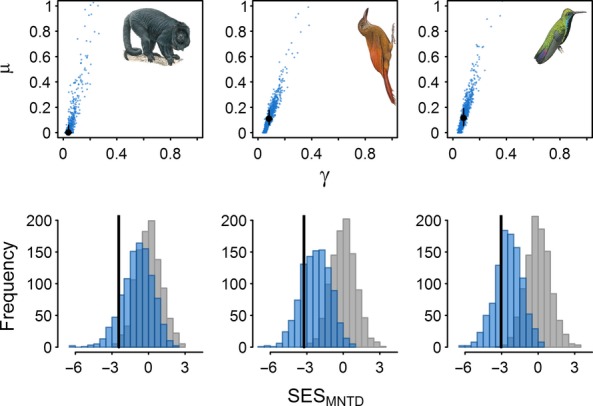
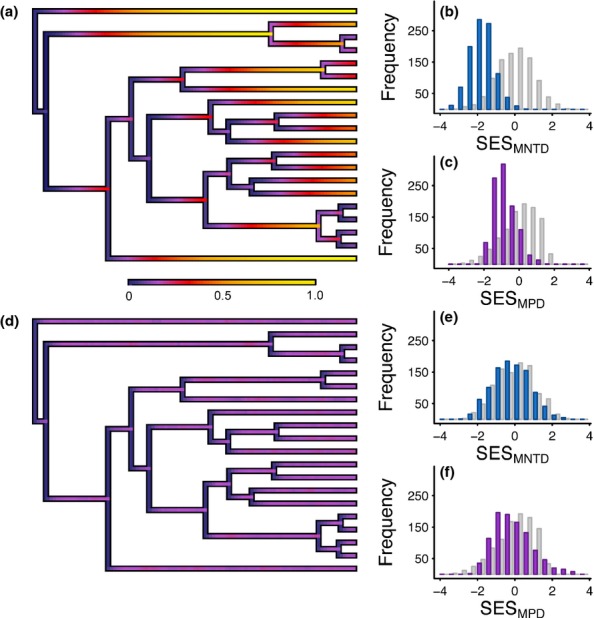
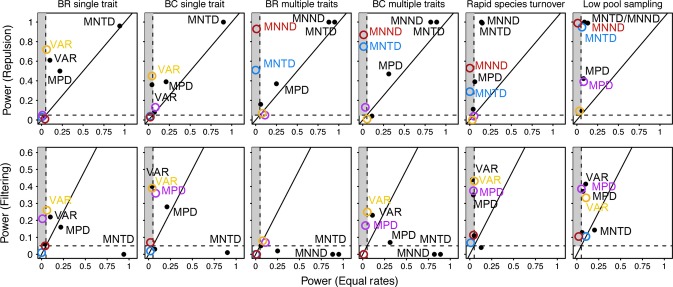
Phylogenies are increasingly applied to identify the mechanisms structuring ecological communities but progress has been hindered by a reliance on statistical null models that ignore the historical process of community assembly. Here, we address this, and develop a dynamic null model of assembly by allopatric speciation, colonisation and local extinction. Incorporating these processes fundamentally alters the structure of communities expected due to chance, with speciation leading to phylogenetic overdispersion compared to a classical statistical null model assuming equal probabilities of community membership. Applying this method to bird and primate communities in South America we show that patterns of phylogenetic overdispersion - often attributed to negative biotic interactions - are instead consistent with a species neutral model of allopatric speciation, colonisation and local extinction. Our findings provide a new null expectation for phylogenetic community patterns and highlight the importance of explicitly accounting for the dynamic history of assembly when testing the mechanisms governing community structure.
系统发育学越来越多地被用于识别构建生态群落的机制,但进展受到了依赖忽略群落组装历史过程的统计零模型的阻碍。在此,我们解决这一问题,并通过异域物种形成、殖民化和局部灭绝建立了一个动态的组装零模型。纳入这些过程从根本上改变了因偶然因素而预期的群落结构,与假设群落成员概率相等的经典统计零模型相比,物种形成导致系统发育过度分散。将这种方法应用于南美洲的鸟类和灵长类群落,我们发现,通常归因于负面生物相互作用的系统发育过度分散模式,反而与异域物种形成、殖民化和局部灭绝的物种中性模型一致。我们的研究结果为系统发育群落模式提供了新的零期望,并强调了在测试控制群落结构的机制时明确考虑组装动态历史的重要性。