Blanchet Simon, Rey Olivier, Etienne Roselyne, Lek Sovan, Loot Géraldine
Eco-Ex Moulis, Station d'Ecologie Experimentale du CNRS à Moulis U.S.R. 2936, Moulis, France ; Laboratoire Evolution et Diversité Biologique, U.M.R 5174, C.N.R.S - Université Paul Sabatier Toulouse cedex 4, France.
Laboratoire Evolution et Diversité Biologique, U.M.R 5174, C.N.R.S - Université Paul Sabatier Toulouse cedex 4, France ; Centre de Biologie et de Gestion des Populations, Campus International de Baillarguet Montferrier-sur-Lez Cedex, France.
Evol Appl. 2010 May;3(3):291-304. doi: 10.1111/j.1752-4571.2009.00110.x. Epub 2010 Jan 25.
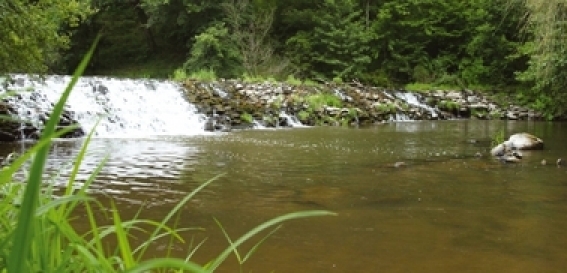
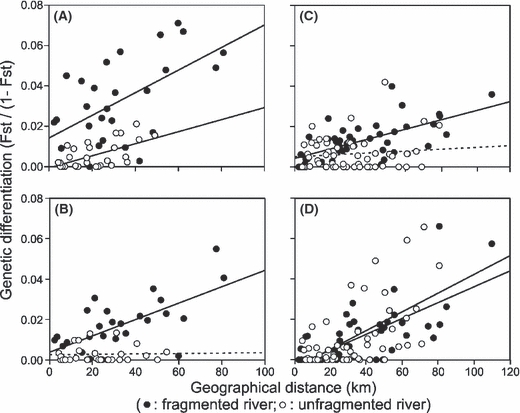
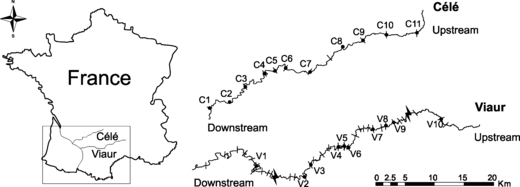
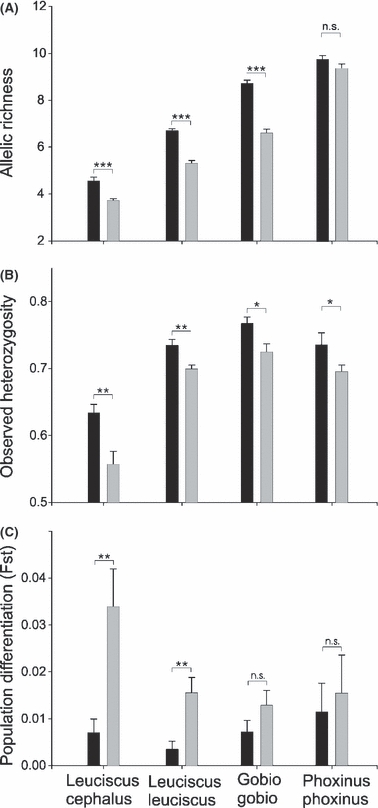
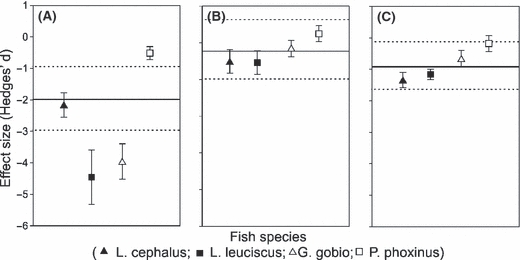
Habitat fragmentation affects the integrity of many species, but little is known about species-specific sensitivity to fragmentation. Here, we compared the genetic structure of four freshwater fish species differing in their body size (Leuciscus cephalus; Leuciscus leuciscus; Gobio gobio and Phoxinus phoxinus) between a fragmented and a continuous landscape. We tested if, overall, fragmentation affected the genetic structure of these fish species, and if these species differed in their sensitivity to fragmentation. Fragmentation negatively affected the genetic structure of these species. Indeed, irrespective of the species identity, allelic richness and heterozygosity were lower, and population divergence was higher in the fragmented than in the continuous landscape. This response to fragmentation was highly species-specific, with the smallest fish species (P. phoxinus) being slightly affected by fragmentation. On the contrary, fish species of intermediate body size (L. leuciscus and G. gobio) were highly affected, whereas the largest fish species (L. cephalus) was intermediately affected by fragmentation. We discuss the relative role of dispersal ability and effective population size on the responses to fragmentation we report here. The weirs studied here are of considerable historical importance. We therefore conclude that restoration programmes will need to consider both this societal context and the biological characteristics of the species sharing this ecosystem.
栖息地破碎化影响着许多物种的完整性,但对于物种对破碎化的特异性敏感性却知之甚少。在此,我们比较了四种体型各异的淡水鱼(欧洲圆腹雅罗鱼、拟赤梢鱼、吻鮈和湖拟鲤)在破碎化景观和连续景观中的遗传结构。我们检验了总体而言破碎化是否影响这些鱼类物种的遗传结构,以及这些物种对破碎化的敏感性是否存在差异。破碎化对这些物种的遗传结构产生了负面影响。实际上,无论物种种类如何,在破碎化景观中,等位基因丰富度和杂合度较低,而种群分化程度高于连续景观。这种对破碎化的反应具有高度的物种特异性,最小的鱼类物种(湖拟鲤)受破碎化的影响较小。相反,中等体型的鱼类物种(拟赤梢鱼和吻鮈)受到的影响很大,而最大的鱼类物种(欧洲圆腹雅罗鱼)受到的影响处于中等程度。我们讨论了扩散能力和有效种群大小在此处报告的对破碎化反应中的相对作用。此处研究的堰具有相当重要的历史意义。因此,我们得出结论,恢复计划需要同时考虑这一社会背景以及共享该生态系统的物种的生物学特性。