School of Medicine, Stanford University, Palo Alto, CA, United States.
JMIR Med Inform. 2014 Jan 17;2(1):e1. doi: 10.2196/medinform.2913.
In the past few decades, medically related data collection saw a huge increase, referred to as big data. These huge datasets bring challenges in storage, processing, and analysis. In clinical medicine, big data is expected to play an important role in identifying causality of patient symptoms, in predicting hazards of disease incidence or reoccurrence, and in improving primary-care quality.
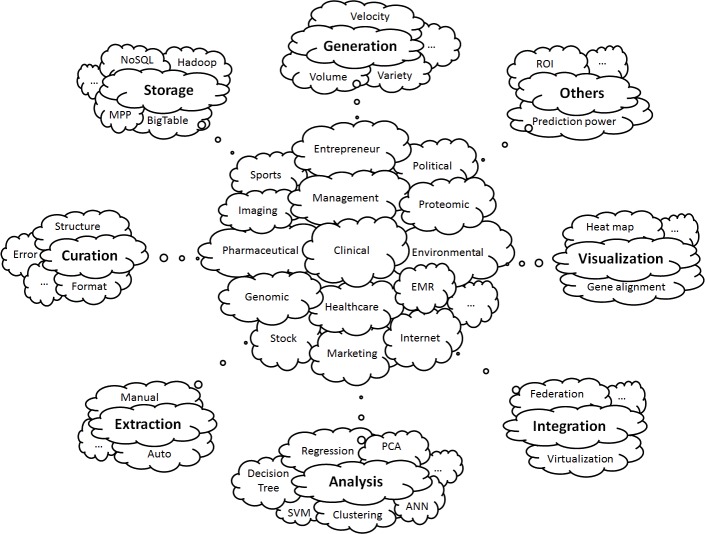
The objective of this review was to provide an overview of the features of clinical big data, describe a few commonly employed computational algorithms, statistical methods, and software toolkits for data manipulation and analysis, and discuss the challenges and limitations in this realm.
We conducted a literature review to identify studies on big data in medicine, especially clinical medicine. We used different combinations of keywords to search PubMed, Science Direct, Web of Knowledge, and Google Scholar for literature of interest from the past 10 years.
This paper reviewed studies that analyzed clinical big data and discussed issues related to storage and analysis of this type of data.
Big data is becoming a common feature of biological and clinical studies. Researchers who use clinical big data face multiple challenges, and the data itself has limitations. It is imperative that methodologies for data analysis keep pace with our ability to collect and store data.
在过去几十年中,医学相关数据的收集量大幅增加,这些大量数据集在存储、处理和分析方面带来了挑战。在临床医学中,大数据有望在确定患者症状的因果关系、预测疾病发病率或复发的危险以及提高初级保健质量方面发挥重要作用。
本综述的目的是概述临床大数据的特征,描述一些常用于数据处理和分析的计算算法、统计方法和软件工具包,并讨论该领域的挑战和局限性。
我们进行了文献综述,以确定医学,特别是临床医学中关于大数据的研究。我们使用不同的关键词组合在 PubMed、Science Direct、Web of Knowledge 和 Google Scholar 上搜索了过去 10 年中感兴趣的文献。
本文综述了分析临床大数据的研究,并讨论了与这类数据存储和分析相关的问题。
大数据正在成为生物学和临床研究的共同特征。使用临床大数据的研究人员面临着多个挑战,而且数据本身也存在局限性。数据分析方法必须与我们收集和存储数据的能力保持同步。