Korpela E, Vesprini D, Liu S K
1] Biological Sciences, Sunnybrook Health Sciences Centre, Sunnybrook Research Institute, 2075 Bayview Avenue, Toronto, Ontario, Canada M4N 3M5 [2] Department of Medical Biophysics, University of Toronto, Toronto, Ontario, Canada M5G 1L7.
1] Biological Sciences, Sunnybrook Health Sciences Centre, Sunnybrook Research Institute, 2075 Bayview Avenue, Toronto, Ontario, Canada M4N 3M5 [2] Department of Radiation Oncology, University of Toronto, Toronto, Ontario, Canada M5T 1P5 [3] Odette Cancer Centre, Sunnybrook Health Sciences Centre, 2075 Bayview Avenue, Toronto, Ontario, Canada M4N 3M5.
Br J Cancer. 2015 Mar 3;112(5):777-82. doi: 10.1038/bjc.2015.6. Epub 2015 Jan 22.
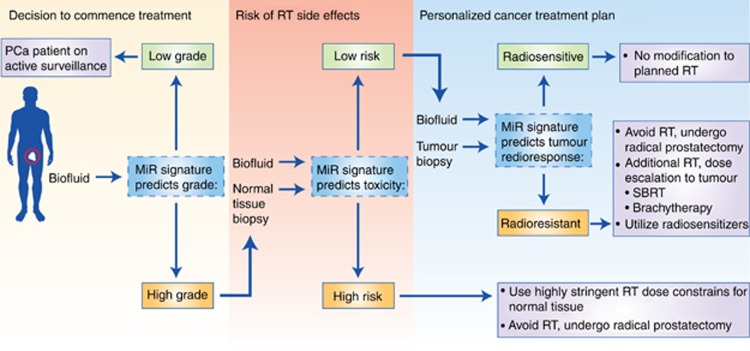
At least half of all cancer patients will receive radiation therapy. Tumour radioresistance, or the failure to control certain tumours with this treatment, can result in locoregional recurrence; thus there is great interest in understanding the underlying biology and developing strategies to overcome this problem. The expanding investigation of microRNA in cancer suggests that these regulatory factors can influence the DNA damage response, the microenvironment and survival pathways, among other processes, and thereby may affect tumour radioresistance. As microRNA are readily detectable in tumours and biofluids, they hold promise as predictive biomarkers for therapy response and prognosis. This review highlights the current insights on the major ways that microRNA may contribute to tumour radiation response and whether their levels reflect treatment success. We conclude by applying the potential framework of future roles of miR in personalised radiotherapy using prostate cancer clinical management as an example.
至少一半的癌症患者将接受放射治疗。肿瘤放射抗性,即使用这种治疗方法无法控制某些肿瘤,可导致局部区域复发;因此,人们对了解其潜在生物学机制并制定克服这一问题的策略有着浓厚兴趣。对癌症中微小RNA的研究不断扩展,表明这些调节因子可影响DNA损伤反应、微环境和生存途径等多个过程,进而可能影响肿瘤放射抗性。由于微小RNA在肿瘤和生物流体中易于检测,它们有望成为治疗反应和预后的预测生物标志物。本综述重点介绍了关于微小RNA可能影响肿瘤放射反应的主要方式以及它们的水平是否反映治疗成功的当前见解。我们以前列腺癌临床管理为例,应用miR在个性化放疗中未来作用的潜在框架进行总结。