Seipke Ryan F
School of Molecular and Cellular Biology, University of Leeds, Leeds, LS2 9JT, United Kingdom.
PLoS One. 2015 Jan 30;10(1):e0116457. doi: 10.1371/journal.pone.0116457. eCollection 2015.
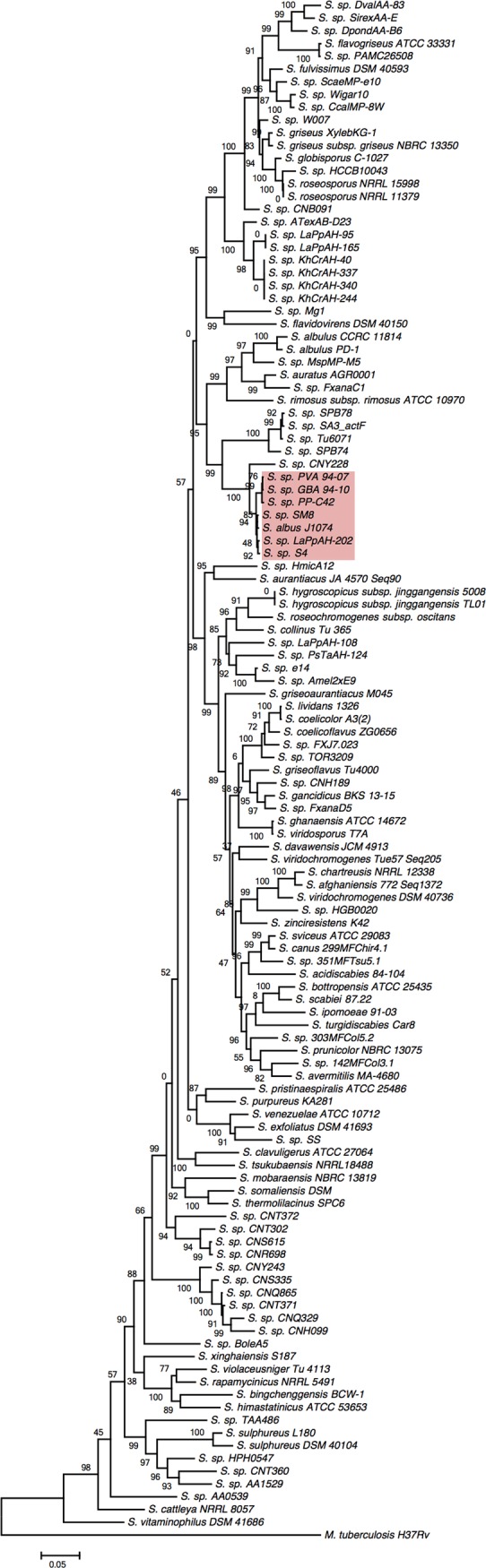
Streptomyces spp. are robust producers of medicinally-, industrially- and agriculturally-important small molecules. Increased resistance to antibacterial agents and the lack of new antibiotics in the pipeline have led to a renaissance in natural product discovery. This endeavor has benefited from inexpensive high quality DNA sequencing technology, which has generated more than 140 genome sequences for taxonomic type strains and environmental Streptomyces spp. isolates. Many of the sequenced streptomycetes belong to the same species. For instance, Streptomyces albus has been isolated from diverse environmental niches and seven strains have been sequenced, consequently this species has been sequenced more than any other streptomycete, allowing valuable analyses of strain-level diversity in secondary metabolism. Bioinformatics analyses identified a total of 48 unique biosynthetic gene clusters harboured by Streptomyces albus strains. Eighteen of these gene clusters specify the core secondary metabolome of the species. Fourteen of the gene clusters are contained by one or more strain and are considered auxiliary, while 16 of the gene clusters encode the production of putative strain-specific secondary metabolites. Analysis of Streptomyces albus strains suggests that each strain of a Streptomyces species likely harbours at least one strain-specific biosynthetic gene cluster. Importantly, this implies that deep sequencing of a species will not exhaust gene cluster diversity and will continue to yield novelty.
链霉菌属是药用、工业和农业重要小分子的强大生产者。对抗菌剂耐药性的增加以及研发中新抗生素的缺乏,导致了天然产物发现的复兴。这一努力受益于廉价的高质量DNA测序技术,该技术已为分类学模式菌株和环境链霉菌属分离株生成了140多个基因组序列。许多已测序的链霉菌属于同一物种。例如,白色链霉菌已从不同的环境生态位中分离出来,并且有7个菌株已被测序,因此该物种的测序次数超过了任何其他链霉菌,从而能够对次级代谢中的菌株水平多样性进行有价值的分析。生物信息学分析确定白色链霉菌菌株总共含有48个独特的生物合成基因簇。其中18个基因簇指定了该物种的核心次级代谢组。14个基因簇被一个或多个菌株所包含,被认为是辅助性的,而16个基因簇编码假定的菌株特异性次级代谢产物的产生。对白色链霉菌菌株的分析表明,链霉菌属的每个菌株可能至少含有一个菌株特异性生物合成基因簇。重要的是,这意味着对一个物种进行深度测序不会耗尽基因簇的多样性,并且将继续产生新的发现。