Barnett S F, Friedman D L, LeStourgeon W M
Department of Molecular Biology, Vanderbilt University, Nashville, Tennessee 37235.
Mol Cell Biol. 1989 Feb;9(2):492-8. doi: 10.1128/mcb.9.2.492-498.1989.
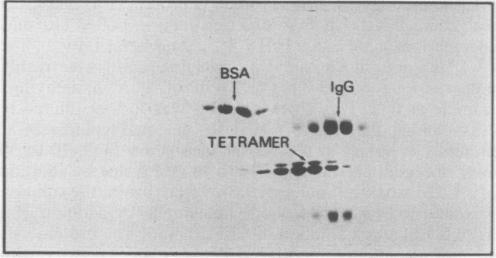
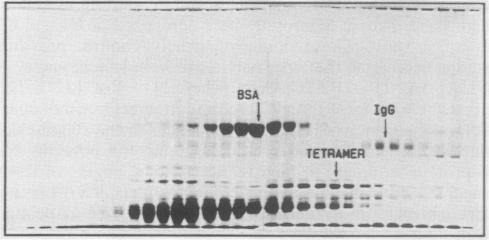
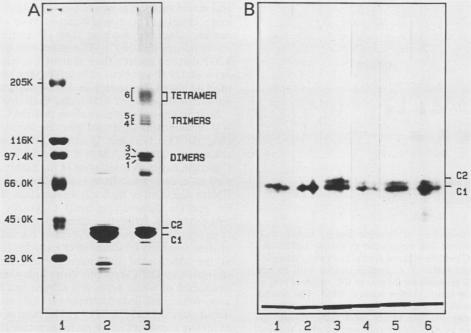
The C proteins (C1 and C2) of HeLa 40S heterogeneous nuclear ribonucleoprotein particles copurify under native conditions as a stable complex with a fixed molar protein ratio (S.F. Barnett, W.M. LeStourgeon, and D.L. Friedman, J. Biochem. Biophys. Methods 16:87-97, 1988). Gel filtration chromatography and velocity sedimentation analyses of these complexes revealed a large Stokes radius (6.2 nm) and a sedimentation coefficient of 5.8S. On the basis of these values and a partial specific volume of 0.70 cm3/g based on the amino acid composition, the molecular weight of the complex was calculated to be 135,500. This corresponds well to 129,056, the sequence-determined molecular weight of a (C1)3C2 tetramer. Reversible chemical cross-linking with dithiobis(succinimidyl propionate) and analysis of cross-linked and cleaved complexes in sodium dodecyl sulfate-polyacrylamide gel electrophoresis confirmed that the C proteins exist as tetramers, most or all of which are composed of (C1)3C2. The tetramer is stable in a wide range of NaCl concentrations (0.09 to 2.0 M) and is not dissociated by 0.5% sodium deoxycholate. This stability is not the result of disulfide bonds or interactions with divalent cations. The hydrodynamic properties of highly purified C-protein tetramers are the same for C-protein complexes released from intact particles with RNase or high salt. These findings support previous studies indicating that the core particle protein stoichiometry of 40S heterogeneous nuclear ribonucleoproteins is N(3A1-3A2-1B1-1B2-3C1-1C2), where N = 3 to 4, and demonstrate that the C-protein tetramer is a fundamental structural element in these RNA-packaging complexes. The presence of at least three tetramers per 40S monoparticle, together with the highly anisotropic nature of the tetramer, suggesting that one-third of the 700-nucleotide pre-mRNA moiety packaged in monoparticles is associated through a sequence-independent mechanism with the C protein.
海拉细胞40S异质性核核糖核蛋白颗粒中的C蛋白(C1和C2)在天然条件下与一种固定摩尔蛋白比的稳定复合物共纯化(S.F. 巴尼特、W.M. 勒斯特尔金和D.L. 弗里德曼,《生物化学与生物物理方法杂志》16:87 - 97,1988年)。对这些复合物进行凝胶过滤色谱和速度沉降分析,结果显示其斯托克斯半径较大(6.2纳米),沉降系数为5.8S。基于这些数值以及根据氨基酸组成得出的0.70立方厘米/克的偏比容,计算出该复合物的分子量为135,500。这与通过序列测定的(C1)3C2四聚体分子量129,056相当吻合。用二硫代双(琥珀酰亚胺丙酸酯)进行可逆化学交联,并在十二烷基硫酸钠 - 聚丙烯酰胺凝胶电泳中分析交联和裂解后的复合物,证实C蛋白以四聚体形式存在,其中大部分或全部由(C1)3C2组成。该四聚体在很宽的NaCl浓度范围(0.09至2.0 M)内稳定,并且不会被0.5%的脱氧胆酸钠解离。这种稳定性并非二硫键或与二价阳离子相互作用的结果。从完整颗粒中用核糖核酸酶或高盐释放出的C蛋白复合物与高度纯化的C蛋白四聚体的流体动力学性质相同。这些发现支持了先前的研究,这些研究表明40S异质性核核糖核蛋白的核心颗粒蛋白化学计量比为N(3A1 - 3A2 - 1B1 - 1B2 - 3C1 - 1C2),其中N = 3至4,并证明C蛋白四聚体是这些RNA包装复合物中的基本结构元件。每个40S单颗粒中至少存在三个四聚体,再加上四聚体高度各向异性的性质,这表明包装在单颗粒中的700个核苷酸前体mRNA部分的三分之一是通过一种不依赖序列的机制与C蛋白相关联的。