Welk Gregory J, Kim Youngwon
Department of Kinesiology, Iowa State University, Ames, IA.
Med Sci Sports Exerc. 2015 Oct;47(10):2102-10. doi: 10.1249/MSS.0000000000000641.
The establishment of formal physical activity (PA) guidelines has led to considerable interest in quantifying participation in moderate to vigorous PA (MVPA). However, evidence on the context of MVPA at the population level is scarce. The aim of this study was to provide information on the type, location, and purpose of MVPA in a representative sample of adults.
Data from a representative sample of 1234 Iowa adults were included in this study. Each participant performed a telephone-administered 24-h PA recall method to recall PA in the previous 24 h. Self-reported data from the recall instrument included time and types of reported activities across five distinct location and purpose codes. Reported activities were matched with corresponding metabolic equivalent (MET) scores from a reduced list of compendium of physical activities. MVPA was defined as any activity with assigned MET ≥ 3.0.
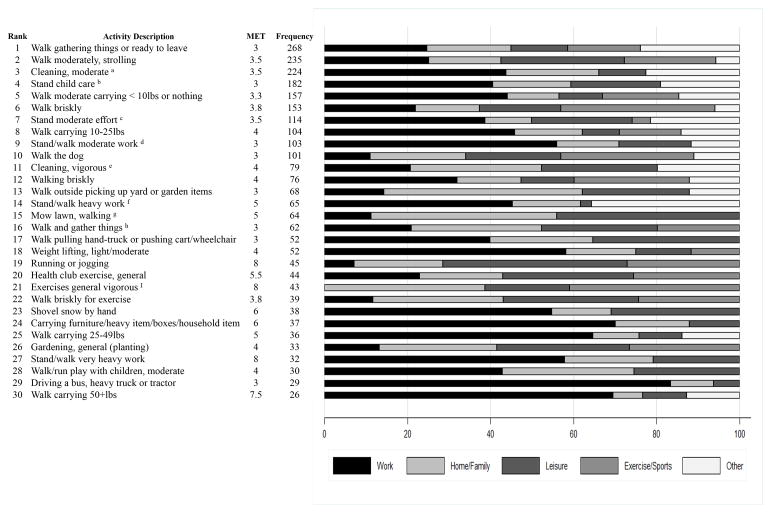
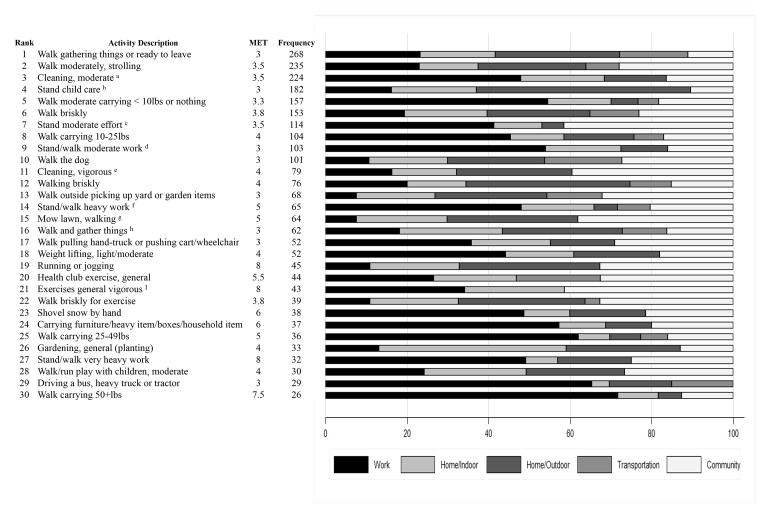
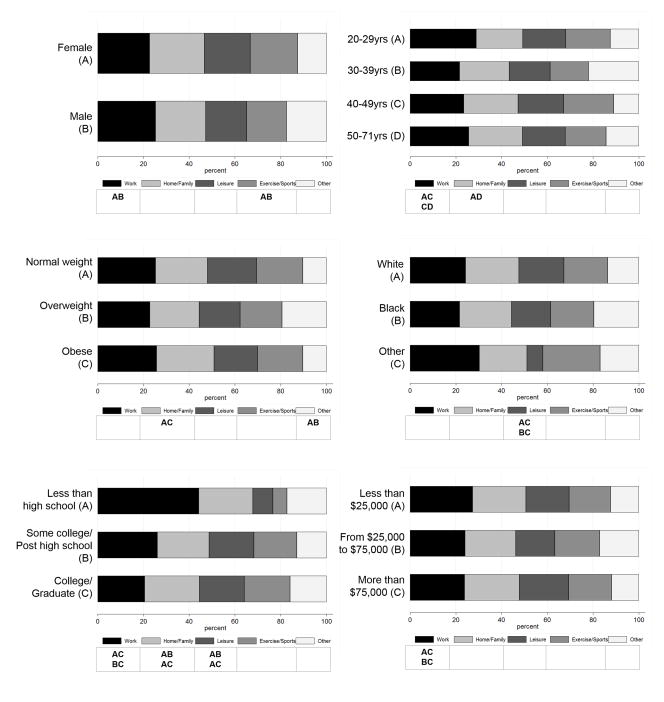
Of the top 30 most frequently reported MVPA, 16 were lifestyle activities involving walking, and only 4 can be regarded as traditional "exercises." Occupational activities (41% for purpose and 40% for location) and household activities (37% for purpose and 39% for location) accounted for nearly 80% of total reported MVPA time. Time allocations across purpose and location codes considerably differed by sociodemographic indicators.
Lifestyle activities are more frequently reported than sports and/or recreational activities. Individuals with varying levels of sociodemographic indicators exhibit different patterns of use of time within a given day. A multidomain approach is needed to better understand and increase MVPA in diverse populations of US adults.
正式体育活动(PA)指南的制定引发了人们对量化中度至剧烈体育活动(MVPA)参与情况的浓厚兴趣。然而,关于人群层面MVPA背景的证据却很匮乏。本研究的目的是提供有关成年人代表性样本中MVPA的类型、地点和目的的信息。
本研究纳入了来自爱荷华州1234名成年人的代表性样本数据。每位参与者通过电话进行了24小时体育活动回忆法,以回忆前24小时内的体育活动。回忆工具中的自我报告数据包括跨越五个不同地点和目的代码的报告活动的时间和类型。报告的活动与体育活动简编简化列表中的相应代谢当量(MET)得分相匹配。MVPA被定义为任何指定MET≥3.0的活动。
在最常报告的30项MVPA中,16项是涉及步行的生活方式活动,只有4项可被视为传统的“锻炼”。职业活动(目的占41%,地点占40%)和家务活动(目的占37%,地点占39%)占报告的MVPA总时间的近80%。不同社会人口统计学指标在目的和地点代码上的时间分配差异很大。
生活方式活动的报告频率高于体育和/或娱乐活动。不同社会人口统计学指标水平的个体在一天内表现出不同的时间使用模式。需要一种多领域方法来更好地理解和增加美国成年人群体中的MVPA。