Boaru Sorina Georgiana, Merle Uta, Uerlings Ricarda, Zimmermann Astrid, Flechtenmacher Christa, Willheim Claudia, Eder Elisabeth, Ferenci Peter, Stremmel Wolfgang, Weiskirchen Ralf
Institute of Molecular Pathobiochemistry, Experimental Gene Therapie and Clinical Chemistry, RWTH Aachen University Hospital Aachen, Aachen, Germany.
J Cell Mol Med. 2015 Apr;19(4):806-14. doi: 10.1111/jcmm.12497. Epub 2015 Feb 20.
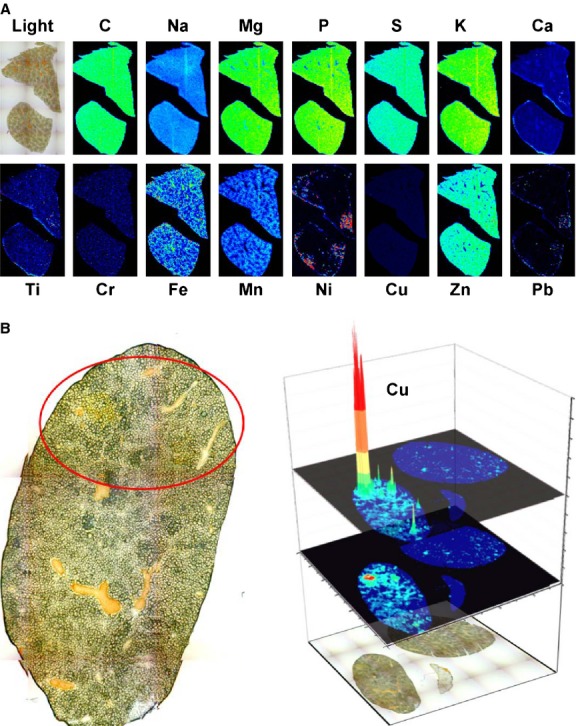
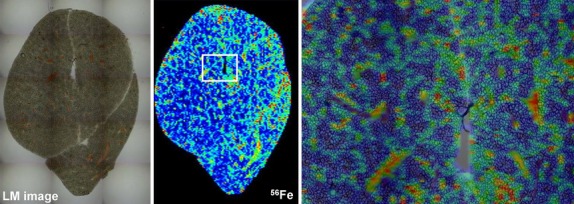
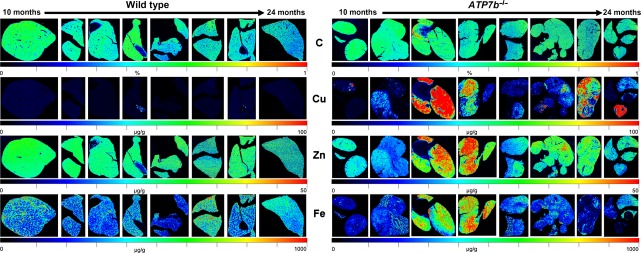
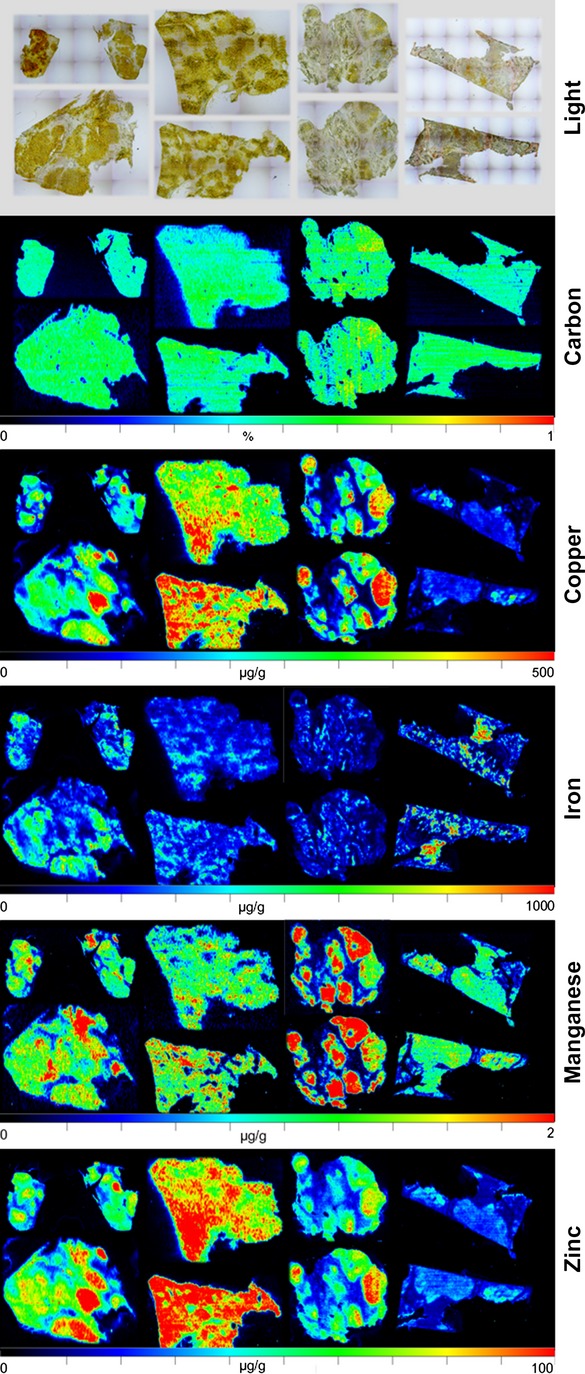
Wilson's disease is an autosomal recessive disorder in which the liver does not properly release copper into bile, resulting in prominent copper accumulation in various tissues. Affected patients suffer from hepatic disorders and severe neurological defects. Experimental studies in mutant mice in which the copper-transporting ATPase gene (Atp7b) is disrupted revealed a drastic, time-dependent accumulation of hepatic copper that is accompanied by formation of regenerative nodes resembling cirrhosis. Therefore, these mice represent an excellent exploratory model for Wilson's disease. However, the precise time course in hepatic copper accumulation and its impact on other trace metals within the liver is yet poorly understood. We have recently established novel laser ablation inductively coupled plasma mass spectrometry protocols allowing quantitative metal imaging in human and murine liver tissue with high sensitivity, spatial resolution, specificity and quantification ability. By use of these techniques, we here aimed to comparatively analyse hepatic metal content in wild-type and Atp7b deficient mice during ageing. We demonstrate that the age-dependent accumulation of hepatic copper is strictly associated with a simultaneous increase in iron and zinc, while the intrahepatic concentration and distribution of other metals or metalloids is not affected. The same findings were obtained in well-defined human liver samples that were obtained from patients suffering from Wilson's disease. We conclude that in Wilson's disease the imbalances of hepatic copper during ageing are closely correlated with alterations in intrahepatic iron and zinc content.
威尔逊氏病是一种常染色体隐性疾病,肝脏无法将铜正常释放到胆汁中,导致各种组织中铜显著蓄积。患病患者会出现肝脏疾病和严重的神经缺陷。对铜转运ATP酶基因(Atp7b)被破坏的突变小鼠进行的实验研究表明,肝脏铜会急剧、随时间蓄积,并伴有类似肝硬化的再生结节形成。因此,这些小鼠是威尔逊氏病的优良探索模型。然而,肝脏铜蓄积的确切时间进程及其对肝脏内其他痕量金属的影响仍知之甚少。我们最近建立了新型激光烧蚀电感耦合等离子体质谱分析方法,可在人和小鼠肝脏组织中进行高灵敏度、高空间分辨率、高特异性和高定量能力的金属定量成像。利用这些技术,我们旨在比较分析野生型和Atp7b缺陷型小鼠在衰老过程中的肝脏金属含量。我们证明,肝脏铜随年龄增长的蓄积与铁和锌的同时增加密切相关,而其他金属或类金属在肝脏内的浓度和分布不受影响。从威尔逊氏病患者获取的明确人肝脏样本也得到了相同的结果。我们得出结论,在威尔逊氏病中,衰老过程中肝脏铜的失衡与肝脏内铁和锌含量的改变密切相关。