Sun Huihua, Liu Zihe, Zhao Huimin, Ang Ee Lui
Metabolic Engineering Research Laboratory, Institute of Chemical and Engineering Sciences, Agency for Science, Technology and Research, Singapore.
Metabolic Engineering Research Laboratory, Institute of Chemical and Engineering Sciences, Agency for Science, Technology and Research, Singapore ; Department of Chemical and Biomolecular Engineering, University of Illinois at Urbana-Champaign, Urbana, IL, USA.
Drug Des Devel Ther. 2015 Feb 12;9:823-33. doi: 10.2147/DDDT.S63023. eCollection 2015.
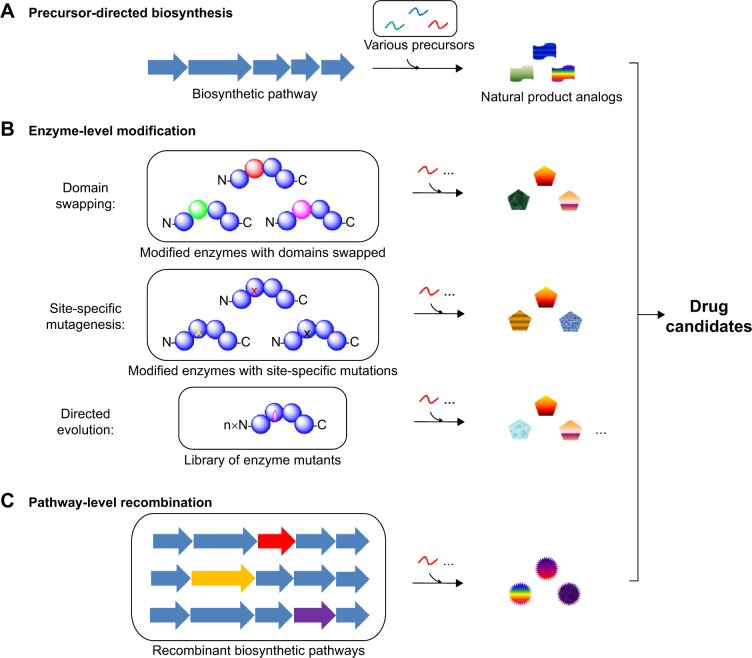
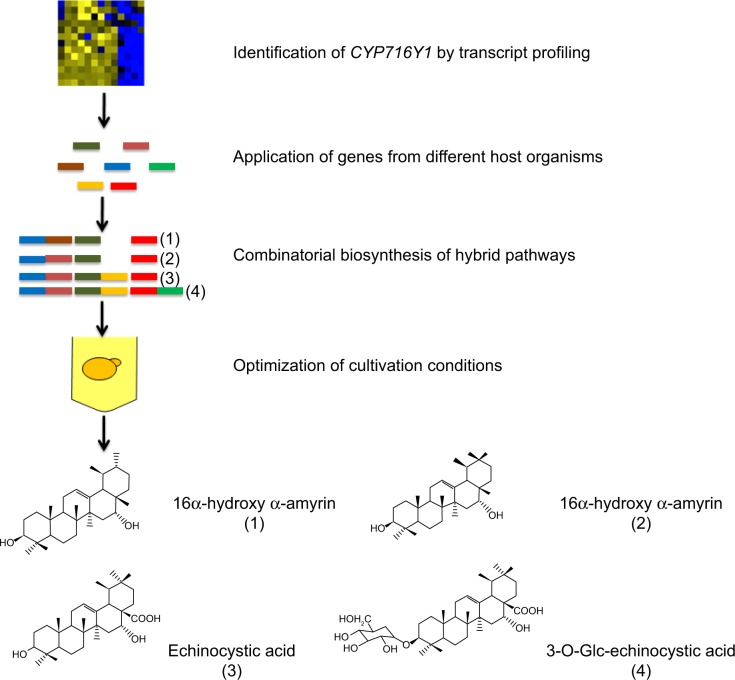
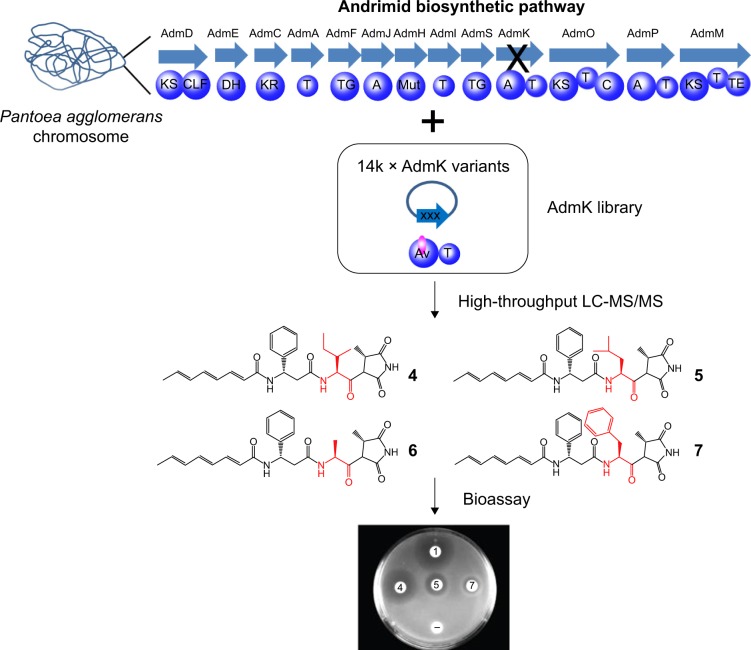
Because of extraordinary structural diversity and broad biological activities, natural products have played a significant role in drug discovery. These therapeutically important secondary metabolites are assembled and modified by dedicated biosynthetic pathways in their host living organisms. Traditionally, chemists have attempted to synthesize natural product analogs that are important sources of new drugs. However, the extraordinary structural complexity of natural products sometimes makes it challenging for traditional chemical synthesis, which usually involves multiple steps, harsh conditions, toxic organic solvents, and byproduct wastes. In contrast, combinatorial biosynthesis exploits substrate promiscuity and employs engineered enzymes and pathways to produce novel "unnatural" natural products, substantially expanding the structural diversity of natural products with potential pharmaceutical value. Thus, combinatorial biosynthesis provides an environmentally friendly way to produce natural product analogs. Efficient expression of the combinatorial biosynthetic pathway in genetically tractable heterologous hosts can increase the titer of the compound, eventually resulting in less expensive drugs. In this review, we will discuss three major strategies for combinatorial biosynthesis: 1) precursor-directed biosynthesis; 2) enzyme-level modification, which includes swapping of the entire domains, modules and subunits, site-specific mutagenesis, and directed evolution; 3) pathway-level recombination. Recent examples of combinatorial biosynthesis employing these strategies will also be highlighted in this review.
由于具有非凡的结构多样性和广泛的生物活性,天然产物在药物发现中发挥了重要作用。这些具有重要治疗意义的次生代谢产物在其宿主生物体中通过专门的生物合成途径进行组装和修饰。传统上,化学家们试图合成作为新药重要来源的天然产物类似物。然而,天然产物非凡的结构复杂性有时使得传统化学合成具有挑战性,传统化学合成通常涉及多个步骤、苛刻的条件、有毒的有机溶剂和副产物废物。相比之下,组合生物合成利用底物的混杂性,并采用工程化酶和途径来生产新型“非天然”天然产物,极大地扩展了具有潜在药用价值的天然产物的结构多样性。因此,组合生物合成提供了一种生产天然产物类似物的环境友好方式。在易于进行基因操作的异源宿主中高效表达组合生物合成途径可以提高化合物的产量,最终带来成本更低的药物。在这篇综述中,我们将讨论组合生物合成的三种主要策略:1)前体导向生物合成;2)酶水平修饰,包括整个结构域、模块和亚基的交换、位点特异性诱变和定向进化;3)途径水平重组。本综述还将重点介绍采用这些策略的组合生物合成的最新实例。