Seidl Rupert
Institute of Silviculture, in the Department of Forest and Soil Sciences at the University of Natural Resources and Life Sciences (BOKU), in Vienna, Austria.
Bioscience. 2014 Dec 1;64(12):1159-1169. doi: 10.1093/biosci/biu172.
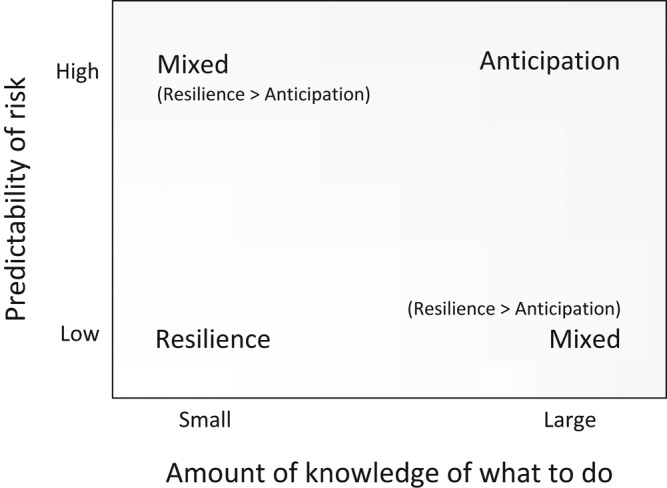
Global change is increasingly challenging the sustainable provisioning of ecosystem services to society. Addressing future uncertainty and risk has therefore become a central problem of ecosystem management. With risk management and resilience-based stewardship, two contrasting approaches have been proposed to address this issue. Whereas one is concentrated on anticipating and mitigating risks, the other is focused on fostering the ability to absorb perturbations and maintain desired properties. While they have hitherto been discussed largely separately in the literature, I here propose a unifying framework of anticipating risks and fostering resilience in ecosystem management. Anticipatory action is advocated when the predictability of risk is high and sufficient knowledge to address it is available. Conversely, in situations in which predictability and knowledge are limited, resilience-based measures are paramount. I conclude that, by adopting a purposeful combination of insights from risk and resilience research, we can make ecosystem services provisioning more robust to future uncertainty and change.
全球变化正对生态系统服务向社会的可持续供应构成越来越大的挑战。因此,应对未来的不确定性和风险已成为生态系统管理的核心问题。针对这一问题,人们提出了风险管理和基于恢复力的管理这两种截然不同的方法。一种方法专注于预测和减轻风险,另一种则侧重于培养吸收干扰并维持理想特性的能力。虽然它们迄今在文献中大多是分开讨论的,但我在此提出一个在生态系统管理中预测风险和培养恢复力的统一框架。当风险的可预测性高且有足够的知识来应对时,提倡采取前瞻性行动。相反,在可预测性和知识有限的情况下,基于恢复力的措施至关重要。我得出结论,通过有目的地结合风险和恢复力研究的见解,我们可以使生态系统服务的供应对未来的不确定性和变化更具韧性。