Albuquerque Fabio, Beier Paul
School of Forestry, Northern Arizona University, Flagstaff, Arizona, United States of America.
PLoS One. 2015 Mar 17;10(3):e0119905. doi: 10.1371/journal.pone.0119905. eCollection 2015.
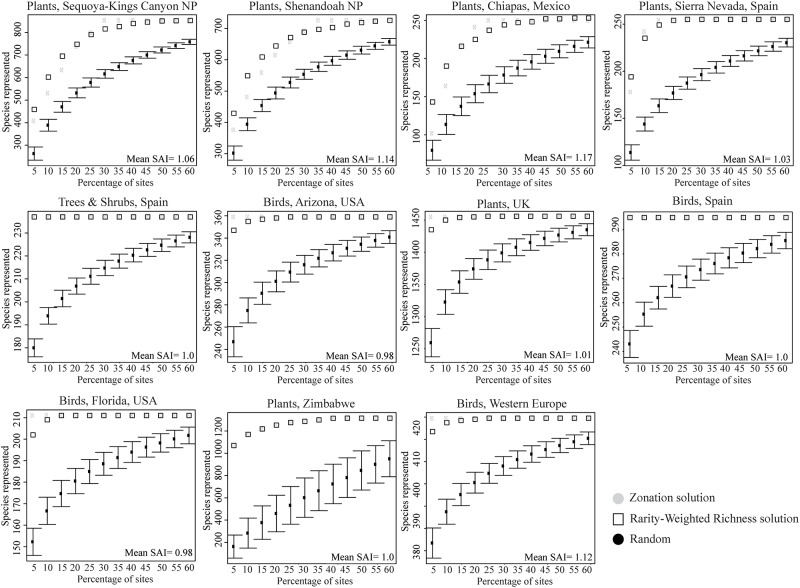
Here we report that prioritizing sites in order of rarity-weighted richness (RWR) is a simple, reliable way to identify sites that represent all species in the fewest number of sites (minimum set problem) or to identify sites that represent the largest number of species within a given number of sites (maximum coverage problem). We compared the number of species represented in sites prioritized by RWR to numbers of species represented in sites prioritized by the Zonation software package for 11 datasets in which the size of individual planning units (sites) ranged from <1 ha to 2,500 km2. On average, RWR solutions were more efficient than Zonation solutions. Integer programming remains the only guaranteed way find an optimal solution, and heuristic algorithms remain superior for conservation prioritizations that consider compactness and multiple near-optimal solutions in addition to species representation. But because RWR can be implemented easily and quickly in R or a spreadsheet, it is an attractive alternative to integer programming or heuristic algorithms in some conservation prioritization contexts.
在此我们报告,按照稀有度加权丰富度(RWR)对地点进行排序,是一种简单、可靠的方法,可用于识别以最少数量的地点代表所有物种的地点(最小集问题),或识别在给定数量的地点内代表最多物种的地点(最大覆盖问题)。我们将通过RWR排序的地点中所代表的物种数量,与通过Zonation软件包排序的地点中所代表的物种数量进行了比较,这些地点来自11个数据集,其中各个规划单元(地点)的面积范围从小于1公顷到2500平方公里。平均而言,RWR解决方案比Zonation解决方案更有效。整数规划仍然是找到最优解的唯一有保证的方法,而启发式算法在保护优先级排序方面仍然更具优势,这种排序除了考虑物种代表性之外,还考虑紧凑性和多个接近最优的解决方案。但是由于RWR可以在R语言或电子表格中轻松快速地实现,因此在某些保护优先级排序的情况下,它是整数规划或启发式算法的一个有吸引力的替代方案。