Culbertson Jennifer, Newport Elissa L
Linguistics and English Language, The University of Edinburgh, Edinburgh EH8 9AD, UK.
Center for Brain Plasticity and Recovery, Georgetown University, Washington, DC 20057, USA.
Cognition. 2015 Jun;139:71-82. doi: 10.1016/j.cognition.2015.02.007. Epub 2015 Mar 22.
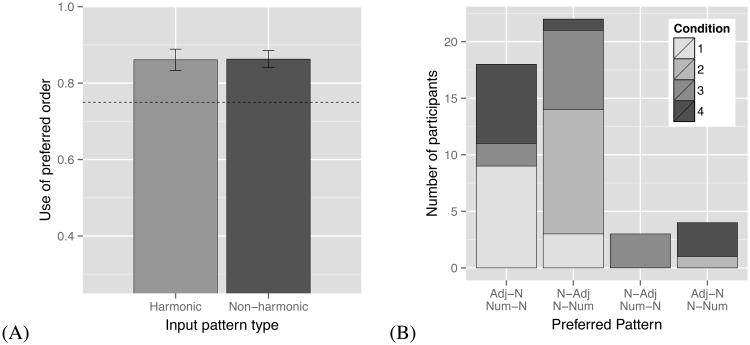
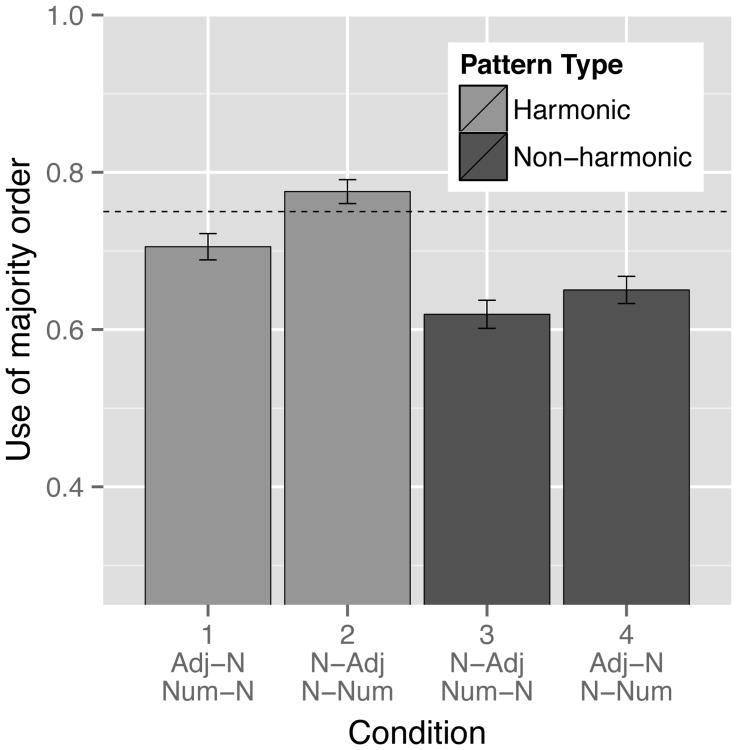
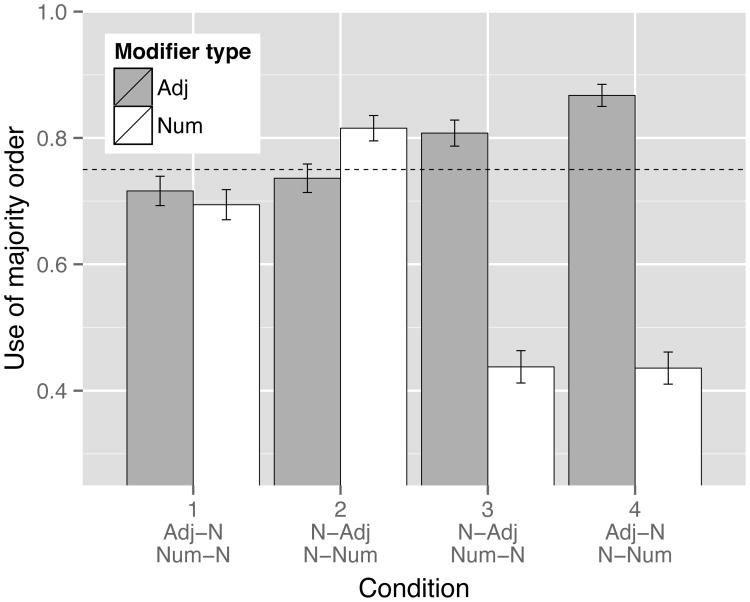
A fundamental question for cognitive science concerns the ways in which languages are shaped by the biases of language learners. Recent research using laboratory language learning paradigms, primarily with adults, has shown that structures or rules that are common in the languages of the world are learned or processed more easily than patterns that are rare or unattested. Here we target child learners, investigating a set of biases for word order learning in the noun phrase studied by Culbertson, Smolensky, and Legendre (2012) in college-age adults. We provide the first evidence that child learners exhibit a preference for typologically common harmonic word order patterns-those which preserve the order of the head with respect to its complements-validating the psychological reality of a principle formalized in many different linguistic theories. We also discuss important differences between child and adult learners in terms of both the strength and content of the biases at play during language learning. In particular, the bias favoring harmonic patterns is markedly stronger in children than adults, and children (unlike adults) acquire adjective ordering more readily than numeral ordering. The results point to the importance of investigating learning biases across development in order to understand how these biases may shape the history and structure of natural languages.
认知科学的一个基本问题涉及语言学习者的偏好塑造语言的方式。最近使用实验室语言学习范式(主要针对成年人)的研究表明,世界语言中常见的结构或规则比罕见或未被证实的模式更容易被学习或处理。在此,我们以儿童学习者为研究对象,调查库尔伯特森、斯莫伦斯基和勒让德(2012年)在大学生中研究的名词短语中词序学习的一组偏好。我们提供了首个证据,表明儿童学习者表现出对类型学上常见的和谐词序模式的偏好——即那些保持中心语相对于其补足语顺序的模式——从而证实了在许多不同语言理论中形式化的一个原则在心理层面的真实性。我们还讨论了儿童和成人学习者在语言学习过程中偏好的强度和内容方面的重要差异。特别是,儿童比成年人更明显地偏好和谐模式,并且儿童(与成年人不同)比数字顺序更容易习得形容词顺序。研究结果表明,研究不同发展阶段的学习偏好对于理解这些偏好如何塑造自然语言的历史和结构很重要。