Tang Fang, Qin Ping
Department of Epidemiology and Biostatistics and Centre for Suicide Prevention and Research, School of Public Health, Shandong University, Jinan, China; Health Management Centre, Qianfoshan Hospital Affiliated to Shandong University, Jinan, China.
Department of Epidemiology and Biostatistics and Centre for Suicide Prevention and Research, School of Public Health, Shandong University, Jinan, China; National Centre for Suicide Research and Prevention, Institute of Clinical Medicine, University of Oslo, Oslo, Norway.
PLoS One. 2015 Mar 24;10(3):e0121023. doi: 10.1371/journal.pone.0121023. eCollection 2015.
Personal social network and coping skills have important influences on suicidality of young people and such influences must be understood in the context of other factors. This study aims to assess the influences of social contacts and coping skills on risk for suicidal ideation and to disentangle their possible pathways using a large sample of university students from China.
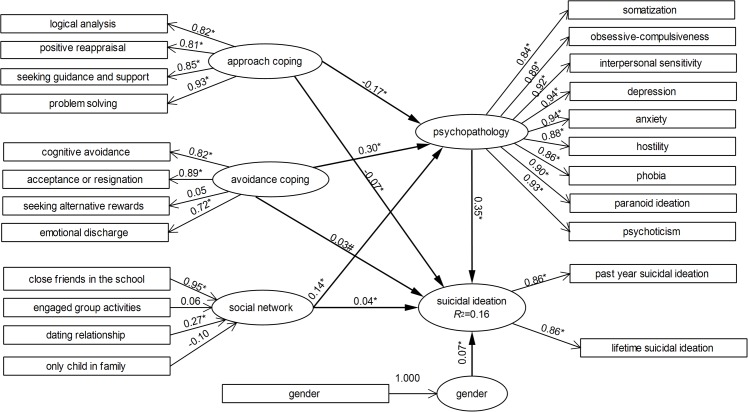
5972 students, randomly selected from 6 universities in China, completed the questionnaire survey for the study. Logistic regression was performed to estimate individual effect of social contacts and coping skills on risk for suicidal ideation. A partial least squares path model (PLSPM) was used to probe possible paths of their effects in the context of psychopathology.
Of the 5972 students, 16.39% reported the presence of suicidal ideation. Poor social contacts were significantly associated with an increased risk for suicidal ideation. The influence of coping skills varied by coping styles adapted toward problems. A high score of skills on seeking guidance and support, problem solving as well as seeking alternative rewards was associated with a reduced risk of suicidal ideation; whereas a high score of acceptance or resignation, emotional discharge as well as logical analysis was associated with a significantly increased risk. Modeling the data with PLSPM indicated that the avoidance coping skills conferred the most important dimensional variable in suicidal ideation prediction, followed by the approach coping skills and social network.
Poor social contacts and deficient coping skills are strong risk factors for suicidal ideation in young students. Prevention program focusing on these problems may have an enduring effect on reducing suicidal behavior in this population.
个人社交网络和应对技能对年轻人的自杀倾向有重要影响,且必须在其他因素的背景下理解这种影响。本研究旨在评估社交接触和应对技能对自杀意念风险的影响,并利用来自中国的大量大学生样本理清其可能的途径。
从中国6所大学随机抽取5972名学生完成该研究的问卷调查。进行逻辑回归以估计社交接触和应对技能对自杀意念风险的个体影响。使用偏最小二乘路径模型(PLSPM)探究其在精神病理学背景下影响的可能途径。
在5972名学生中,16.39%报告有自杀意念。社交接触差与自杀意念风险增加显著相关。应对技能的影响因应对问题的方式而异。寻求指导和支持、解决问题以及寻求替代奖励方面的高技能得分与自杀意念风险降低相关;而接受或顺从、情绪宣泄以及逻辑分析方面的高得分与自杀意念风险显著增加相关。用PLSPM对数据进行建模表明,回避应对技能是自杀意念预测中最重要的维度变量,其次是积极应对技能和社交网络。
社交接触差和应对技能不足是青年学生自杀意念的强烈风险因素。针对这些问题的预防项目可能对减少该人群的自杀行为产生持久影响。