Booth H P, Prevost A T, Gulliford M C
Department of Primary Care and Public Health Sciences, King's College London, London, UK.
J Hum Hypertens. 2016 Jan;30(1):40-5. doi: 10.1038/jhh.2015.23. Epub 2015 Mar 26.
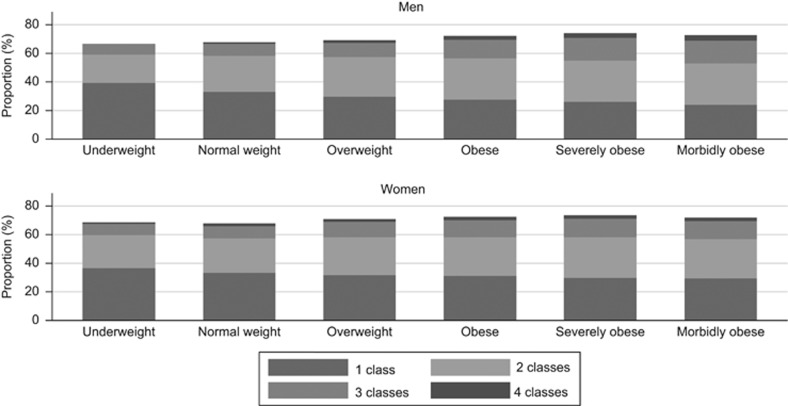
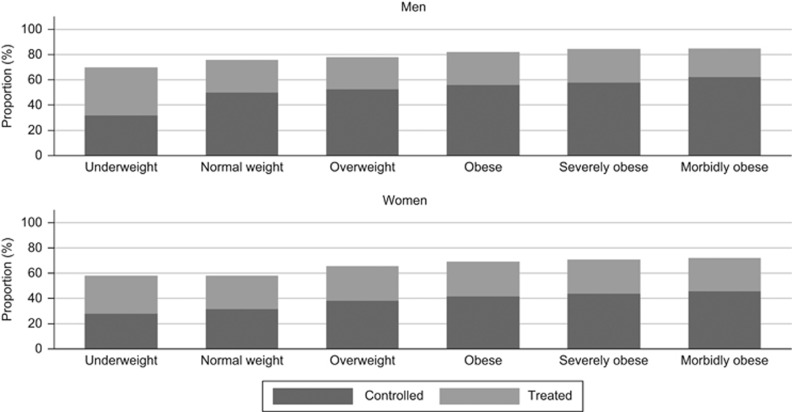
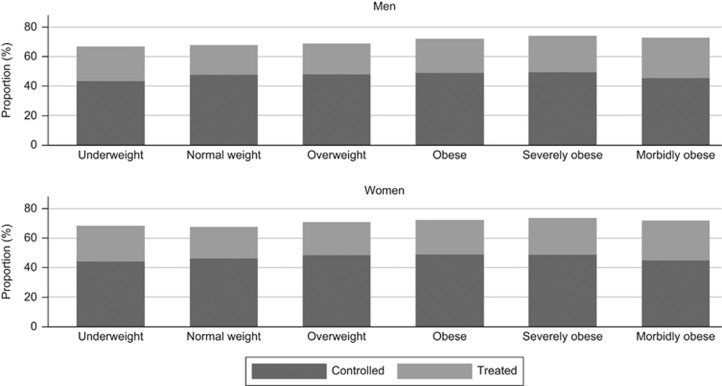
Obesity and obesity-associated cardiovascular risk are increasing worldwide. This study aimed to determine how different levels of obesity are associated with the management of smoking, hypertension and hypercholesterolaemia in primary care. We conducted a cohort study of adults aged 30-100 years in England, sampled from the primary care electronic health records in the Clinical Practice Research Datalink. Prevalence, treatment and control were estimated for each risk factor by body mass index (BMI) category. Adjusted odds ratios (AOR) were estimated, allowing for age, gender, comorbidity and socioeconomic status, with normal weight as reference category. Data were analysed for 247,653 patients including 153,308 (62%) with BMI recorded, of whom 46,149 (30%) were obese. Participants were classified into simple (29,257), severe (11,059) and morbid obesity (5833) categories. Smoking declined with the increasing BMI category, but smoking cessation treatment increased. Age-standardised hypertension prevalence was twice as high in morbid obesity (men 78.6%; women 66.0%) compared with normal weight (men 37.3%; women 29.4%). Hypertension treatment was more frequent (AOR 1.75, 1.59-1.92) but hypertension control less frequent (AOR 0.63, 0.59-0.69) in morbid obesity, with similar findings for severe obesity. Hypercholesterolaemia was more frequent in morbid obesity (men 48.2%; women 36.3%) than normal weight (men 25.0%; women 20.0%). Lipid lowering therapy was more frequent in morbid obesity (AOR 1.83, 1.61-2.07) as was cholesterol control (AOR 1.19, 1.06-1.34). Increasing obesity category is associated with elevated risks from hypertension and hypercholesterolaemia. Inadequate hypertension control in obesity emerges as an important target for future interventions.
全球范围内,肥胖及肥胖相关的心血管疾病风险正在增加。本研究旨在确定不同程度的肥胖与初级保健中吸烟、高血压和高胆固醇血症管理之间的关联。我们对英格兰30至100岁的成年人进行了一项队列研究,样本取自临床实践研究数据链中的初级保健电子健康记录。按体重指数(BMI)类别估计每种风险因素的患病率、治疗率和控制率。以正常体重为参照类别,对年龄、性别、合并症和社会经济状况进行校正后估计调整比值比(AOR)。对247,653名患者的数据进行了分析,其中153,308名(62%)记录了BMI,其中46,149名(30%)为肥胖患者。参与者被分为单纯肥胖(29,257名)、重度肥胖(11,059名)和病态肥胖(5,833名)类别。吸烟率随BMI类别增加而下降,但戒烟治疗增加。与正常体重者(男性37.3%;女性29.4%)相比,病态肥胖者(男性78.6%;女性66.0%)的年龄标准化高血压患病率高出两倍。病态肥胖者的高血压治疗更为频繁(AOR 1.75,1.59 - 1.92),但高血压控制率较低(AOR 0.63,0.59 - 0.69),重度肥胖者也有类似结果。病态肥胖者(男性48.2%;女性36.3%)的高胆固醇血症比正常体重者(男性25.0%;女性20.0%)更为常见。病态肥胖者的降脂治疗更为频繁(AOR 1.83,1.61 - 2.07),胆固醇控制情况也是如此(AOR 1.19,1.06 - 1.34)。肥胖程度增加与高血压和高胆固醇血症风险升高相关。肥胖人群中高血压控制不足成为未来干预的一个重要目标。