Clinton Chelsea M, O'Brien Shanley, Law Junwen, Renier Colleen M, Wendt Mary R
Department of Internal Medicine, Michigan State University College of Human Medicine, 15 Michigan Street NE, Grand Rapids, MI 49503, USA.
Arthritis. 2015;2015:708152. doi: 10.1155/2015/708152. Epub 2015 Feb 28.
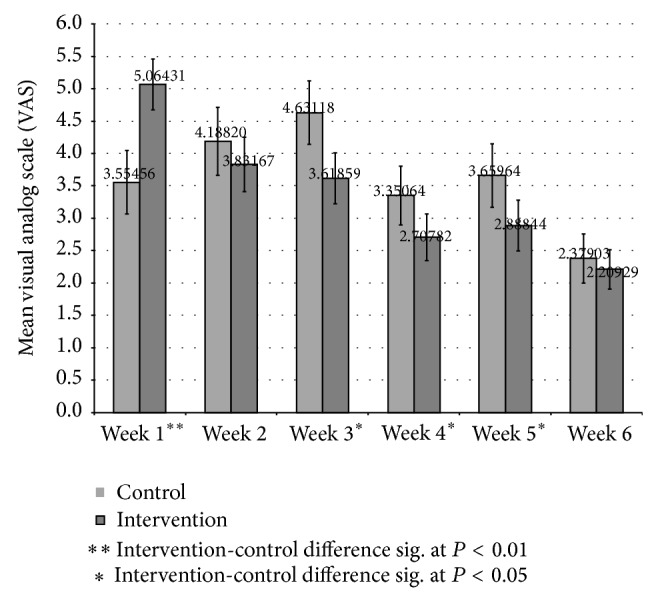
Objective. To evaluate the effectiveness of a whole-foods, plant-based diet (WFPB) to reduce symptoms of osteoarthritis. Methods. Six-week, prospective randomized open-label study of patients aged 19-70 with osteoarthritis. Participants were randomized to a WFPB (intervention) or continuing current diet (control). Outcomes were assessed by mixed models analysis of participant self-assessed weekly SF-36v2 domain t scores, weekly Patient Global Impression of Change (PGIC) scales, and mean weekly Visual Analog Scale (VAS) pain assessment. Mixed models analysis also evaluated pre-post change from baseline level for standard clinical measures: weight, BMI, body temperature, pulse, and blood pressure. Results. Forty participants were randomized. Thirty-seven of them, 18 control and 19 intervention, completed the study. The intervention group reported a significantly greater improvement than the control group in SF-36v2 energy/vitality, physical functioning, role physical, and the physical component summary scale. The differences between the intervention and control PGIC scales were statistically significant over time. Intervention group improvement in VAS weekly mean was also significantly greater than that of the control group from week 2 onward. Conclusion. Study results suggest that a whole-foods, plant-based diet significantly improves self-assessed measures of functional status among osteoarthritis patients.
目的。评估全食物、植物性饮食(WFPB)减轻骨关节炎症状的有效性。方法。对19至70岁的骨关节炎患者进行为期六周的前瞻性随机开放标签研究。参与者被随机分为WFPB组(干预组)或继续当前饮食组(对照组)。通过对参与者每周自我评估的SF-36v2领域t分数、每周患者整体改善印象(PGIC)量表以及每周平均视觉模拟量表(VAS)疼痛评估进行混合模型分析来评估结果。混合模型分析还评估了标准临床指标(体重、体重指数、体温、脉搏和血压)从基线水平的前后变化。结果。40名参与者被随机分组。其中37人,18名对照组和19名干预组,完成了研究。干预组在SF-36v2能量/活力、身体功能、角色身体和身体成分汇总量表方面的改善明显大于对照组。随着时间的推移,干预组和对照组PGIC量表之间的差异具有统计学意义。从第2周起,干预组VAS每周平均值的改善也明显大于对照组。结论。研究结果表明,全食物、植物性饮食能显著改善骨关节炎患者自我评估的功能状态指标。