James Bryan D, Boyle Patricia A, Yu Lei, Han S Duke, Bennett David A
Rush Alzheimer's Disease Center, Chicago, IL, United States of America; Department of Internal Medicine, Rush University Medical Center, Chicago, IL, United States of America.
Rush Alzheimer's Disease Center, Chicago, IL, United States of America; Department of Behavioral Sciences, Rush University Medical Center, Chicago, IL, United States of America.
PLoS One. 2015 Apr 2;10(4):e0121900. doi: 10.1371/journal.pone.0121900. eCollection 2015.
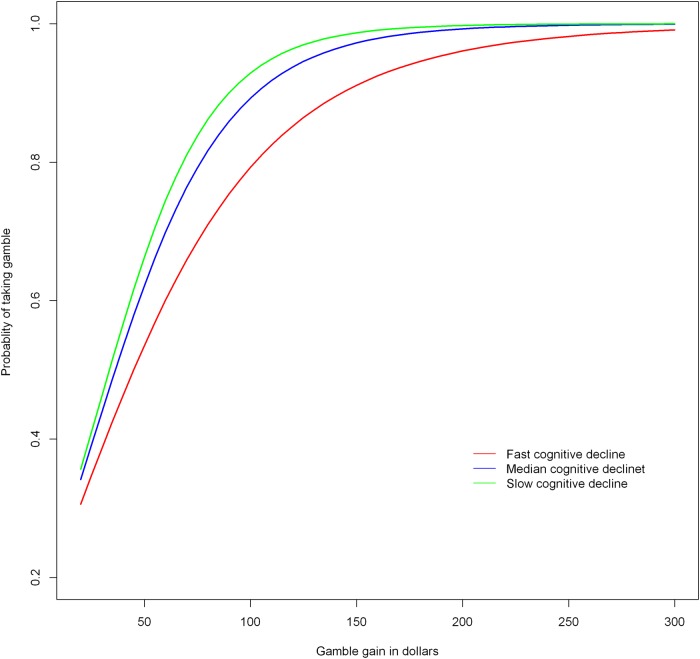
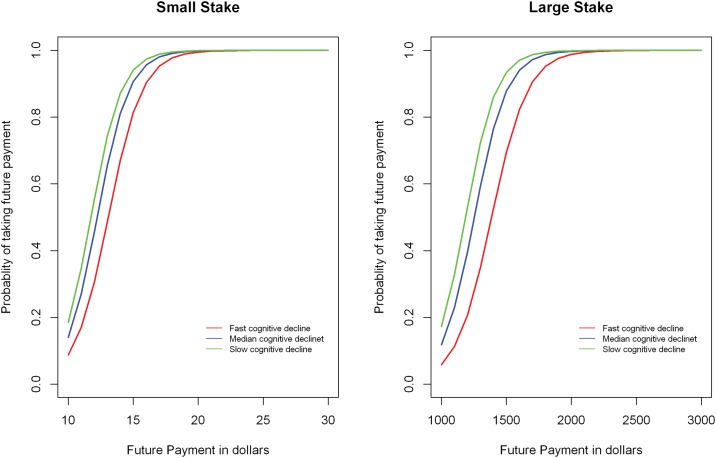
Risk aversion and temporal discounting are preferences that are strongly linked to sub-optimal financial and health decision making ability. Prior studies have shown they differ by age and cognitive ability, but it remains unclear whether differences are due to age-related cognitive decline or lower cognitive abilities over the life span. We tested the hypothesis that cognitive decline is associated with higher risk aversion and temporal discounting in 455 older persons without dementia from the Memory and Aging Project, a longitudinal cohort study of aging in Chicago. All underwent repeated annual cognitive evaluations using a detailed battery including 19 tests. Risk aversion was measured using standard behavioral economics questions: participants were asked to choose between a certain monetary payment versus a gamble in which they could gain more or nothing; potential gamble gains varied across questions. Temporal discounting: participants were asked to choose between an immediate, smaller payment and a delayed, larger one; two sets of questions addressed small and large stakes based on payment amount. Regression analyses were used to examine whether prior rate of cognitive decline predicted level of risk aversion and temporal discounting, controlling for age, sex, and education. Over an average of 5.5 (SD=2.9) years, cognition declined at an average of 0.016 units per year (SD=0.03). More rapid cognitive decline predicted higher levels of risk aversion (p=0.002) and temporal discounting (small stakes: p=0.01, high stakes: p=0.006). Further, associations between cognitive decline and risk aversion (p=0.015) and large stakes temporal discounting (p=0.026) persisted in analyses restricted to persons without any cognitive impairment (i.e., no dementia or mild cognitive impairment); the association of cognitive decline and small stakes temporal discounting was no longer statistically significant (p=0.078). These findings are consistent with the hypothesis that subtle age-related changes in cognition can detrimentally affect individual preferences that are critical for maintaining health and well being.
风险规避和时间贴现是与次优金融和健康决策能力密切相关的偏好。先前的研究表明,它们因年龄和认知能力而异,但差异是由于与年龄相关的认知衰退还是一生中较低的认知能力尚不清楚。我们在记忆与衰老项目中对455名无痴呆的老年人进行了测试,该项目是芝加哥一项关于衰老的纵向队列研究,以验证认知衰退与更高的风险规避和时间贴现相关的假设。所有人都使用包括19项测试的详细组合进行了年度重复认知评估。风险规避通过标准行为经济学问题进行测量:参与者被要求在一定的货币支付与一种赌博之间进行选择,在这种赌博中他们可能获得更多或一无所获;不同问题的潜在赌博收益各不相同。时间贴现:参与者被要求在即时的小额支付和延迟的大额支付之间进行选择;两组问题根据支付金额涉及小额和大额赌注。回归分析用于检验先前的认知衰退率是否能预测风险规避和时间贴现水平,并控制年龄、性别和教育程度。在平均5.5(标准差=2.9)年的时间里,认知平均每年下降0.016个单位(标准差=0.03)。更快的认知衰退预测了更高水平的风险规避(p=0.002)和时间贴现(小额赌注:p=0.01,大额赌注:p=0.006)。此外,在仅限于没有任何认知障碍(即无痴呆或轻度认知障碍)的人群的分析中,认知衰退与风险规避(p=0.015)和大额赌注时间贴现(p=0.026)之间的关联仍然存在;认知衰退与小额赌注时间贴现之间的关联不再具有统计学意义(p=0.078)。这些发现与以下假设一致,即与年龄相关的认知细微变化会对维持健康和幸福至关重要的个人偏好产生不利影响。