de Valk Silke, Olgers Tycho Joan, Holman Mirjam, Ismael Farouq, Ligtenberg Jack Johannes Maria, Ter Maaten Jan Cornelis
Emergency Department, Department of Internal Medicine, University Medical Center Groningen, UMCG, Hanzeplein 1, 9700 RB Groningen, The Netherlands.
Emergency Department, University Medical Center Groningen, UMCG, Hanzeplein 1, 9700 RB Groningen, The Netherlands.
BMC Anesthesiol. 2014 Dec 12;14:114. doi: 10.1186/1471-2253-14-114. eCollection 2014.
Fluid therapy is the first important step in patients with signs of shock but assessment of the volume status is difficult and invasive measurements are not readily available in the emergency department. We have investigated whether the respiratory variation in diameter of the inferior vena cava is a reliable parameter to predict fluid responsiveness in spontaneous breathing emergency department patients with signs of shock.
All patients admitted to the emergency department during a 15 week period were screened for signs of shock. If the attending physician planned to give a fluid challenge, the caval index was determined by transabdominal ultrasonography in supine position. Immediately afterwards 500 ml NaCl 0.9% was administered in 15 minutes and the clinical response was observed. An adequate response was defined as an increase in systolic blood pressure of at least 10 mm Hg. Based on this definition patients were divided into responders and non-responders.
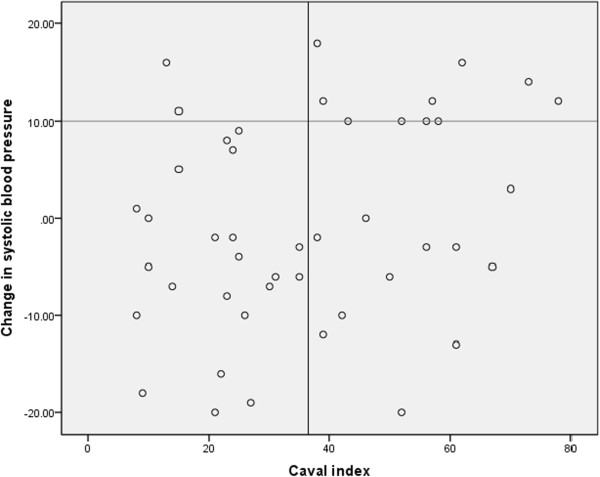
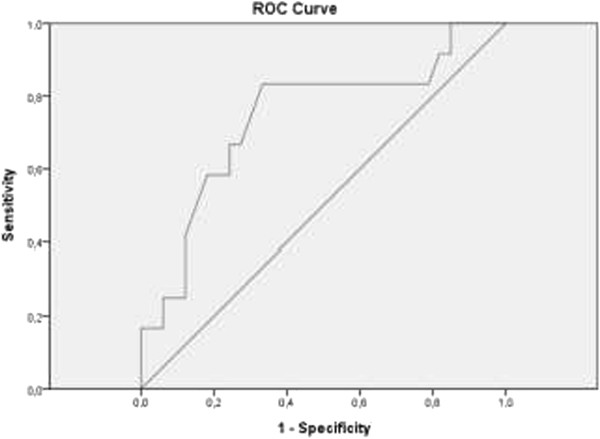
After selection a total number of 45 patients was included. A low caval index (< 36.5%) in patients with signs of shock reliably predicted the absence of an adequate response to fluid therapy (negative predictive value 92%). The positive predictive value of a high caval index was much lower (48%) despite the fact that responders had a significantly higher pre-infusion caval index than non-responders (48.7% vs 31.8%, p 0.014).
In spontaneously breathing patients with signs of shock in the emergency department, a high caval index (>36.5%) does not reliably predict fluid responsiveness in our study, while a low caval index (<36.5%) makes fluid responsiveness unlikely. An explanation for the absence of a blood pressure response in the group of patients with a low high caval index might be that these patients represent a group requiring more volume therapy than 500 ml.
液体治疗是休克患者首要的重要治疗措施,但评估容量状态存在困难,且在急诊科难以进行侵入性测量。我们研究了下腔静脉直径的呼吸变化是否是预测急诊科有休克体征的自主呼吸患者液体反应性的可靠参数。
在15周期间入住急诊科的所有患者均接受休克体征筛查。如果主治医生计划进行液体负荷试验,则在仰卧位通过经腹超声测定腔静脉指数。随后立即在15分钟内输注500ml 0.9%氯化钠溶液,并观察临床反应。充分反应定义为收缩压至少升高10mmHg。根据这一定义,将患者分为反应者和无反应者。
筛选后共纳入45例患者。有休克体征患者的低腔静脉指数(<36.5%)可可靠地预测对液体治疗无充分反应(阴性预测值为92%)。尽管反应者输注前的腔静脉指数显著高于无反应者(48.7%对31.8%,p<0.014),但高腔静脉指数的阳性预测值要低得多(48%)。
在急诊科有休克体征的自主呼吸患者中,在我们的研究中,高腔静脉指数(>36.5%)不能可靠地预测液体反应性,而低腔静脉指数(<36.5%)则提示液体反应性不佳。低高腔静脉指数组患者无血压反应的一个解释可能是,这些患者需要的容量治疗超过500ml。