Fishman Elliot, Böcker Lars, Helbich Marco
Department of Human Geography and Spatial Planning, Faculty of Geosciences, Utrecht University, Utrecht, The Netherlands.
Department of Innovation, Environmental & Energy Sciences, Faculty of Geosciences, Utrecht University, Utrecht, The Netherlands.
PLoS One. 2015 Apr 7;10(4):e0121871. doi: 10.1371/journal.pone.0121871. eCollection 2015.
Modern, urban lifestyles have engineered physical activity out of everyday life and this presents a major threat to human health. The Netherlands is a world leader in active travel, particularly cycling, but little research has sought to quantify the cumulative amount of physical activity through everyday walking and cycling.
Using data collected as part of the Dutch National Travel Survey (2010 - 2012), this paper determines the degree to which Dutch walking and cycling contributes to meeting minimum level of physical activity of 150 minutes of moderate intensity aerobic activity throughout the week. The sample includes 74,465 individuals who recorded at least some travel on the day surveyed. As physical activity benefits are cumulative, all walking and cycling trips are analysed, including those to and from public transport. These trips are then converted into an established measure of physical activity intensity, known as metabolic equivalents of tasks. Multivariate Tobit regression models were performed on a range of socio-demographic, transport resources, urban form and meteorological characteristics.
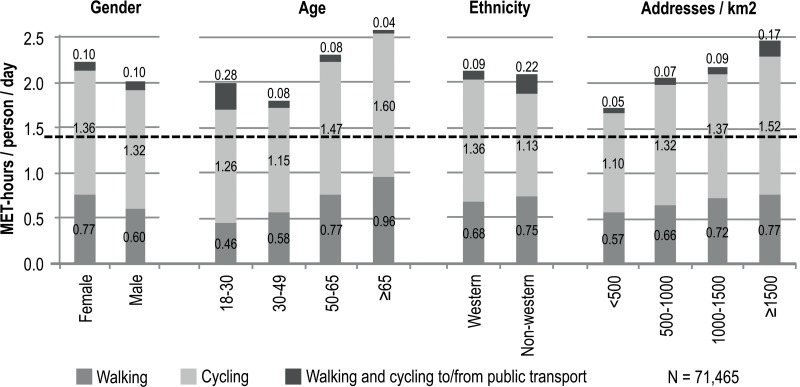
The results reveal that Dutch men and women participate in 24 and 28 minutes of daily physical activity through walking and cycling, which is 41% and 55% more than the minimum recommended level. It should be noted however that some 57% of the entire sample failed to record any walking or cycling, and an investigation of this particular group serves as an important topic of future research. Active transport was positively related with age, income, bicycle ownership, urban density and air temperature. Car ownership had a strong negative relationship with physically active travel.
The results of this analysis demonstrate the significance of active transport to counter the emerging issue of sedentary lifestyle disease. The Dutch experience provides other countries with a highly relevant case study in the creation of environments and cultures that support healthy, active living.
现代城市生活方式使身体活动远离了日常生活,这对人类健康构成了重大威胁。荷兰在积极出行方面处于世界领先地位,尤其是骑自行车,但很少有研究试图量化日常步行和骑自行车所累积的身体活动量。
利用作为荷兰国家旅行调查(2010 - 2012年)一部分收集的数据,本文确定了荷兰的步行和骑自行车对达到每周150分钟中等强度有氧运动的最低身体活动水平的贡献程度。样本包括74465名在调查当天至少记录了一些出行情况的个体。由于身体活动的益处是累积性的,因此分析了所有步行和骑自行车的行程,包括往返公共交通的行程。然后将这些行程转换为一种既定的身体活动强度衡量标准,即代谢当量任务。对一系列社会人口统计学、交通资源、城市形态和气象特征进行了多元托比特回归模型分析。
结果显示,荷兰男性和女性通过步行和骑自行车每天进行24分钟和28分钟的身体活动,这比建议的最低水平分别高出41%和55%。然而,应该注意的是,整个样本中约57%的人没有记录任何步行或骑自行车的情况,对这一特定群体的调查是未来研究的一个重要课题。积极出行与年龄、收入、自行车拥有量、城市密度和气温呈正相关。汽车拥有量与积极的出行方式呈强烈负相关。
该分析结果表明了积极出行对于应对久坐生活方式疾病这一新兴问题的重要性。荷兰的经验为其他国家提供了一个高度相关的案例研究,即在创造支持健康、积极生活的环境和文化方面。