Conversano Ciro, Carmassi Claudia, Carlini Marina, Casu Giulia, Gremigni Paola, Dell'Osso Liliana
Section of Psychiatry, Department of Clinical and Experimental Medicine, University of Pisa ; Italy.
Department of Psychology, University of Bologna , Italy.
Hematol Rep. 2015 Mar 3;7(1):5632. doi: 10.4081/hr.2015.5632. eCollection 2015 Feb 24.
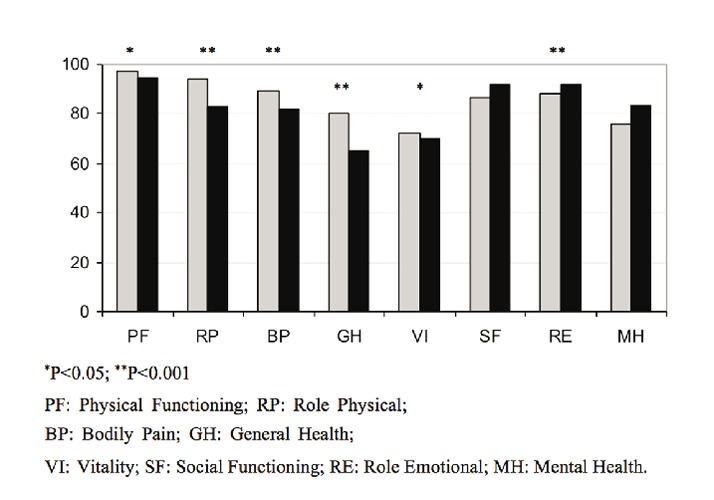
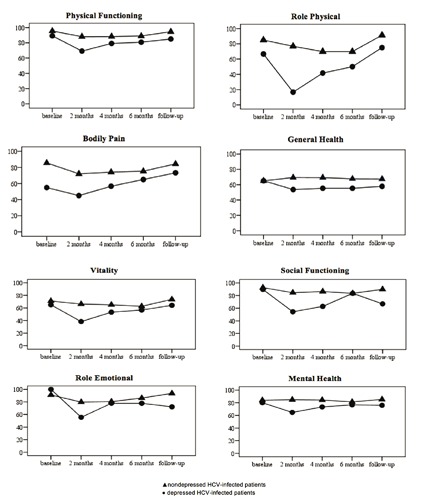
Health-related quality of life was examined in 49 patients with hepatitis C virus with no psychiatric history who received interferon (IFN)-α treatment. Quality of life was assessed at baseline, at 3-time points during IFN-α therapy and at 1-6 month follow-up, using SF-36. Hepatitis C virus patients showed poorer physical functioning and better social and mental functioning than a normal population. Significant decreases from baseline SF-36 scores were observed at an early phase of treatment. Six patients developed major depression during IFN-α treatment. At baseline, they had reported more bodily pain than patients who did not develop depression during treatment. Planned contrasts revealed that worsening in some dimensions of quality of life at 2 months was greater in depressed than in non-depressed patients. Results suggest that depressive symptoms should be accurately monitored during IFN-α therapy even in patients with no psychiatric history, especially if they present with bodily pain.
对49例无精神病史且接受干扰素(IFN)-α治疗的丙型肝炎病毒患者的健康相关生活质量进行了研究。使用SF-36在基线、IFN-α治疗期间的3个时间点以及1-6个月随访时评估生活质量。丙型肝炎病毒患者的身体功能较正常人群差,但社会和心理功能较好。在治疗早期观察到SF-36评分较基线有显著下降。6例患者在IFN-α治疗期间出现重度抑郁。基线时,他们报告的身体疼痛比治疗期间未出现抑郁的患者更多。计划对比显示,治疗2个月时,抑郁患者生活质量某些维度的恶化程度比非抑郁患者更大。结果表明,即使在无精神病史的患者中,在IFN-α治疗期间也应准确监测抑郁症状,尤其是那些伴有身体疼痛的患者。