Thant Kyaw Zin, Tun Mya Myat Ngwe, Parquet Maria Del Carmen, Inoue Shingo, Lwin Yee Yee, Lin Sanda, Aye Kay Thi, Khin Pe Thet, Myint Tin, Htwe Khin, Nabeshima Takeshi, Morita Kouichi
Department of Molecular Epidemiology, Institute of Tropical Medicine, Nagasaki University , Japan ; Virology Research Division, Department of Medical Research (Upper Myanmar) , Pyin Oo Lwin, Myanmar.
Department of Virology, Institute of Tropical Medicine, Nagasaki University , Japan ; Global COE Program, 21st Century COE Program, MEXT , Tokyo, Japan.
Trop Med Health. 2015 Mar;43(1):21-7. doi: 10.2149/tmh.2014-27. Epub 2014 Nov 15.
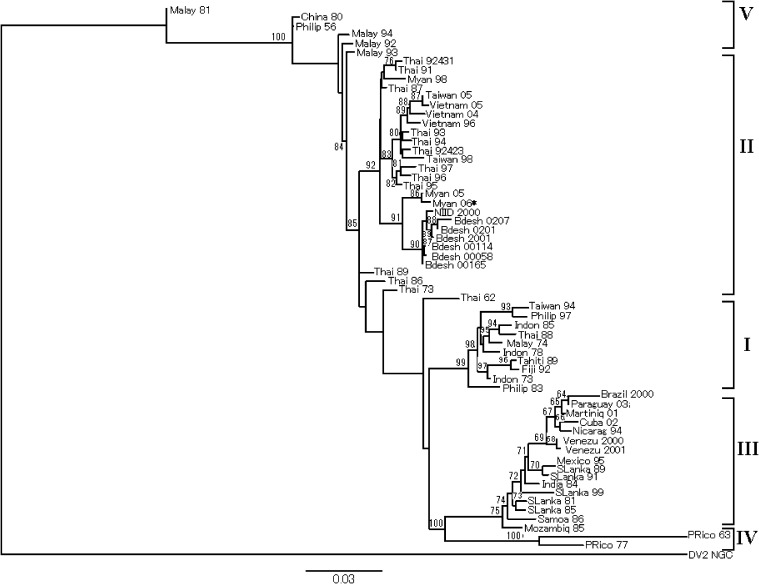
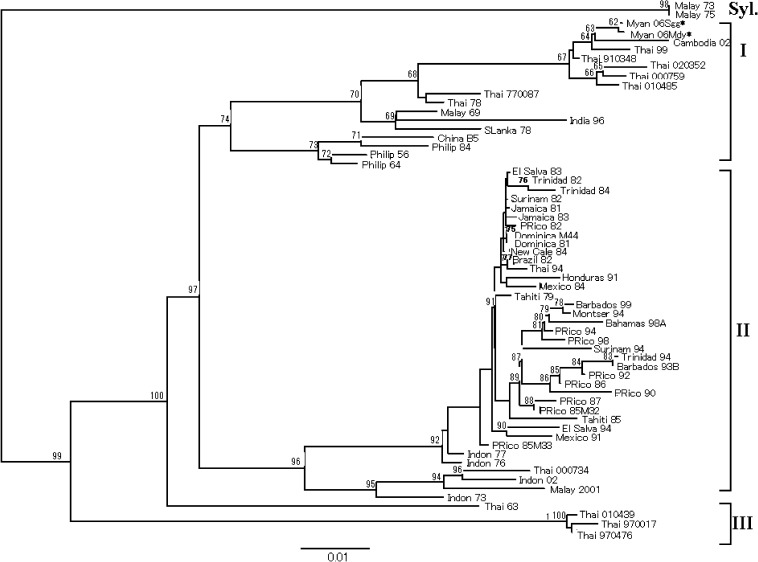
To understand the molecular epidemiology of circulating dengue viruses (DENV) in Upper Myanmar, DENV isolation was attempted by inoculating the sera of a panel of 110 serum samples onto a C6/36 mosquito cell line. The samples were collected from dengue (DEN) patients admitted at Mandalay Children's Hospital in 2006. Infected culture fluids were subjected to a RT-PCR to detect the DENV genome. Three DENV strains were isolated. This was the first DENV isolation performed either in Mandalay or in Upper Myanmar. One strain belonged to DENV serotype-3 (DENV-3), and two other strains belonged to DENV serotype-4 (DEN-4). The sequence data for the envelope gene of these strains were used in a phylogenetic comparison of DENV-3 and DENV-4 from various countries. Phylogenetic analyses revealed that this DENV-3 strain was clustered within genotype II, and the two DENV-4 strains were clustered within genotype I in each serotype. The Myanmar strains were closely related to strains from the neighboring countries of Thailand and Bangladesh. These results are important for elucidating the trends of recent and future DEN outbreaks in Myanmar.
为了解缅甸北部流行的登革病毒(DENV)的分子流行病学情况,研究人员尝试通过将110份血清样本接种到C6/36蚊细胞系上来分离DENV。这些样本采集自2006年在曼德勒儿童医院住院的登革热(DEN)患者。对感染的培养液进行逆转录聚合酶链反应(RT-PCR)以检测DENV基因组。分离出了三株DENV毒株。这是在曼德勒或缅甸北部首次进行的DENV分离。其中一株属于登革病毒血清型3(DENV-3),另外两株属于登革病毒血清型4(DEN-4)。这些毒株包膜基因的序列数据用于对来自不同国家的DENV-3和DENV-4进行系统发育比较。系统发育分析表明,该DENV-3毒株聚类在基因型II内,两株DENV-4毒株在每个血清型中均聚类在基因型I内。缅甸的毒株与邻国泰国和孟加拉国的毒株密切相关。这些结果对于阐明缅甸近期和未来登革热疫情的趋势具有重要意义。