Brown Jason L, Yoder Anne D
Biology Department, Duke University Durham, North Carolina, 27705.
Ecol Evol. 2015 Mar;5(6):1131-42. doi: 10.1002/ece3.1418. Epub 2015 Feb 17.
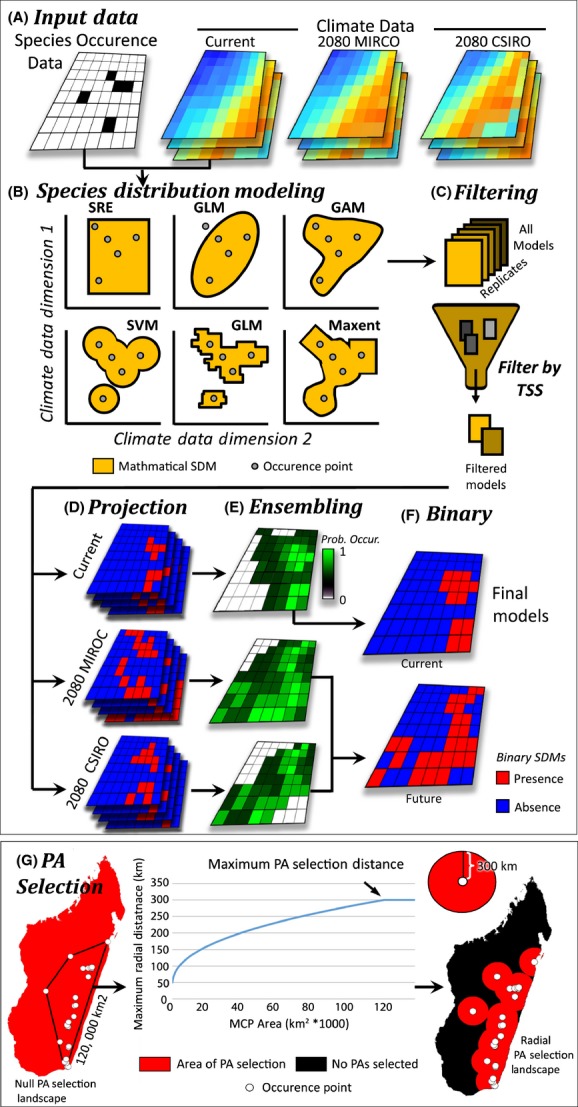
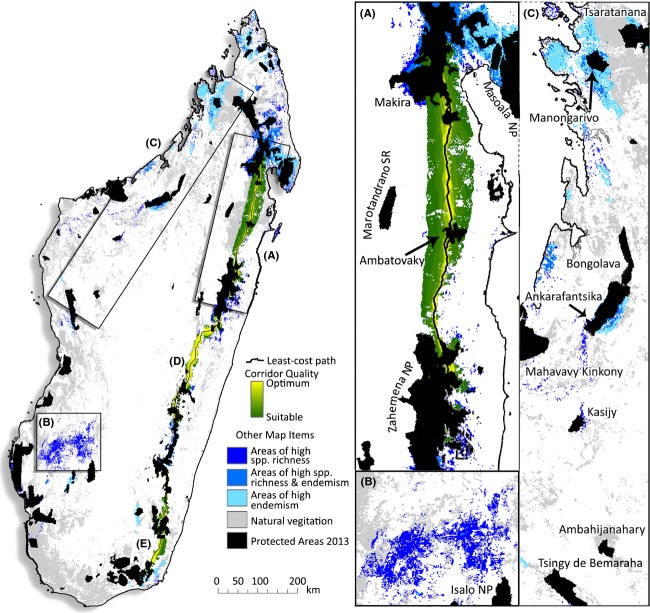
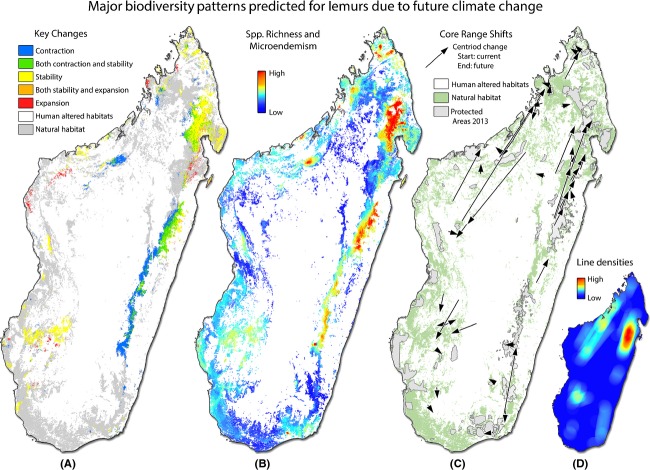
Geospatial modeling is one of the most powerful tools available to conservation biologists for estimating current species ranges of Earth's biodiversity. Now, with the advantage of predictive climate models, these methods can be deployed for understanding future impacts on threatened biota. Here, we employ predictive modeling under a conservative estimate of future climate change to examine impacts on the future abundance and geographic distributions of Malagasy lemurs. Using distribution data from the primary literature, we employed ensemble species distribution models and geospatial analyses to predict future changes in species distributions. Current species distribution models (SDMs) were created within the BIOMOD2 framework that capitalizes on ten widely used modeling techniques. Future and current SDMs were then subtracted from each other, and areas of contraction, expansion, and stability were calculated. Model overprediction is a common issue associated Malagasy taxa. Accordingly, we introduce novel methods for incorporating biological data on dispersal potential to better inform the selection of pseudo-absence points. This study predicts that 60% of the 57 species examined will experience a considerable range of reductions in the next seventy years entirely due to future climate change. Of these species, range sizes are predicted to decrease by an average of 59.6%. Nine lemur species (16%) are predicted to expand their ranges, and 13 species (22.8%) distribution sizes were predicted to be stable through time. Species ranges will experience severe shifts, typically contractions, and for the majority of lemur species, geographic distributions will be considerably altered. We identify three areas in dire need of protection, concluding that strategically managed forest corridors must be a key component of lemur and other biodiversity conservation strategies. This recommendation is all the more urgent given that the results presented here do not take into account patterns of ongoing habitat destruction relating to human activities.
地理空间建模是保护生物学家可用于估计地球生物多样性当前物种分布范围的最强大工具之一。如今,借助预测性气候模型的优势,这些方法可用于了解对受威胁生物群的未来影响。在此,我们在对未来气候变化的保守估计下采用预测建模,以研究对马达加斯加狐猴未来数量和地理分布的影响。利用来自主要文献的分布数据,我们采用集合物种分布模型和地理空间分析来预测物种分布的未来变化。当前物种分布模型(SDMs)是在BIOMOD2框架内创建的,该框架利用了十种广泛使用的建模技术。然后将未来和当前的SDMs相互相减,并计算收缩、扩张和稳定区域。模型过度预测是与马达加斯加分类群相关的常见问题。因此,我们引入了新方法,将关于扩散潜力的生物学数据纳入其中,以便更好地为伪缺失点的选择提供信息。本研究预测,在所研究的57个物种中,60%将在未来七十年内经历相当程度的范围缩小,完全是由于未来气候变化所致。在这些物种中,预测范围大小平均将减少59.6%。预计有9种狐猴(16%)的分布范围会扩大,13种(22.8%)的分布大小预计随时间保持稳定。物种分布范围将经历严重变化,通常是收缩,并且对于大多数狐猴物种而言,地理分布将发生显著改变。我们确定了三个急需保护的区域,得出结论认为,战略管理的森林走廊必须是狐猴和其他生物多样性保护策略的关键组成部分。鉴于此处呈现的结果未考虑与人类活动相关的持续栖息地破坏模式,这一建议就显得更加紧迫。