Department of Veterinary Biomedical Sciences, Western College of Veterinary Medicine, University of Saskatchewan Saskatoon, SK, Canada.
School of Kinesiology and Health Sciences, York University Toronto, ON, Canada.
Front Cell Dev Biol. 2015 Apr 8;3:22. doi: 10.3389/fcell.2015.00022. eCollection 2015.
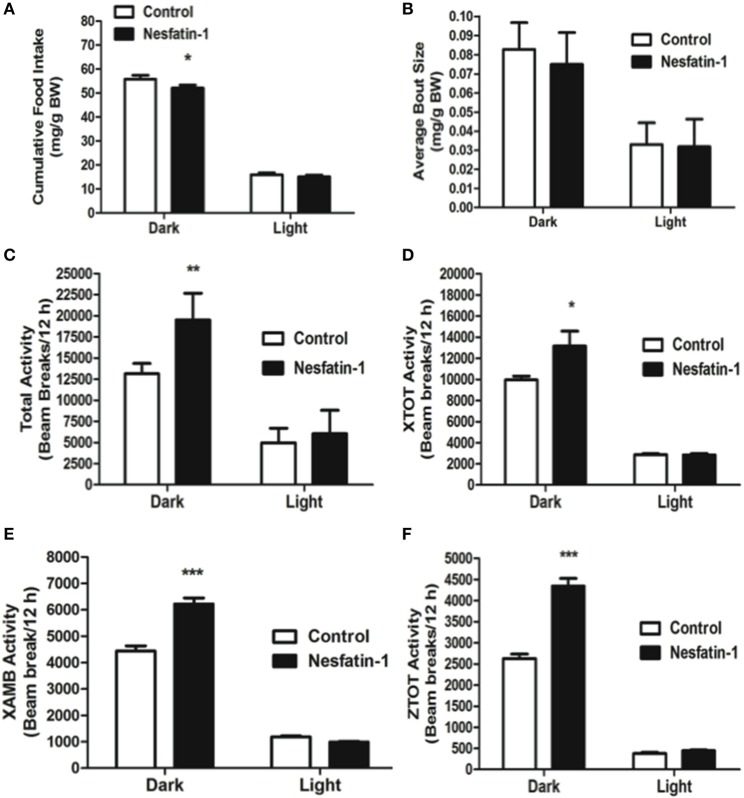
Nesfatin-1, the N-terminal fragment of nucleobindin 2 (NUCB2), is an 82 amino-acid peptide that inhibits food intake and exerts weight-reducing effects. Nesfatin-1 has been proposed as a potential anti-obesity peptide. However, studies to date have mainly focused on the acute satiety effects of centrally administered nesfatin-1. The main objective of our studies was to characterize the long-term/chronic effects of peripheral administration of nesfatin-1 on whole-body energy balance and metabolic partitioning in male Fischer 344 rats. Short-term (1 day) subcutaneous infusion of nesfatin-1 (50 μg/kg body weight/day) using osmotic mini-pumps increased spontaneous physical activity and whole-body fat oxidation during the dark phase. This was accompanied by decreased food intake and basal metabolic rate compared to saline infused controls. On the seventh day of nesfatin-1 infusion, cumulative food intake, and total spontaneous physical activity during the dark phase were significantly reduced and elevated, respectively. Meanwhile, intraperitoneal injection of nesfatin-1 only caused a dark phase specific reduction in food intake and an increase in physical activity. NUCB2 mRNA expression in the brain and stomach, as well as serum NUCB2 concentrations were significantly reduced after 24 h fasting, while a post-prandial increase in serum NUCB2 was found in ad libitum fed rats. Collectively, our results indicate that chronic peripheral administration of nesfatin-1 at the dose tested, results in a sustained reduction in food intake and modulation of whole body energy homeostasis.
Nesfatin-1 是核蛋白 2(NUCB2)的 N 端片段,是一种 82 个氨基酸的肽,可抑制食欲并产生减肥作用。Nesfatin-1 被认为是一种潜在的抗肥胖肽。然而,迄今为止的研究主要集中在中枢给予 nesfatin-1 的急性饱腹感效应上。我们研究的主要目的是描述外周给予 nesfatin-1 对雄性 Fischer 344 大鼠全身能量平衡和代谢分配的长期/慢性影响。使用渗透微型泵进行短期(1 天)皮下输注 nesfatin-1(50 μg/kg 体重/天)可增加黑暗期自发身体活动和全身脂肪氧化。与盐水输注对照组相比,这伴随着食物摄入量和基础代谢率的降低。在 nesfatin-1 输注的第 7 天,累积食物摄入量和黑暗期的总自发身体活动分别显著减少和增加。同时,腹腔内注射 nesfatin-1 仅导致黑暗期食物摄入量特异性减少和身体活动增加。禁食 24 小时后,大脑和胃中的 NUCB2 mRNA 表达以及血清 NUCB2 浓度显著降低,而自由进食大鼠的餐后血清 NUCB2 增加。总之,我们的结果表明,在测试剂量下慢性外周给予 nesfatin-1 会导致食物摄入量持续减少,并调节全身能量稳态。