Lin Lin, Frelinger Jacob, Jiang Wenxin, Finak Greg, Seshadri Chetan, Bart Pierre-Alexandre, Pantaleo Giuseppe, McElrath Julie, DeRosa Steve, Gottardo Raphael
Vaccine and Infectious Disease Division, Fred Hutchinson Cancer Research Center, Seattle, Washington.
Division of Allergy and Infectious Diseases, University of Washington, Seattle, Washington.
Cytometry A. 2015 Jul;87(7):675-82. doi: 10.1002/cyto.a.22623. Epub 2015 Apr 23.
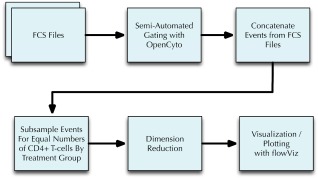
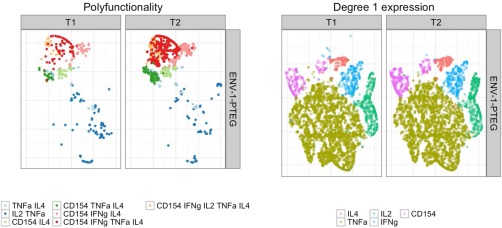
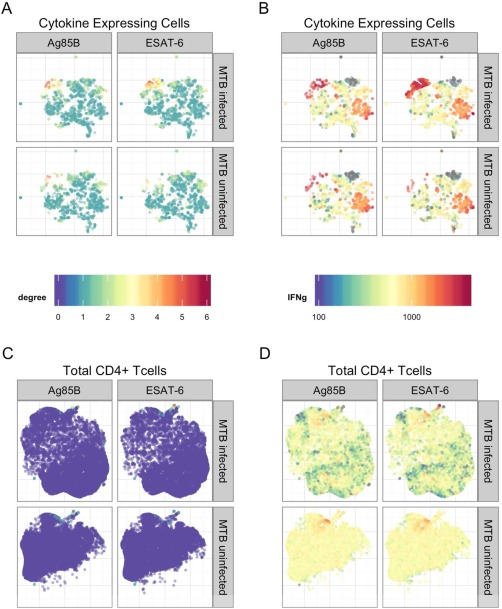
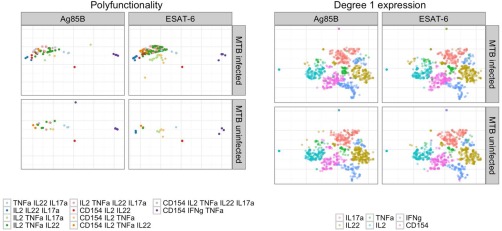
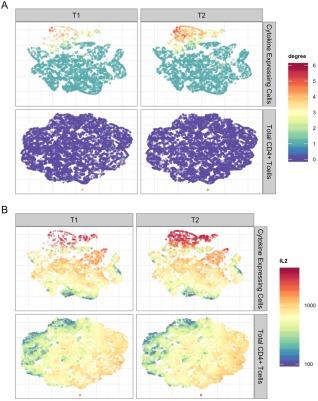
An important aspect of immune monitoring for vaccine development, clinical trials, and research is the detection, measurement, and comparison of antigen-specific T-cells from subject samples under different conditions. Antigen-specific T-cells compose a very small fraction of total T-cells. Developments in cytometry technology over the past five years have enabled the measurement of single-cells in a multivariate and high-throughput manner. This growth in both dimensionality and quantity of data continues to pose a challenge for effective identification and visualization of rare cell subsets, such as antigen-specific T-cells. Dimension reduction and feature extraction play pivotal role in both identifying and visualizing cell populations of interest in large, multi-dimensional cytometry datasets. However, the automated identification and visualization of rare, high-dimensional cell subsets remains challenging. Here we demonstrate how a systematic and integrated approach combining targeted feature extraction with dimension reduction can be used to identify and visualize biological differences in rare, antigen-specific cell populations. By using OpenCyto to perform semi-automated gating and features extraction of flow cytometry data, followed by dimensionality reduction with t-SNE we are able to identify polyfunctional subpopulations of antigen-specific T-cells and visualize treatment-specific differences between them.
免疫监测在疫苗研发、临床试验及研究中一个重要方面是在不同条件下对受试者样本中抗原特异性T细胞进行检测、测量及比较。抗原特异性T细胞在总T细胞中所占比例极小。过去五年中细胞计数技术的发展已能够以多变量和高通量方式对单细胞进行测量。数据在维度和数量上的这种增长,对于有效识别和可视化稀有细胞亚群(如抗原特异性T细胞)仍然构成挑战。降维和特征提取在识别和可视化大型多维细胞计数数据集中的目标细胞群体方面发挥着关键作用。然而,稀有高维细胞亚群的自动识别和可视化仍然具有挑战性。在此我们展示了一种将靶向特征提取与降维相结合的系统且综合的方法,如何用于识别和可视化稀有抗原特异性细胞群体中的生物学差异。通过使用OpenCyto对流式细胞术数据进行半自动设门和特征提取,随后用t-SNE进行降维,我们能够识别抗原特异性T细胞的多功能亚群,并可视化它们之间的治疗特异性差异。