Vafeiadi Marina, Georgiou Vaggelis, Chalkiadaki Georgia, Rantakokko Panu, Kiviranta Hannu, Karachaliou Marianna, Fthenou Eleni, Venihaki Maria, Sarri Katerina, Vassilaki Maria, Kyrtopoulos Soterios A, Oken Emily, Kogevinas Manolis, Chatzi Leda
Department of Social Medicine, Faculty of Medicine, University of Crete, Heraklion, Greece.
Environ Health Perspect. 2015 Oct;123(10):1015-21. doi: 10.1289/ehp.1409062. Epub 2015 Apr 24.
Prenatal exposure to endocrine-disrupting chemicals such as persistent organic pollutants (POPs) may increase risk of obesity later in life.
We examined the relation of in utero POPs exposure to offspring obesity and cardiometabolic risk factors at 4 years of age in the Rhea mother-child cohort in Crete, Greece (n = 689).
We determined concentrations of polychlorinated biphenyls (PCBs), dichlorodiphenyldichloroethylene (DDE), and hexachlorobenzene (HCB) in first-trimester maternal serum. We measured child weight, height, waist circumference, skinfold thicknesses, blood pressure (BP), blood levels of lipids, C-reactive protein, and adipokines at 4 years of age. Childhood obesity was defined using age- and sex-specific cut points for body mass index (BMI) as recommended by the International Obesity Task Force.
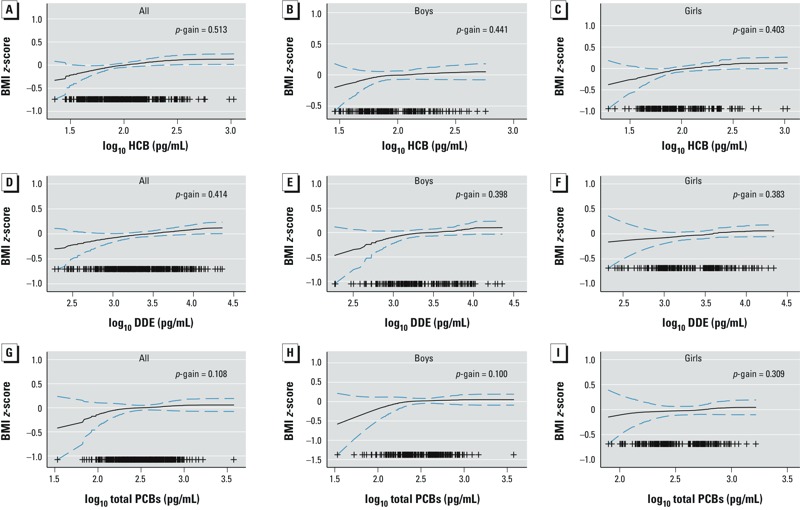
On multivariable regression analyses, a 10-fold increase in HCB was associated with a higher BMI z-score (adjusted β = 0.49; 95% CI: 0.12, 0.86), obesity [relative risk (RR) = 8.14; 95% CI: 1.85, 35.81], abdominal obesity (RR = 3.49; 95% CI: 1.08, 11.28), greater sum of skinfold thickness (β = 7.71 mm; 95% CI: 2.04, 13.39), and higher systolic BP (β = 4.34 mmHg; 95% CI: 0.63, 8.05) at 4 years of age. Prenatal DDE exposure was associated with higher BMI z-score (β = 0.27; 95% CI: 0.04, 0.5), abdominal obesity (RR = 3.76; 95% CI: 1.70, 8.30), and higher diastolic BP (β = 1.79 mmHg; 95% CI: 0.13, 3.46). PCBs were not significantly associated with offspring obesity or cardiometabolic risk factors.
Prenatal exposure to DDE and HCB was associated with excess adiposity and higher blood pressure levels in early childhood.
孕期暴露于内分泌干扰化学物质,如持久性有机污染物(POPs),可能会增加日后肥胖的风险。
在希腊克里特岛的瑞亚母婴队列研究(n = 689)中,我们研究了子宫内POPs暴露与4岁后代肥胖及心脏代谢危险因素之间的关系。
我们测定了孕早期母体血清中多氯联苯(PCBs)、二氯二苯二氯乙烯(DDE)和六氯苯(HCB)的浓度。我们测量了4岁儿童的体重、身高、腰围、皮褶厚度、血压(BP)、血脂、C反应蛋白和脂肪因子水平。根据国际肥胖特别工作组的建议,使用年龄和性别特异性的体重指数(BMI)切点来定义儿童肥胖。
在多变量回归分析中,HCB浓度增加10倍与更高的BMI z评分(调整β = 0.49;95%CI:0 .12,0.86)、肥胖[相对风险(RR) = 8.14;95%CI:1.85,35.81]、腹部肥胖(RR = 3.49;95%CI:1.08,11.28)、更大的皮褶厚度总和(β = 7.71mm;95%CI:2.04,13.39)以及4岁时更高的收缩压(β = 4.34mmHg;95%CI:0.63,8.05)相关。产前DDE暴露与更高的BMI z评分(β = 0.27;95%CI:0.04,0.5)、腹部肥胖(RR = 3.76;95%CI:1.70,8.30)和更高的舒张压(β = 1.79mmHg;95%CI:0.13,3.46)相关。PCBs与后代肥胖或心脏代谢危险因素无显著关联。
产前暴露于DDE和HCB与儿童早期肥胖和更高的血压水平相关。