Kim Sungshin, Callier Thierri, Tabot Gregg A, Tenore Francesco V, Bensmaia Sliman J
Department of Organismal Biology and Anatomy, University of Chicago Chicago, IL, USA.
Committee on Computational Neuroscience, University of Chicago Chicago, IL, USA.
Front Syst Neurosci. 2015 Apr 10;9:47. doi: 10.3389/fnsys.2015.00047. eCollection 2015.
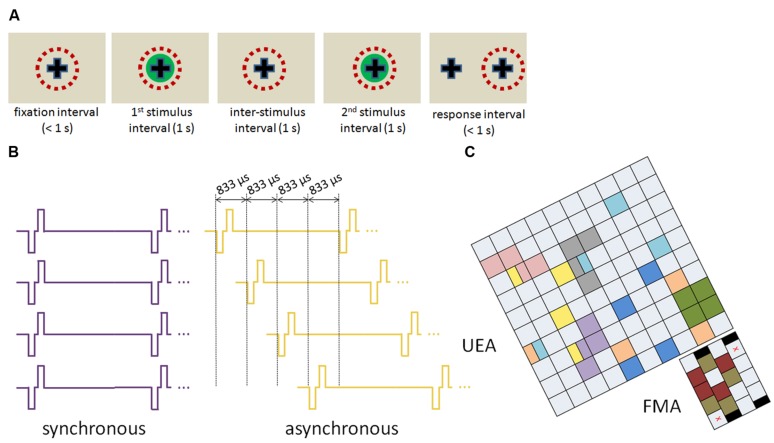
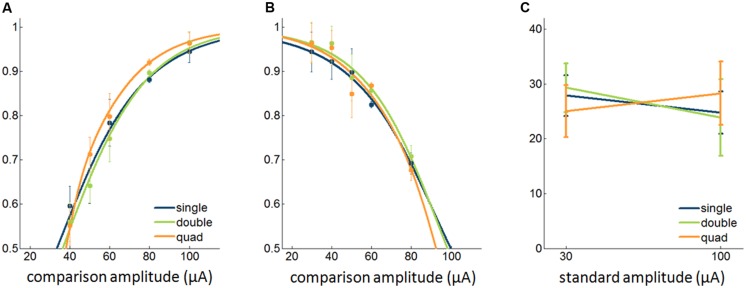
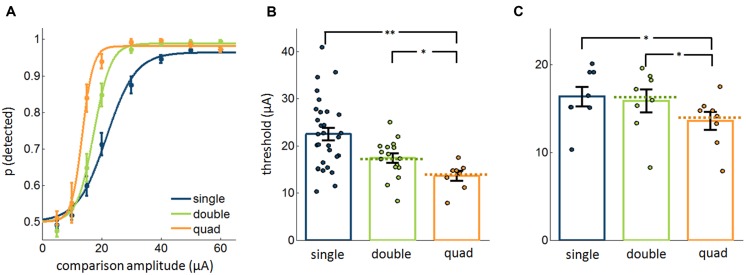
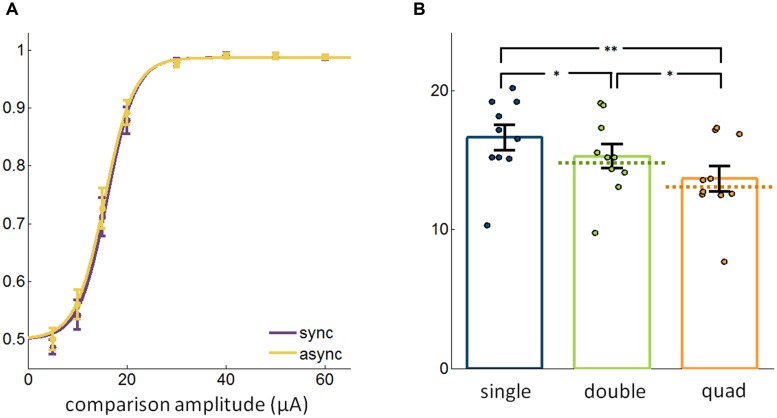
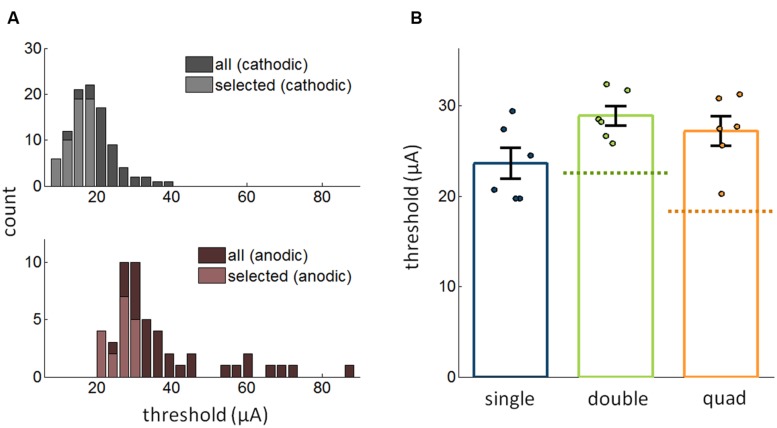
Meaningful and repeatable tactile sensations can be evoked by electrically stimulating primary somatosensory cortex. Intracortical microstimulation (ICMS) may thus be a viable approach to restore the sense of touch in individuals who have lost it, for example tetraplegic patients. One of the potential limitations of this approach, however, is that high levels of current can damage the neuronal tissue if the resulting current densities are too high. The limited range of safe ICMS amplitudes thus limits the dynamic range of ICMS-evoked sensations. One way to get around this limitation would be to distribute the ICMS over multiple electrodes in the hopes of intensifying the resulting percept without increasing the current density experienced by the neuronal tissue. Here, we test whether stimulating through multiple electrodes is a viable solution to increase the dynamic range of ICMS-elicited sensations without increasing the peak current density. To this end, we compare the ability of non-human primates to detect ICMS delivered through one vs. multiple electrodes. We also compare their ability to discriminate pulse trains differing in amplitude when these are delivered through one or more electrodes. We find that increasing the number of electrodes through which ICMS is delivered only has a marginal effect on detectability or discriminability despite the fact that 2-4 times more current is delivered overall. Furthermore, the impact of multielectrode stimulation (or lack thereof) is found whether pulses are delivered synchronously or asynchronously, whether the leading phase of the pulses is cathodic or anodic, and regardless of the spatial configuration of the electrode groups.
通过电刺激初级体感皮层可诱发有意义且可重复的触觉感受。因此,皮层内微刺激(ICMS)可能是一种可行的方法,用于恢复失去触觉的个体(例如四肢瘫痪患者)的触觉。然而,这种方法的一个潜在局限性在于,如果产生的电流密度过高,高水平的电流会损害神经元组织。安全的ICMS振幅范围有限,因此限制了ICMS诱发感觉的动态范围。解决这一局限性的一种方法是将ICMS分布在多个电极上,以期在不增加神经元组织所经历的电流密度的情况下增强产生的感知。在此,我们测试通过多个电极进行刺激是否是一种可行的解决方案,以在不增加峰值电流密度的情况下增加ICMS诱发感觉的动态范围。为此,我们比较了非人灵长类动物检测通过单个电极与多个电极施加的ICMS的能力。我们还比较了它们在通过一个或多个电极施加时区分不同振幅脉冲序列的能力。我们发现,增加施加ICMS的电极数量对可检测性或可辨别性仅有微小影响,尽管总体上施加的电流增加了2至4倍。此外,无论脉冲是同步还是异步传递,脉冲的领先相位是阴极还是阳极,以及电极组的空间配置如何,都能发现多电极刺激(或缺乏多电极刺激)的影响。