Malkemper E Pascal, Eder Stephan H K, Begall Sabine, Phillips John B, Winklhofer Michael, Hart Vlastimil, Burda Hynek
Department of General Zoology, Faculty of Biology, University of Duisburg-Essen, 45117 Essen, Germany.
Department of Earth and Environmental Sciences, Geophysics, Munich University, 80333 Munich, Germany.
Sci Rep. 2015 Apr 29;4:9917. doi: 10.1038/srep09917.
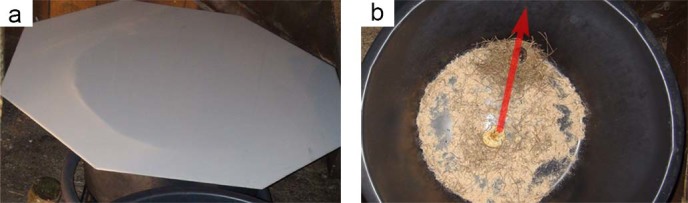
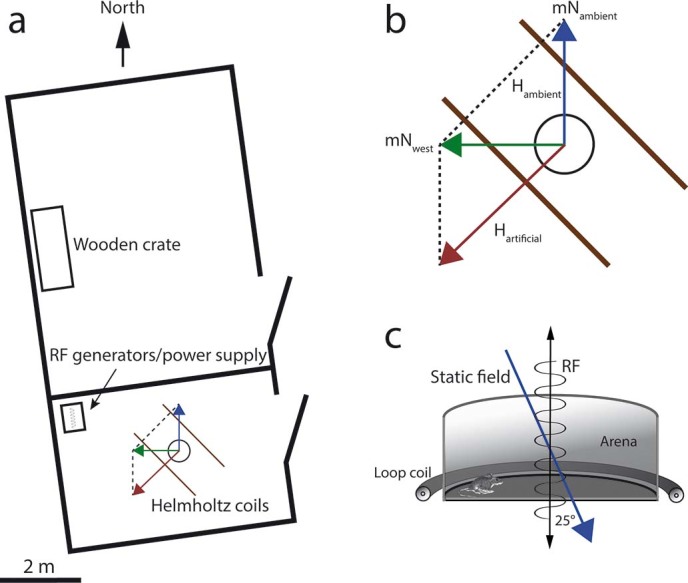
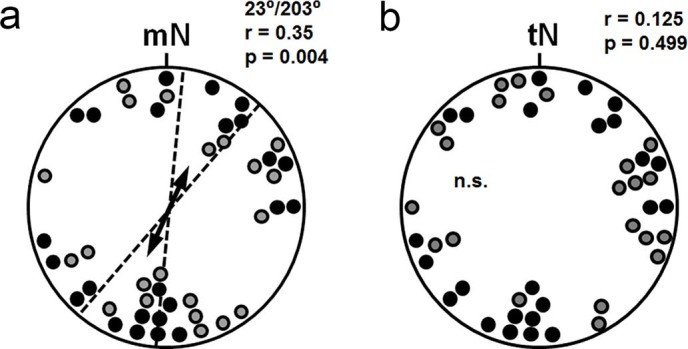
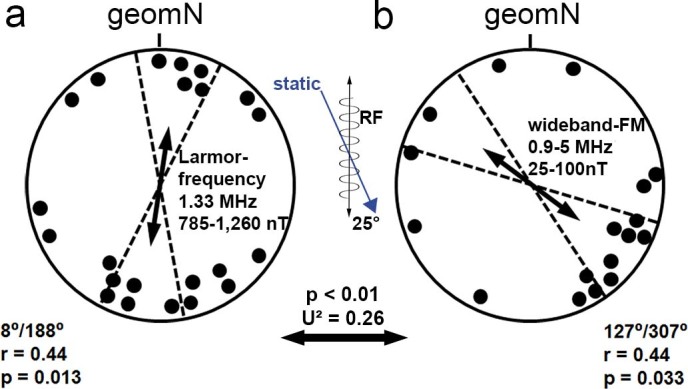
The mammalian magnetic sense is predominantly studied in species with reduced vision such as mole-rats and bats. Far less is known about surface-dwelling (epigeic) rodents with well-developed eyes. Here, we tested the wood mouse Apodemus sylvaticus for magnetoreception using a simple behavioural assay in which mice are allowed to build nests overnight in a visually symmetrical, circular arena. The tests were performed in the ambient magnetic field or in a field rotated by 90°. When plotted with respect to magnetic north, the nests were bimodally clustered in the northern and southern sectors, clearly indicating that the animals used magnetic cues. Additionally, mice were tested in the ambient magnetic field with a superimposed radio frequency magnetic field of the order of 100 nT. Wood mice exposed to a 0.9 to 5 MHz frequency sweep changed their preference from north-south to east-west. In contrast to birds, however, a constant frequency field tuned to the Larmor frequency (1.33 MHz) had no effect on mouse orientation. In sum, we demonstrated magnetoreception in wood mice and provide first evidence for a radical-pair mechanism in a mammal.
哺乳动物的磁感主要是在视力退化的物种中进行研究,比如鼹形鼠和蝙蝠。对于眼睛发育良好的地面栖息(表土栖居)啮齿动物,人们了解得要少得多。在此,我们使用一种简单的行为测定法对林姬鼠进行了磁感受测试,在该测定法中,让小鼠在一个视觉上对称的圆形场地中过夜筑巢。测试在环境磁场或旋转了90°的磁场中进行。当相对于磁北绘制时,巢穴在北部和南部区域呈双峰聚集,清楚地表明动物利用了磁线索。此外,还在环境磁场中对小鼠施加了叠加的约100 nT量级的射频磁场进行测试。暴露于0.9至5 MHz频率扫描的林姬鼠改变了它们从南北方向到东西方向的偏好。然而,与鸟类不同的是,调谐到拉莫尔频率(1.33 MHz)的恒定频率场对小鼠的定向没有影响。总之,我们证明了林姬鼠具有磁感受能力,并为哺乳动物中的自由基对机制提供了首个证据。