Janbaz Khalid Hussain, Akhtar Tashfeen, Saqib Fatima, Imran Imran, Zia-Ul-Haq Muhammad, Jansakul Chaweeewan, De Feo Vincenzo, Moga Marius
Faculty of Pharmacy, Bahauddin Zakariya University, Multan, Pakistan.
Office of Research, Innovation and Commercialization, Lahore College for Women University, Jail Road, Lahore, 54000, Pakistan.
J Transl Med. 2015 Apr 30;13:134. doi: 10.1186/s12967-015-0470-8.
Solena heterophylla Lour. has traditionally been used in the management of diseases pertaining to gastrointestinal, respiratory and vascular system and present study was undertaken to validate its traditional uses.
The aqueous ethanolic extract of Solena heterophylla Lour (Sh.Cr) was tested in-vitro on isolated rabbit jejunum, tracheal and aorta preparations. The responses of tissues were recorded using isotonic transducers coupled with PowerLab data acquisition system.
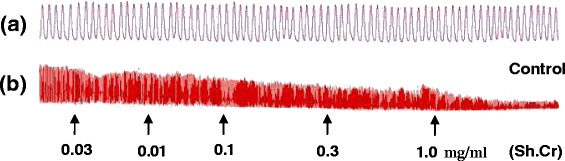
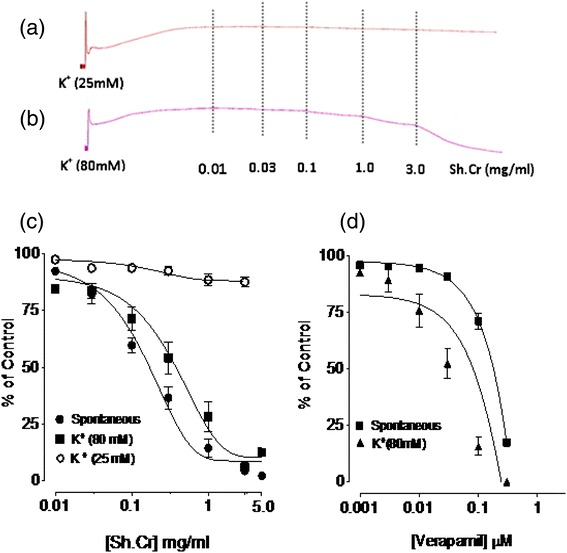
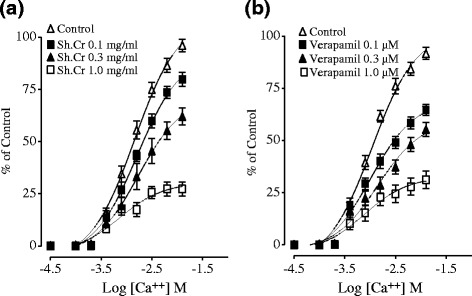
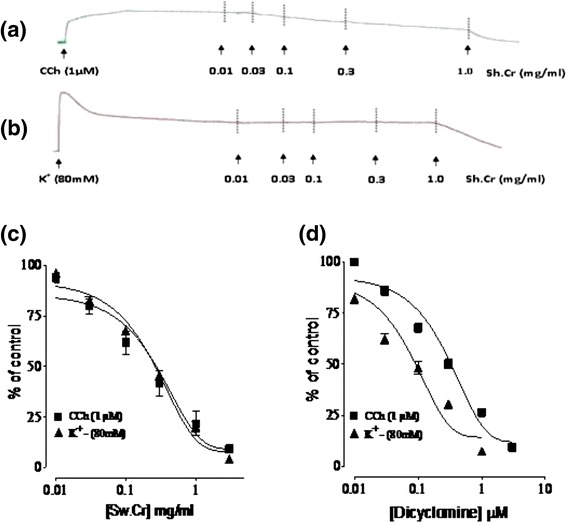
The aqueous ethanolic extract of Solena heterophylla Lour (Sh.Cr) (0.03-1.0 mg/ml) on application to spontaneous contractions in isolated rabbit jejunum preparation exerted relaxant effect through decrease in magnitude and frequency of contractions, caused relaxation of K(+)(80 mM)-induced contractions and shifted the Ca(2+) concentration response curves toward right in isolated rabbit jejunum preparations in a manner similar to verapamil (a standard Ca(2+) channel blocker), thus confirming its Ca(2+) channel blocking activity. The Sh.Cr also caused relaxation of carbachol (1 μM)- and K(+)(80 mM)-induced contractions in isolated rabbit tracheal preparations in a manner comparable to dicyclomine.
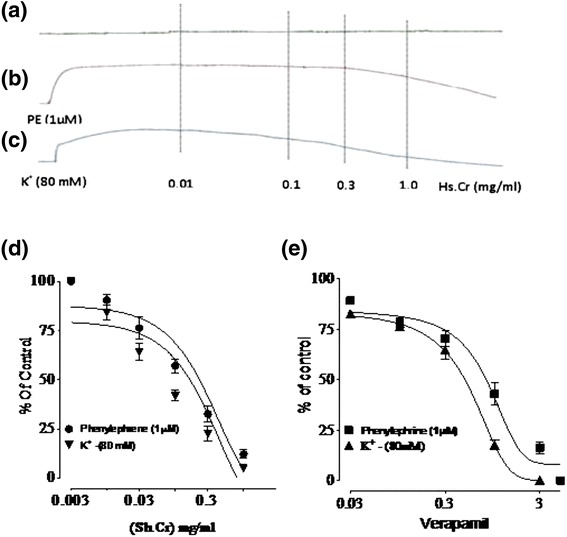
The observed relaxant effect may be outcome of anti-muscarinic and Ca(2+) channel blocking activities. The Sh.Cr (0.03-1.0 mg/ml) against phenyephrine (1 μM)- and K(+)(80 mM)-induced contractions in isolated rabbit aortic preparations exerted a relaxant effect, possibly through Ca(2+) channel blocking activity. These findings provide a rationale for the folkloric uses of the plant in the management of ailments pertaining to gastrointestinal, respiratory and vascular system.
异叶地锦草传统上用于治疗与胃肠、呼吸和血管系统相关的疾病,本研究旨在验证其传统用途。
对异叶地锦草的水乙醇提取物(Sh.Cr)进行体外实验,观察其对离体兔空肠、气管和主动脉标本的作用。使用与PowerLab数据采集系统相连的等张换能器记录组织的反应。
异叶地锦草的水乙醇提取物(Sh.Cr)(0.03 - 1.0毫克/毫升)作用于离体兔空肠标本的自发收缩时,通过降低收缩幅度和频率发挥松弛作用,能使K⁺(80毫摩尔)诱导的收缩松弛,并使离体兔空肠标本中的Ca²⁺浓度反应曲线向右移动,其方式类似于维拉帕米(一种标准的Ca²⁺通道阻滞剂),从而证实其Ca²⁺通道阻断活性。Sh.Cr还能使离体兔气管标本中卡巴胆碱(1微摩尔)和K⁺(80毫摩尔)诱导的收缩松弛,其作用方式与双环维林相当。
观察到的松弛作用可能是抗毒蕈碱和Ca²⁺通道阻断活性的结果。Sh.Cr(0.03 - 1.0毫克/毫升)对离体兔主动脉标本中去氧肾上腺素(1微摩尔)和K⁺(80毫摩尔)诱导的收缩发挥松弛作用,可能是通过Ca²⁺通道阻断活性。这些发现为该植物在治疗胃肠、呼吸和血管系统相关疾病的民间应用提供了理论依据。