Janulevicius Albertas, van Loosdrecht Mark, Picioreanu Cristian
Department of Biotechnology, Delft University of Technology, Delft, The Netherlands.
PLoS Comput Biol. 2015 Apr 30;11(4):e1004213. doi: 10.1371/journal.pcbi.1004213. eCollection 2015 Apr.
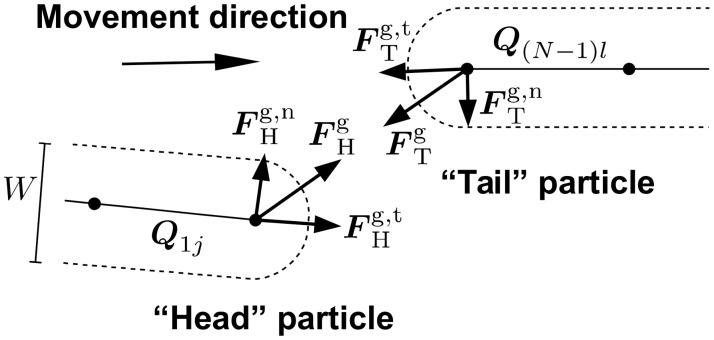
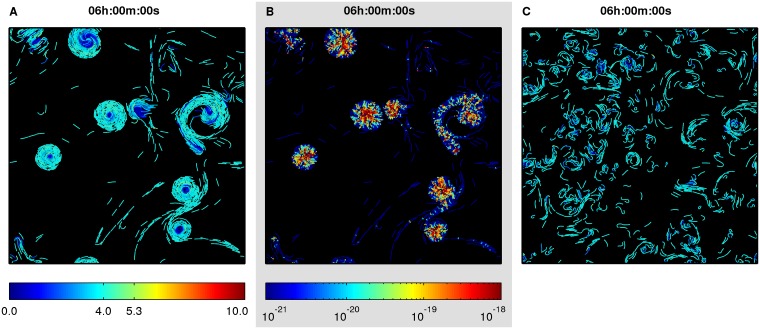
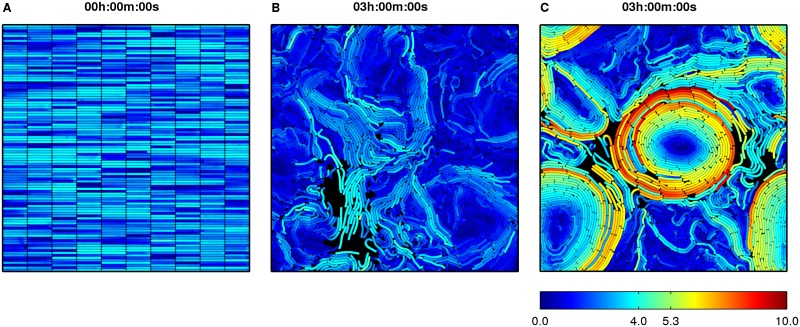
Myxobacteria are social bacteria that upon starvation form multicellular fruiting bodies whose shape in different species can range from simple mounds to elaborate tree-like structures. The formation of fruiting bodies is a result of collective cell movement on a solid surface. In the course of development, groups of flexible rod-shaped cells form streams and move in circular or spiral patterns to form aggregation centers that can become sites of fruiting body formation. The mechanisms of such cell movement patterns are not well understood. It has been suggested that myxobacterial development depends on short-range contact-mediated interactions between individual cells, i.e. cell aggregation does not require long-range signaling in the population. In this study, by means of a computational mass-spring model, we investigate what types of short-range interactions between cells can result in the formation of streams and circular aggregates during myxobacterial development. We consider short-range head-to-tail guiding between individual cells, whereby movement direction of the head of one cell is affected by the nearby presence of the tail of another cell. We demonstrate that stable streams and circular aggregates can arise only when the trailing cell, in addition to being steered by the tail of the leading cell, is able to speed up to catch up with it. It is suggested that necessary head-to-tail interactions between cells can arise from physical adhesion, response to a diffusible substance or slime extruded by cells, or pulling by motility engine pili. Finally, we consider a case of long-range guiding between cells and show that circular aggregates are able to form without cells increasing speed. These findings present a possibility to discriminate between short-range and long-range guiding mechanisms in myxobacteria by experimentally measuring distribution of cell speeds in circular aggregates.
粘细菌是群居细菌,在饥饿时会形成多细胞子实体,不同物种的子实体形状从简单的土堆到复杂的树状结构不等。子实体的形成是细胞在固体表面集体运动的结果。在发育过程中,一群灵活的杆状细胞形成溪流,并以圆形或螺旋模式移动,形成聚集中心,这些中心可能成为子实体形成的位点。这种细胞运动模式的机制尚不清楚。有人提出,粘细菌的发育依赖于单个细胞之间短程接触介导的相互作用,即细胞聚集不需要群体中的长程信号传导。在本研究中,我们通过计算质量-弹簧模型,研究细胞之间何种类型的短程相互作用会导致粘细菌发育过程中溪流和圆形聚集体的形成。我们考虑单个细胞之间的短程头对尾引导,即一个细胞头部的运动方向会受到另一个细胞尾部附近存在的影响。我们证明,只有当尾随细胞除了被领先细胞的尾部引导外,还能够加速赶上领先细胞时,才能形成稳定的溪流和圆形聚集体。有人提出,细胞之间必要的头对尾相互作用可能源于物理粘附、对细胞分泌的可扩散物质或黏液的反应,或运动引擎菌毛的拉动。最后,我们考虑细胞之间长程引导的情况,并表明圆形聚集体能够在细胞不增加速度的情况下形成。这些发现为通过实验测量圆形聚集体中细胞速度的分布来区分粘细菌中的短程和长程引导机制提供了一种可能性。